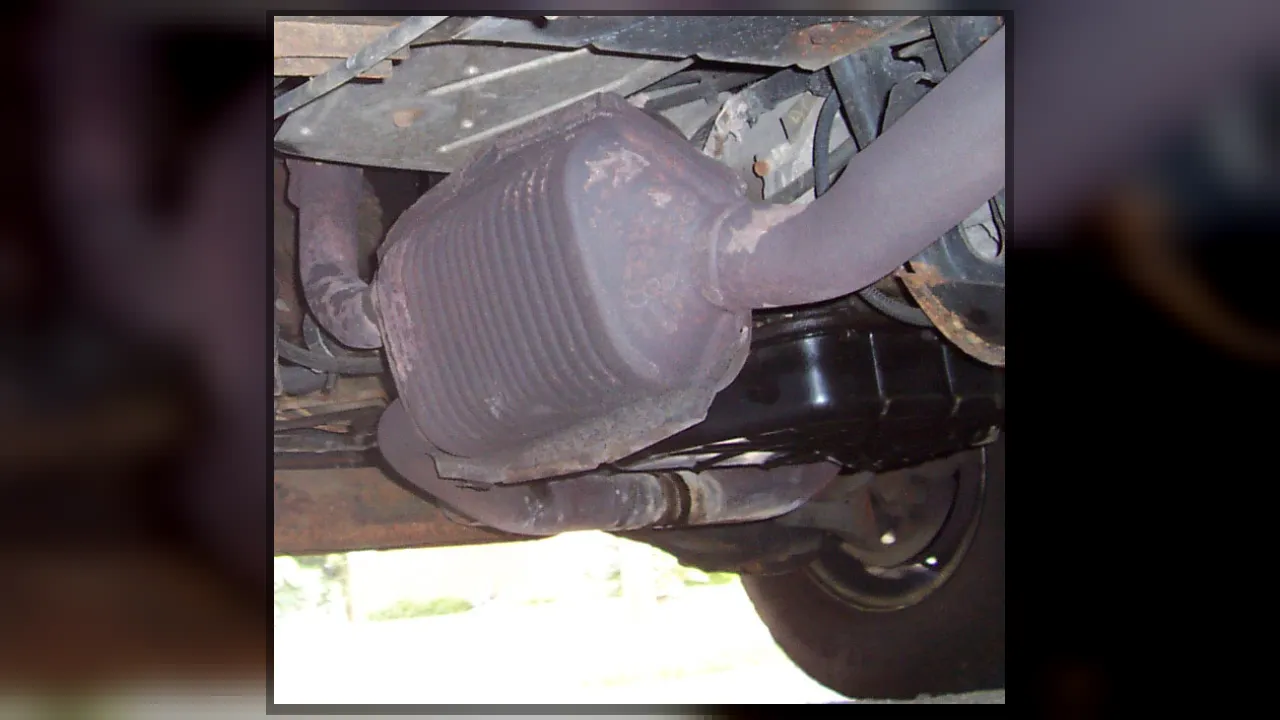
1. Where on a car does a catalytic converter sit to do its job?
2. What does the honeycomb block inside a catalytic converter do?
🤯 Mind-Blowing Fact • Grade 2
Introducing catalytic converters in 1975 also forced oil companies to take poisonous lead out of gasoline, making city air much healthier for kids everywhere!
✨ Word Sparks (Grade 2 Glossary)
Tap 🔊 to hear
smog
Dirty brown haze hanging in city air
catalyst
A helper that speeds up chemical changes
ceramic
Hard baked clay material resisting extreme heat
🪝
Why does a car exhaust cleaner carry tiny specks of metals rarer than gold?
1
Clearing Up City Smog
Cough, squint! In the 1950s, thick brown haze called hung over sunny cities like Los Angeles, stinging people's eyes. French-born engineer Eugène Houdry realized millions of car tailpipes were pumping out invisible air pollution.
2
Helpers That Never Wear Out
Houdry invented a muffler-sized cleaner using special helpers called . A catalyst speeds up a chemical change without getting used up itself! Engineers Carl Keith and John Mooney perfected honeycomb converters for 1975 cars.
3
Tiny Specks of Precious Metal
Microscopic dots of platinum, palladium, and rhodium coat a honeycomb block. When hot engine gases rush through, those rare metals break apart harmful pollutants and recombine them into harmless nitrogen and steam.
1. What inspired engineer Eugène Houdry to invent the catalytic converter in the 1950s?
2. What makes a chemical 'catalyst' so special?
🤯 Mind-Blowing Fact • Grade 3
Catalytic converters work best once warmed past 750 degrees Fahrenheit—hotter than a pizza oven—which is why engineers mount them close to the engine!
✨ Word Sparks (Grade 3 Glossary)
Tap 🔊 to hear
pollutant
A harmful substance that dirties air or water
monoxide
A poisonous gas with one oxygen atom
unleaded
Gasoline made without toxic lead metal added
🪝
How can three invisible poisons enter a ceramic block and exit milliseconds later as ordinary air and steam?
1
Three Troublemakers in Exhaust
Every gasoline engine produces three sneaky air when fuel does not burn perfectly cleanly: poisonous carbon , unburned fuel vapors called hydrocarbons, and smog-making nitrogen oxides.
2
Why Lead Had to Leave
Although Eugène Houdry patented an exhaust converter in 1956, lead additives inside old gasoline coated his catalysts and stopped them cold. Once the U.S. Clean Air Act mandated cleaner 1975 cars, fuel allowed Carl Keith and John Mooney's ceramic honeycomb converter to shine.
3
Inside a Three-Way Converter
Modern cars use a three-way catalytic converter packed with hundreds of narrow square channels per square inch. First, rhodium and platinum strip oxygen atoms off nitrogen oxides to leave harmless nitrogen gas—the main ingredient of the air you breathe!
4
Adding Oxygen to Finish the Job
Milliseconds later, platinum and palladium help carbon and leftover fuel vapors grab oxygen atoms. Out the tailpipe float harmless water vapor and carbon dioxide, cutting smog by more than ninety-five percent!
1. Why couldn't Eugène Houdry's 1950s catalytic converter work on most cars right away?
2. Why is a modern car's cleaner called a 'three-way' catalytic converter?
🤯 Mind-Blowing Fact • Grade 4
Only about four to nine grams of platinum-group metals—roughly the weight of a single five-cent nickel—sit dispersed as nanoparticles inside a typical car's catalytic converter!
✨ Word Sparks (Grade 4 Glossary)
Tap 🔊 to hear
monolith
A single solid block containing narrow channels
oxidation
A chemical reaction combining substances with oxygen
nanoparticle
An ultra-tiny speck billions of times smaller
🪝
Why does packing a football field of rough ceramic walls into a coffee-can space clean millions of city streets?
1
Photochemical Smog and Clean Air Laws
Step onto a Los Angeles sidewalk in 1965 and sunlit photochemical smog could hide mountains just blocks away! Sunlight baked tailpipe hydrocarbons and nitrogen oxides into ground-level ozone. Passing the landmark 1970 U.S. Clean Air Act challenged engineers to slash automobile tailpipe emissions by ninety percent within five years.
2
Engineering the Honeycomb Monolith
Building on Eugène Houdry's 1956 catalyst patent, Corning glass scientists Rodney Bagley, Irwin Lachman, and Ronald Lewis extruded heat-shock-resistant cordierite ceramic into a thin-walled honeycomb . Chemical engineers Carl Keith and John Mooney then added a porous aluminum-oxide washcoat speckled with microscopic of platinum, palladium, and rhodium.
3
Splitting and Combining Molecules
Why make the washcoat rough and porous? Chemical catalysis happens strictly on surfaces! Packing 400 to 900 channels per square inch exposes passing gas molecules to billions of active metal sites in milliseconds: reduction reactions rip oxygen off nitrogen oxides ($NO_x$), while reactions combine oxygen with carbon monoxide ($CO$) and hydrocarbons.
4
Oxygen Sensors Lock the Balance
For reduction and to happen simultaneously, the engine cannot run too rich with fuel or too lean with air. Electronic oxygen sensors ahead of the converter check exhaust chemistry dozens of times per second, guiding fuel injectors so cities from Tokyo to London breathe dramatically cleaner air.
1. Why do engineers coat the ceramic honeycomb with a rough, porous washcoat?
2. What job does the electronic oxygen sensor perform just ahead of a three-way catalytic converter?
🤯 Mind-Blowing Fact • Grade 5
Cerium oxide mixed into a converter's washcoat acts like a chemical 'oxygen sponge'—inhaling extra oxygen atoms when the engine runs lean and exhaling them milliseconds later when fuel runs rich!
✨ Word Sparks (Grade 5 Glossary)
Tap 🔊 to hear
activation energy
Minimum energy needed to start chemical reactions
adsorption
Gas molecules clinging thinly onto solid surfaces
stoichiometric
Balanced in exact chemical proportions without leftovers
🪝
How do platinum-group d-orbitals lower activation energy barriers so lethal exhaust gases rearrange into clean nitrogen in forty milliseconds?
1
Heterogeneous Catalysis at Highway Speed
Hurtling through an underbody stainless-steel exhaust canister at 400 to 800 degrees Celsius, burned engine gas spends barely forty milliseconds inside a catalytic converter. Without a catalyst, breaking strong covalent bonds in nitric oxide ($NO$) or oxidizing lethal carbon monoxide ($CO$) that rapidly would require industrial furnace temperatures; transition-metal surfaces dramatically lower the barrier.
2
From Houdry's Pellets to Extruded Cordierite
French-born chemical engineer Eugène Houdry patented an alumina-pellet automotive exhaust catalyst in 1956, yet tetraethyl-lead octane additives quickly poisoned active metal sites by coating them in lead compounds. Phasing out leaded gasoline alongside Corning's thermal-shock-resistant cordierite honeycomb monolith and Carl Keith and John Mooney's 1973 three-way washcoat unlocked clean-air compliance starting in model year 1975.
3
Surface Adsorption, Reduction, and Oxidation
Dispersed across a porous gamma-alumina washcoat whose internal surface area equals a football stadium, 3-to-5-nanometer clusters of rhodium adsorb nitrogen oxides ($NO$ and $NO_2$), weakening nitrogen-oxygen bonds so freed nitrogen atoms pair into harmless $N_2$ gas. Millimeters away, platinum and palladium split $O_2$ molecules to oxidize toxic $CO$ into $CO_2$ and unburned hydrocarbons ($C_xH_y$) into water vapor and $CO_2$.
4
Stoichiometric Lambda Control and Ceria Buffers
Simultaneous reduction and oxidation above 98 percent conversion efficiency occur only inside a narrow window of 14.7 parts air to 1 part gasoline by mass (lambda = 1.00). Heated zirconia lambda sensors check exhaust oxygen dozens of times per second to trim fuel injectors, while cerium-zirconium oxides absorb extra oxygen during lean milliseconds and release it during rich bursts.
5
Public Health Legacy and Precious-Metal Recycling
Joined by urea-based selective catalytic reduction (SCR) and particulate filters on heavy diesel trucks, automotive catalysis cut urban carbon-monoxide and smog-forming hydrocarbon concentrations by more than 80 percent even as global traffic tripled—preventing millions of asthma and cardiovascular cases while high-temperature smelters recycle over 90 percent of retired platinum-group metals.