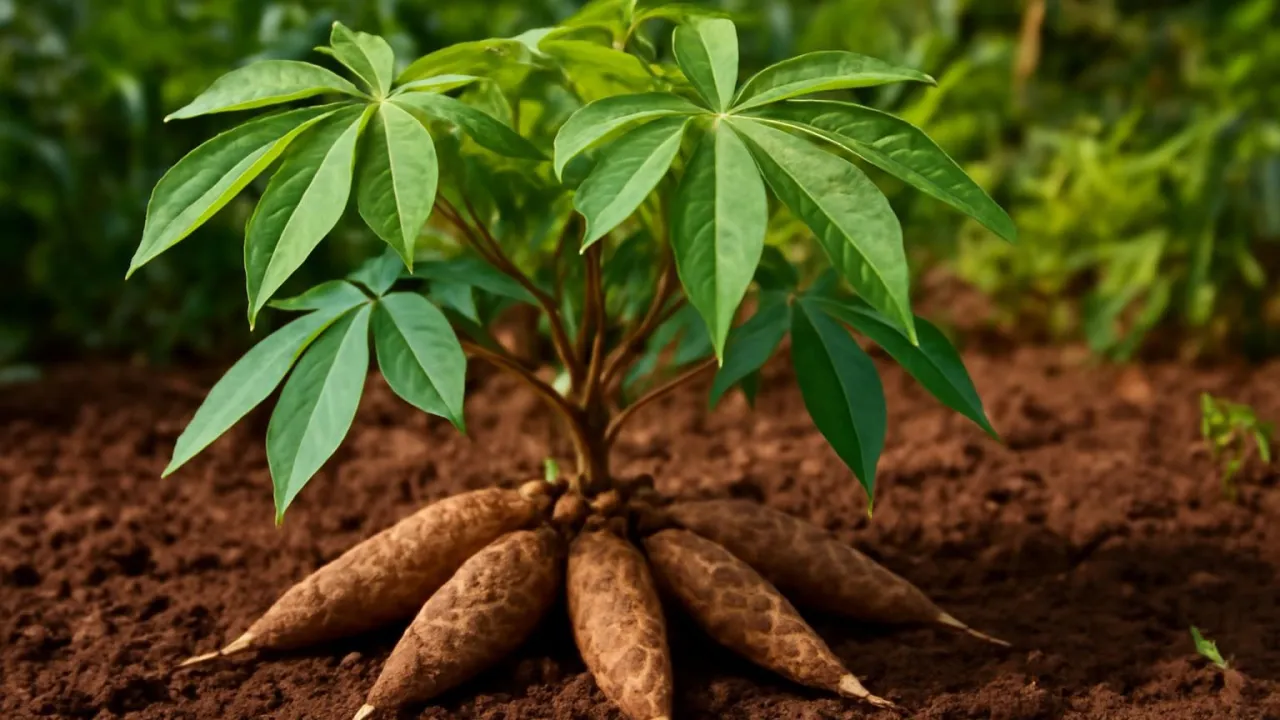
Cassava can grow in soil where many other plants cannot survive.
✨ Word Sparks (Grade 2 Glossary)
Tap 🔊 to hear
harvest
To gather plants when they are ready
nutrients
Food parts plants need to grow
drought
A long time without rain
🪝
Have you ever seen a root that feeds millions of people?
1
Cassava’s Home and Growth
Cassava grows in warm places like South America and Africa. It needs full sun and some water to grow well. The plant can grow very tall, sometimes up to thirteen feet. Its roots grow deep underground to find water and .
2
The Life of Cassava
Cassava starts as a small stem cutting planted in the soil. It grows leaves that are green and shaped like stars. The roots grow thick and white under the ground. Farmers cassava after about one year of growing.
3
Why Cassava is Special
Cassava roots can survive in poor soil and dry weather. People use cassava roots to make flour for bread and other foods. The plant’s leaves can also feed animals. Cassava helps feed many people in places with little food.
Cassava roots store starch that helps the plant survive dry seasons without water.
✨ Word Sparks (Grade 3 Glossary)
Tap 🔊 to hear
adaptation
A change that helps a plant survive
photosynthesis
How plants make food from sunlight
tuber
A thick root that stores food
🪝
Did you know cassava is a root that can survive drought and poor soil?
1
Cassava’s Habitat and Growth
Cassava grows mainly in tropical regions of South America and Africa. It thrives in warm climates with full sunlight and moderate water. The plant can reach heights between three and thirteen feet tall. Its roots grow deep underground to collect nutrients and water.
2
How Cassava Survives
Cassava has adapted to survive drought by storing starch in its thick roots. This starch helps the plant live through dry seasons when water is scarce. Its leaves are shaped to capture sunlight efficiently for . These help cassava thrive where other plants struggle.
3
Cassava’s Role in Food and Farming
Farmers harvest cassava roots after about one year of growth. The roots are peeled and cooked to remove toxins before eating. Cassava is an important food crop for millions of people worldwide. Its flour is used to make bread, cakes, and even tapioca.
4
Interesting Facts About Cassava
Cassava is a root vegetable but is often called a because of its thick roots. It grows well in poor soil where many crops fail. Cassava leaves can also be eaten as a vegetable or used as animal feed. This plant plays a key role in food security for many regions.
2. What must farmers do before eating cassava roots?
🤯 Mind-Blowing Fact • Grade 4
Cassava feeds over 800 million people worldwide and can grow where many crops fail.
✨ Word Sparks (Grade 4 Glossary)
Tap 🔊 to hear
fodder
Food given to farm animals
toxin
A natural poison in some plants
staple
A main food people eat often
🪝
How does cassava help people survive in tough environments?
1
Cassava’s Adaptations and Habitat
Cassava thrives in tropical climates across South America and Africa because it can grow in poor, sandy soils that many plants cannot tolerate. Its deep root system allows it to access water far below the surface, helping it survive drought conditions. The plant’s broad leaves capture sunlight efficiently, maximizing photosynthesis even in less fertile areas. These adaptations make cassava a vital crop in regions with harsh growing conditions.
2
Cassava’s Role in Ecosystems and Food Webs
Cassava contributes to local ecosystems by providing food for humans and animals alike, as its leaves can be used as . It supports food webs by offering energy-rich starch stored in its roots, which many communities rely on during food shortages. Cassava cultivation can improve soil structure through its root growth, but improper farming may lead to soil depletion. Sustainable farming practices help maintain cassava’s benefits for both people and the environment.
3
Human Impact and Agricultural Importance
Cassava is a food for over 800 million people worldwide, especially in Africa, Asia, and Latin America. Its ability to grow in poor soils and tolerate drought makes it crucial for food security in vulnerable regions. However, cassava contains natural that require careful processing to ensure safety. Research and agricultural programs focus on improving cassava varieties to increase yields and reduce toxin levels, supporting farmers and consumers.
4
Geographic Distribution and Cultivation
Originally from South America, cassava was introduced to Africa and Asia centuries ago, where it adapted well to local climates. Today, it is widely cultivated in tropical and subtropical regions around the world. Farmers plant cassava using stem cuttings rather than seeds, which helps maintain plant traits. The crop’s resilience and versatility have made it a key agricultural product in many developing countries.
2. What must farmers do to keep cassava safe to eat?
🤯 Mind-Blowing Fact • Grade 5
Cassava is the third-largest source of carbohydrates worldwide, after rice and maize.
✨ Word Sparks (Grade 5 Glossary)
Tap 🔊 to hear
cyanogenic
A natural toxin found in cassava roots
propagation
How plants grow new plants from cuttings
carbohydrates
Nutrients that give energy to the body
🪝
What makes cassava a vital crop for millions in challenging climates?
1
Scientific Classification and Origins
Cassava, scientifically named Manihot esculenta, belongs to the Euphorbiaceae family, native to tropical South America. It was domesticated thousands of years ago and later spread to Africa and Asia through trade and colonization. This plant is classified as a woody shrub that produces starchy tuberous roots, which are the main edible part. Its genetic diversity allows it to adapt to various environmental conditions.
2
Physiological Adaptations and Growth Mechanics
Cassava’s thick, tuberous roots store large amounts of starch, providing energy during drought periods when water is scarce. The plant’s deep root system accesses moisture deep in the soil, while its broad leaves maximize photosynthesis efficiency. Cassava can grow in nutrient-poor soils due to its ability to fix nutrients and tolerate harsh conditions. Stem cuttings are used for , enabling farmers to maintain desirable traits.
3
Conservation, Cultivation, and Agricultural History
Cassava has become a critical food source globally, especially in Africa, where it supports food security for over 800 million people. Agricultural research focuses on developing varieties with higher yields and lower toxin levels to improve safety and productivity. Conservation efforts include preserving genetic diversity in seed banks and promoting sustainable farming practices. Cassava’s resilience makes it an essential crop amid climate change challenges.
4
Quantitative Comparisons and Economic Importance
Cassava roots can weigh up to 5 pounds (2.3 kilograms) each and grow up to three feet (one meter) underground. It can grow in temperatures ranging from 68 to 95 degrees Fahrenheit (20 to 35 degrees Celsius) and tolerate drought lasting several months. Globally, cassava production exceeds 280 million metric tons annually, making it the third-largest source of after rice and maize. Its economic value supports millions of smallholder farmers worldwide.
5
Cassava’s Role in Food Security and Nutrition
Cassava provides a calorie-rich food source that is crucial in regions with limited agricultural options. Despite containing glycosides, proper processing removes toxins, making it safe for consumption. Cassava flour and tapioca are widely used in various cuisines, contributing to dietary diversity. Its leaves also provide vitamins and protein, supporting nutrition beyond just .