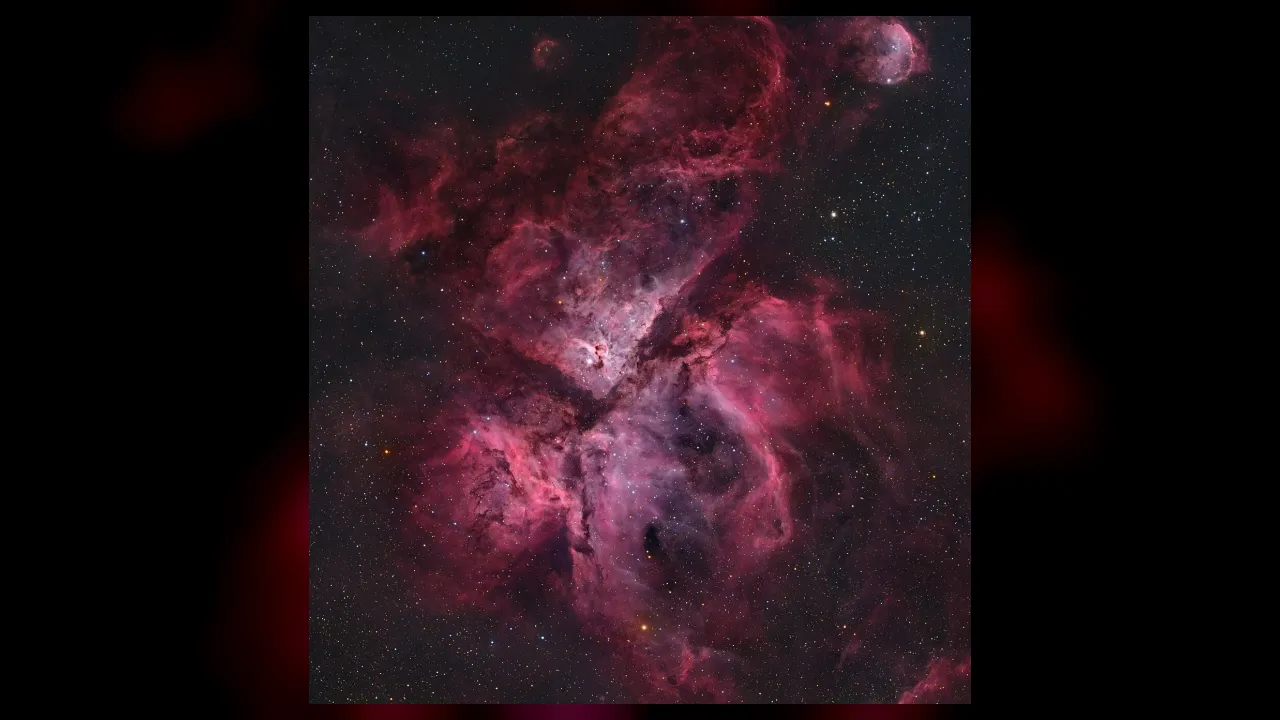
1. How does the size of the Carina Nebula compare to the famous Orion Nebula?
2. What famous starry landscape did the James Webb Space Telescope photograph on the edge of the Carina complex?
🤯 Mind-Blowing Fact • Grade 2
Eta Carinae shines five million times brighter than our Sun and weighs over one hundred Suns combined!
✨ Word Sparks (Grade 2 Glossary)
Tap 🔊 to hear
equator
Imaginary line circling Earth's middle
spire
Tall pointed tower reaching upward
erupt
Burst out suddenly with gas and light
🪝
What happened in the 1840s when one monster star inside the Carina Nebula suddenly erupted?
1
A Southern Sky Treasure
Sailors below the do not even need binoculars to spot the Carina Nebula! Even though it sits 7,600 light-years away, its 300-light-year cloud of glowing gas shines brightly in the constellation Carina.
2
Mystic Mountain and Cosmic Cliffs
Space telescopes love visiting Carina. Hubble photographed a three-light-year of swirling dust nicknamed Mystic Mountain, and the James Webb Space Telescope unveiled the towering orange Cosmic Cliffs!
3
The Great Eruption
Hiding inside Carina is a monster double star called Eta Carinae. In the 1840s, it burped out a giant twin bubble of gas without exploding—briefly becoming the second-brightest star in Earth's entire night sky!
1. What is the name of the famous three-light-year dust spire photographed by Hubble inside Carina?
2. What amazing thing did the monster star system Eta Carinae do in the 1840s?
🤯 Mind-Blowing Fact • Grade 3
The twin peanut-shaped lobes around Eta Carinae race outward at 1.5 million miles per hour—fast enough to travel from Earth to the Moon in fewer than ten minutes!
✨ Word Sparks (Grade 3 Glossary)
Tap 🔊 to hear
spiral arm
Curved starry lane pinwheeling around galaxies
volatile
Unstable and likely to erupt suddenly
lobe
Rounded balloon-like section of a cloud
🪝
How do dozens of heavyweight stars sculpt towering mountains and peanut-shaped bubbles inside Carina?
1
Milky Way Heavyweight Nursery
Cataloged as NGC 3372, the Carina Nebula sits roughly 7,600 light-years away inside the Carina-Sagittarius of our Milky Way. Stretching 300 light-years across, it hosts more than seventy ultra-hot O-type stars—each packing dozens of times our Sun's mass!
2
Peanut Cloud of Eta Carinae
Right near the heart of the nebula lurks Eta Carinae, a binary system weighing over 100 solar masses. During its Great Eruption in the 1840s, it blasted out ten Suns' worth of gas and dust, puffing into twin peanut-shaped called the Homunculus Nebula!
3
Steaming Cosmic Cliffs
On the northwest rim of the complex lies a giant bubble called NGC 3324, carved open by blistering stellar winds. What looks like 'steam' rising off Webb's famous Cosmic Cliffs is actually hot ionized gas streaming into space!
4
Newborn Stars Fighting Back
Even while giant stars erode the cliffs from outside, baby stars tucked inside shoot out twin supersonic jets like cosmic fountains.
1. What is the twin-lobed 'peanut' cloud surrounding Eta Carinae called?
2. What is the 'steam' rising off the top of Webb's Cosmic Cliffs actually made of?
🤯 Mind-Blowing Fact • Grade 4
Peaks along Carina's Cosmic Cliffs tower seven light-years high—over forty trillion miles from valley floor to misty ridge!
✨ Word Sparks (Grade 4 Glossary)
Tap 🔊 to hear
Wolf-Rayet star
Evolved massive star blowing fierce winds
Herbig-Haro jet
Bright shock patch from protostar beams
cavern wall
Curved boundary carved inside gas cloud
🪝
Why is the Carina Nebula one of the best places in our galaxy to watch massive stars live fast and reshape space?
1
A Super-Cluster Metropolis
First recorded from South Africa by French astronomer Nicolas-Louis de Lacaille in 1752, NGC 3372—the Carina Nebula—dwarfs every star nursery in Earth's immediate neighborhood. Spanning 300 light-years at a distance of 7,600 light-years, it houses densely packed young clusters like Trumpler 14 and Trumpler 16, where scores of O-type and unleash hurricane-force stellar winds.
2
Mystery of the Luminous Blue Variable
Trumpler 16's superstar resident, Eta Carinae, is a Luminous Blue Variable binary system radiating five million times our Sun's luminosity! Every 5.5 years, a 30-solar-mass hot companion plunges close to the 100-solar-mass primary star, crashing their stellar winds together at millions of degrees and firing bright X-ray flares recorded by NASA's Chandra X-ray Observatory.
3
Sculpting Mystic Mountain and Keyhole
Fierce radiation pressure and shockwaves carve dark foreground dust lanes like the Keyhole Nebula alongside three-light-year-tall pillars like Mystic Mountain, where Hubble caught twin lancing ten light-years across space from hidden infant protostars.
4
JWST Unveils NGC 3324's Cliffs
In July 2022, NASA's James Webb Space Telescope debuted its science mission by peering straight through the amber dusty of NGC 3324—the Cosmic Cliffs—revealing hundreds of previously hidden newborn stars and supersonic outflows along craggy peaks rising seven light-years tall!
1. Why does Eta Carinae unleash dramatic bursts of X-rays on a steady 5.5-year schedule?
2. Roughly how tall are the highest dusty peaks in JWST's Cosmic Cliffs (NGC 3324)?
🤯 Mind-Blowing Fact • Grade 5
Astronomers discovered faint 'light echoes' of Eta Carinae's 1843 Great Eruption still bouncing off distant dust clouds over 160 years later—letting modern spectrographs analyze 19th-century starlight live!
✨ Word Sparks (Grade 5 Glossary)
Tap 🔊 to hear
light echo
Delayed flash bouncing off distant dust
hypernova
Extra-powerful explosion of ultra-massive star
accretion burst
Sudden gulp of gas feeding protostars
🪝
What happens to a giant molecular cloud when over seventy O-type stars ignite simultaneously inside it?
1
Crown Jewel of the Carina Arm
Cataloged by French astronomer Nicolas-Louis de Lacaille from South Africa's Cape of Good Hope in 1752, NGC 3372—the Carina Nebula—spans nearly 100 parsecs (over 300 light-years) across the Sagittarius-Carina spiral arm at a Gaia-calibrated distance of roughly 2.3 kiloparsecs (7,600 light-years). Hosting over 70 scorching O-type stars, three evolved Wolf-Rayet stars, and compact clusters Trumpler 14 and Trumpler 16, it bridges the scale between modest local nurseries like Orion and giant extragalactic starburst complexes.
2
Eta Carinae and Supernova Impostors
Towering over Trumpler 16 blazes Eta Carinae, an eccentric 5.54-year binary pairing a ~90–100-solar-mass Luminous Blue Variable primary with a hot ~30-solar-mass companion. During its historic 1837–1856 Great Eruption, Eta Carinae rivaled a supernova's visible light output without destroying its core—a classic 'supernova impostor' event that ejected 10 to 20 solar masses into the expanding bipolar Homunculus Nebula before its inevitable future fate as a true core-collapse supernova or .
3
Multi-Wavelength Feedback Across Scales
Wide-field soft X-ray mosaics mapped by NASA's Chandra X-ray Observatory reveal multimillion-kelvin iron-enriched plasma filling Carina's central cavities, proving even more massive stars have already detonated as supernovae inside the complex despite its clusters being scarcely three million years old!
4
JWST's First Deep Infrared Showcase
Targeting the ionized bubble rim of NGC 3324—the Cosmic Cliffs—in July 2022, JWST's NIRCam and MIRI cameras penetrated opaque polycyclic aromatic hydrocarbon walls towering seven light-years high where extreme ultraviolet glare boils gas into steaming ionized mist.
5
Quantifying Triggered Star Birth
Inside those newly transparent infrared cliffs, astronomers cataloged two dozen previously invisible molecular hydrogen jets and supersonic bow shocks launched by embedded infant protostars, timing episodic gas- that unfold across mere thousands of years while demonstrating how radiation both erodes clouds and compresses pockets into fresh stars.