The white chalk used on sidewalks and blackboards is made from millions of tiny ancient sea shells packed with carbon!
✨ Word Sparks (Grade 2 Glossary)
Tap 🔊 to hear
Carbon Dioxide
An invisible gas plants use to grow
Decomposer
A tiny living helper that breaks down leaves
Shell
A hard outer home built by sea animals
🪝
How can one tiny atom belong to a seashell, a cloud, and an oak tree?
1
Earth's Master Builder
Imagine a tiny invisible Lego brick that never wears out. That brick is called carbon, and it builds every plant and animal on Earth. Right now, carbon is traveling all around you in a giant loop.
2
Through Air, Leaves, and Food
In the sky, carbon floats as an invisible gas called . Sunlit plants soak up this gas to make sweet food and new leaves. When deer or caterpillars munch those leaves, carbon moves into their bodies.
3
Back to Sky and Sea
Animals breathe back out, and tiny soil helpers break down fallen logs. Cool ocean waves also soak up carbon so sea creatures can build sturdy .
1. How does carbon move from a plant into a caterpillar?
2. What do ocean creatures build using carbon from seawater?
🤯 Mind-Blowing Fact • Grade 3
Earth's oceans hold about fifty times more carbon than the entire atmosphere above us!
✨ Word Sparks (Grade 3 Glossary)
Tap 🔊 to hear
Atmosphere
The blanket of gases surrounding planet Earth
Respiration
Turning food into energy and breathing out gas
Limestone
Sedimentary rock formed from pressed sea shells
🪝
Where does carbon hide when it isn't floating in the air or growing inside forests?
1
One Element, Many Disguises
Picture an atom that can wear a dozen costumes! Floating in the , carbon pairs with oxygen as invisible carbon dioxide gas. Inside a sunflower stem, it links into sweet sugar molecules. Deep underground, it hardens into pale gray rock.
2
The Fast Living Loop
During photosynthesis, green plants and ocean algae pull carbon dioxide from air and water. They lock that carbon into roots, trunks, and berries. Animals eat plants for energy and release carbon dioxide through , while mushrooms and bacteria recycle dead leaves into rich soil.
3
The Slow Rock Loop
Oceans absorb huge amounts of carbon from the wind. Clams and corals turn dissolved carbon into calcium carbonate shells. Over millions of years, sunken shells press together on the seafloor to become solid .
4
Keeping Earth in Balance
Rainwater slowly dissolves exposed rock, and erupting volcanoes vent ancient carbon gas back into the sky. Together, fast living pathways and slow geologic pathways keep Earth's carbon moving without ever running out.
1. Which process pulls carbon dioxide out of the atmosphere and into green leaves?
2. How does carbon become solid limestone rock in the slow cycle?
🤯 Mind-Blowing Fact • Grade 4
Roughly ninety-nine percent of all carbon on Earth isn't in air or trees—it is locked inside crustal rocks like limestone and marble!
✨ Word Sparks (Grade 4 Glossary)
Tap 🔊 to hear
Carbon Sink
A natural reservoir storing more carbon than released
Phytoplankton
Microscopic ocean drifters that make food from sunlight
Lithosphere
Earth's solid outer crust and upper mantle rock
🪝
Why does Earth have both a quick living carbon racetrack and a million-year underground vault?
1
Four Connected Earth Spheres
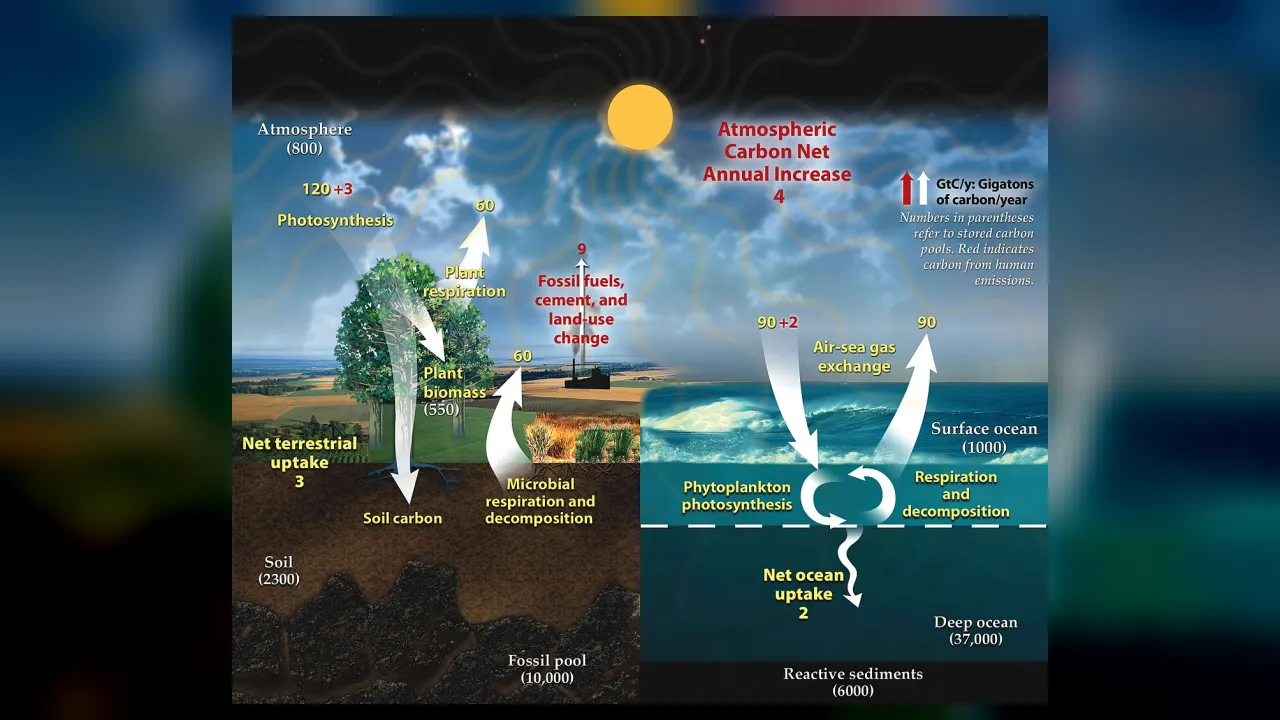
Step into a Virginia oak forest after a spring rain, and you are standing inside a vast planetary exchange. Carbon constantly travels among four Earth spheres: the atmosphere (air), biosphere (living things), hydrosphere (oceans and rivers), and (rocks and crust). Because Earth is a closed system for matter, almost no new carbon arrives from space; nature simply rearranges existing atoms.
2
Fast Biological Exchanges
The fast carbon loop operates over days, seasons, and decades. Terrestrial plants and marine absorb atmospheric carbon dioxide to build glucose carbohydrates. Herbivores and carnivores transfer those carbon compounds up food webs, while cellular respiration and microbial decomposition return carbon dioxide to the air and soil.
3
Carbon Sinks and Deep Storage
Places that absorb more carbon than they release—such as thriving forests, peat wetlands, and cold ocean waters—are called . When marine organisms die, their carbonate shells drift to the abyssal seafloor and lithify into limestone, locking carbon inside Earth's crust for millions of years. Ancient swampy plants buried under heat and pressure also formed coal, oil, and natural gas.
4
Natural Release and Human Impact
Plate tectonics eventually subducts seafloor rock, and volcanic eruptions vent stored carbon dioxide back skyward. When humans burn fossil fuels quickly for electricity and transportation, long-buried carbon re-enters the fast atmospheric loop much faster than rocks can reabsorb it.
1. Why are healthy forests and oceans called carbon sinks?
2. Where is the largest share of Earth's total carbon stored?
🤯 Mind-Blowing Fact • Grade 5
Scientists at Hawaii's Mauna Loa Observatory can actually watch the whole planet 'breathe' on a graph as atmospheric carbon dioxide drops every northern summer and rises every winter!
✨ Word Sparks (Grade 5 Glossary)
Tap 🔊 to hear
Biogeochemical
Chemical cycling through living organisms, air, and rocks
Chemical Weathering
Breakdown of rock minerals by mild rainwater acids
Gigaton
One billion metric tons of measured mass
🪝
How do microscopic ocean drifters and shifting tectonic plates team up as Earth's long-term thermostat?
1
Atomic Architecture of Life and Stone
Hold a graphite pencil tip in one hand and a fossilized seashell in the other: both owe their structure to carbon, element number six. With four outer valence electrons, each carbon atom bonds readily with up to four neighbors, forming intricate chains, rings, and crystals. That chemical versatility allows identical atoms to build DNA strands, towering redwood cellulose, dissolved oceanic bicarbonate ions, and kilometer-thick carbonate rock strata.
2
Fluxes of the Fast Biogeochemical Loop
Each year, the fast biological cycle exchanges roughly 120 of carbon between land ecosystems and the atmosphere. Photosynthetic organisms convert solar energy, water, and carbon dioxide into organic biomass, causing northern hemisphere atmospheric CO2 levels to dip measurably every summer when forests leaf out. Cellular respiration, wildfires, and fungal-bacterial decomposition counterbalance that uptake as autumn foliage decays.
3
The Marine Biological and Physical Pumps
Across seventy-one percent of the globe, cold polar waters dissolve atmospheric CO2 and carry it abyssward in deep thermohaline currents. Simultaneously, sunlit phytoplankton and calcifying coccolithophores fix carbon at the surface; when these organisms perish, sinking 'marine snow' transports carbon thousands of meters down, isolating it from the sky for centuries to millennia.
4
The Silicate-Carbonate Weathering Thermostat
Over spans of 100,000 to hundreds of millions of years, geology regulates climate through . Atmospheric CO2 dissolves in raindrops to form weak carbonic acid, which reacts with continental silicate rocks and washes calcium and bicarbonate ions down rivers to the sea. Reefs and plankton lock those ions into limestone until tectonic subduction melts deep crust and volcanic arcs outgas CO2 anew.
5
Perturbing Reservoirs in the Modern Era
Earth's crust holds over 60 million of carbon, dwarfing the roughly 880 gigatons currently in the atmosphere. Combusting coal, petroleum, and natural gas transfers carbon from million-year geologic vaults into the active atmosphere-ocean loop in mere decades—an imbalance scientists track closely to protect climate stability and ocean chemistry.