1. What happens when weak acid like lemon juice touches calcite?
2. What cool optical trick happens when you look through clear calcite at a word?
🤯 Mind-Blowing Fact • Grade 2
Viking sailors a thousand years ago may have used clear calcite 'sunstones' to find the sun's exact spot behind thick ocean clouds!
✨ Word Sparks (Grade 2 Glossary)
Tap 🔊 to hear
Iceland Spar
Crystal-clear calcite that shows double images
Marble
Sparkling rock formed from heated calcite limestone
Coral
Tiny sea animals that build calcite reefs
🪝
How can one clear crystal make a single dot on paper look like twins?
1
Double-Vision Magic
Place a clear, slanted block of calcite over a drawing of a star, and two stars suddenly appear! Clear calcite—called —splits every beam of light into two separate paths as it travels through the crystal.
2
The Fizz Test
Geologists carry small dropper bottles in the field to test for calcite. When weak acid or warm vinegar touches calcite, a chemical reaction releases carbon dioxide bubbles that fizz like soda pop!
3
From Ocean Shells to Marble
Ocean creatures like oysters, , and sea stars use calcite from seawater to build sturdy shells. Millions of years later, those shells harden into gray limestone or transform underground into sparkling statues.
1. Why do geologists drip weak acid onto unknown rocks?
2. How do clams and corals use calcite in the ocean?
🤯 Mind-Blowing Fact • Grade 3
Ancient ocean critters called trilobites actually had compound eyes made out of pure crystal calcite lenses—the only known animals in history to see through solid rock!
✨ Word Sparks (Grade 3 Glossary)
Tap 🔊 to hear
Rhombohedron
A six-sided block with slanted diamond faces
Calcium Carbonate
The chemical compound that forms calcite crystals
Cement
Powder made from limestone that hardens concrete
🪝
What connects a coral reef, a Virginia cave, a marble monument, and a piece of cement?
1
Leaning Boxes and Pointed Teeth
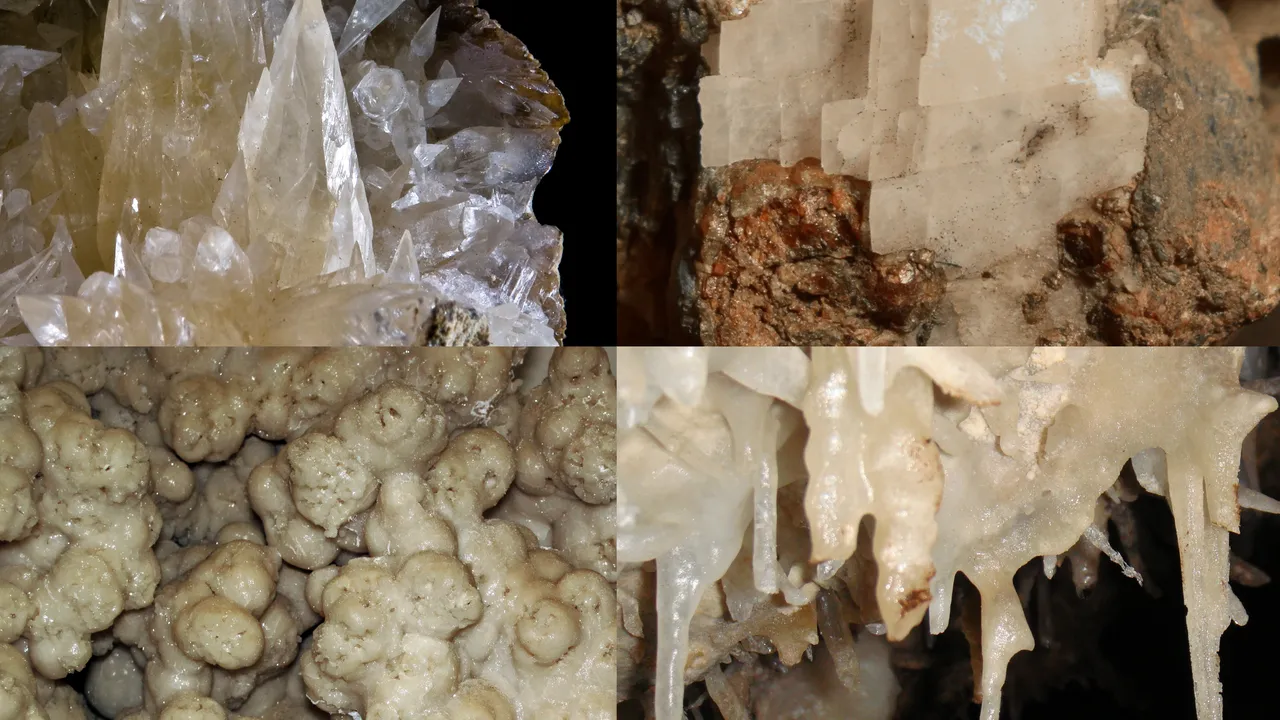
Tap a crystal of calcite gently, and it breaks into neat six-sided blocks that look like cubes pushed slightly sideways! Geologists call this slanted box shape a . In caves and rock pockets, calcite also grows sharp golden points nicknamed dogtooth spar.
2
Number Three on the Mohs Scale
Calcite stands at level 3 on the Mohs hardness scale. It is too hard for your fingernail (2.5) to scratch, yet soft enough for a copper penny (3.5) to scratch! Combined with its famous bubbly fizz in weak acid, calcite is a breeze for young rock hounds to identify.
3
Sculpting Virginia's Caverns
Made of (CaCO3), calcite is the main mineral inside both sedimentary limestone and metamorphic marble. Across Virginia's Shenandoah Valley, slightly acidic rainwater slowly dissolves underground limestone and re-deposits pure calcite as glittering cave formations like Luray Caverns!
4
Building Bridges and Sidewalks
Every day you walk across calcite's work! Heated calcite limestone is the main ingredient in Portland , which binds sand and gravel into concrete sidewalks, bridges, and skyscrapers.
1. Where does calcite rank on the 1-to-10 Mohs hardness scale?
2. Which two major rocks are built almost entirely from the mineral calcite?
🤯 Mind-Blowing Fact • Grade 4
Under ultraviolet 'blacklight' lamps in dark museum halls, trace amounts of manganese inside certain calcite crystals make them glow neon hot-pink and fiery orange!
✨ Word Sparks (Grade 4 Glossary)
Tap 🔊 to hear
Birefringence
Splitting one light ray into two paths
Karst
Landscape of caves and sinkholes in limestone
Plankton
Tiny drifting ocean organisms, many building shells
🪝
How did extinct seafloor trilobites use solid calcite crystals as precision camera lenses 400 million years ago?
1
Rhombohedral Cleavage and Birefringence
Set a transparent rhomb of Iceland spar calcite over printed words, and rotate it slowly: one image stays still while the twin image orbits right around it! This optical phenomenon, called or double refraction, happens because calcite's calcium, carbon, and oxygen atoms (CaCO3) pack into a trigonal crystal structure that slows light differently depending on its angle. Calcite also breaks along three directions of perfect cleavage at roughly 75- and 105-degree angles, forming unmistakable slanted rhombohedra.
2
Nature's Crystal Eyes and Navigation Stones
Because light traveling straight down calcite's main optical axis does not split into blurry double vision, ancient marine arthropods called trilobites grew hundreds of tiny aligned calcite rods in their eyes—giving them crisp underwater vision! Centuries later, Norse navigators crossing foggy North Atlantic seas may have held Iceland spar calcite up to overcast skies to detect polarized sunlight and steer toward land.
3
Karst Topography in the Valley and Ridge
Calcite reacts readily with weak acids, including carbonic acid formed when rainwater absorbs carbon dioxide from air and soil. In Virginia's Valley and Ridge province, weakly acidic groundwater seeps through fractured calcite limestone for millions of years, carving landscapes filled with sinkholes, disappearing streams, natural bridges, and cathedral-sized caverns.
4
Earth's Giant Carbon Bank
Calcite plays a massive role in keeping Earth's climate habitable. Microscopic ocean called coccolithophores and foraminifera pull dissolved carbon out of seawater to build delicate calcite shells. When they sink and compact into chalk and limestone, they lock billions of tons of carbon safely into Earth's crust—just like the famous White Cliffs of Dover!
1. How does rainwater carve caverns and sinkholes out of calcite-rich limestone in Virginia?
2. How do microscopic ocean plankton help regulate carbon on Earth using calcite?
🤯 Mind-Blowing Fact • Grade 5
Oceanographers discovered an invisible underwater boundary called the 'snowline' or Carbonate Compensation Depth nearly three miles down, below which falling calcite shells dissolve completely before touching the seafloor!
✨ Word Sparks (Grade 5 Glossary)
Tap 🔊 to hear
Polymorph
Minerals sharing chemistry but different crystal structures
Effervescence
Vigorous fizzing of escaping gas bubbles
Anisotropic
Having properties that change with crystal direction
🪝
Why does calcite behave completely backward from sugar and salt—dissolving MORE easily in icy deep ocean water than in warm tropical seas?
1
Trigonal Symmetry, Polymorphs, and Polarized Light
Hold a pristine specimen of optical-grade calcite (CaCO3), and you are examining a mineral that helped physicists unlock the wave nature of light. Crystallizing in the trigonal-hexagonal scalenohedral class, calcite alternates planar carbonate groups (CO3^2-) with six-coordinated calcium ions. This atomic geometry creates extreme birefringence: entering light splits into an 'ordinary' ray and an 'extraordinary' ray polarized at right angles and traveling at different velocities. Calcite also shares its exact CaCO3 formula with a denser orthorhombic , aragonite, which pearls and many tropical corals secrete before it gradually recrystallizes into stable calcite over geologic time.
2
Retrograde Solubility and the Carbonate Compensation Depth
Unlike halite or sugar, which dissolve faster as water heats up, calcite exhibits retrograde solubility—dissolving more readily in cold, high-pressure water rich in dissolved carbon dioxide! Warm, sunlit surface waters are supersaturated with calcium carbonate, allowing coral reefs and oolitic shoals to flourish. Below roughly 4,000 to 5,000 meters in the deep ocean—a boundary oceanographers call the Carbonate Compensation Depth (CCD)—cold temperatures and high CO2 concentrations dissolve sinking calcareous shells like falling snowflakes that melt before reaching the abyssal plain.
3
Effervescence Chemistry and Karst Hydrogeology
In mineralogy labs, a single drop of dilute hydrochloric acid triggers diagnostic via the reaction CaCO3 + 2HCl -> CaCl2 + H2O + CO2(g). In nature, soil-enriched carbonic acid (H2CO3) drives a gentler, reversible equilibrium: dissolving Paleozoic limestones across Appalachia to excavate vast phreatic cavern networks, then degassing CO2 inside airy chambers to precipitate speleothems of travertine and dripstone.
4
Paleothermometry Written in Oxygen Isotopes
Because marine foraminifera and cave stalagmites incorporate oxygen atoms from surrounding water into their CaCO3 crystal lattices at ratios controlled by temperature, geochemists measure oxygen-18 to oxygen-16 isotope ratios inside fossil calcite to reconstruct Ice Age ocean temperatures and ancient monsoon cycles with remarkable precision.
5
Sustainable Cement and Mineral Carbonation
Roasting calcite limestone in cement kilns accounts for roughly eight percent of human CO2 emissions because calcination releases carbon dioxide directly from CaCO3. Today, materials engineers are reversing that chemistry—injecting captured industrial CO2 into reactive silicate brines and recycled concrete so synthetic calcite crystals mineralize and lock carbon permanently into high-strength green building blocks.