🎵 INSTRUMENTS
🎶 Valveless Conical Brass Aerophone (Hornbostel-Sachs 423.121)
VA Music, Fine Arts & Sound Physics SOL 5.5
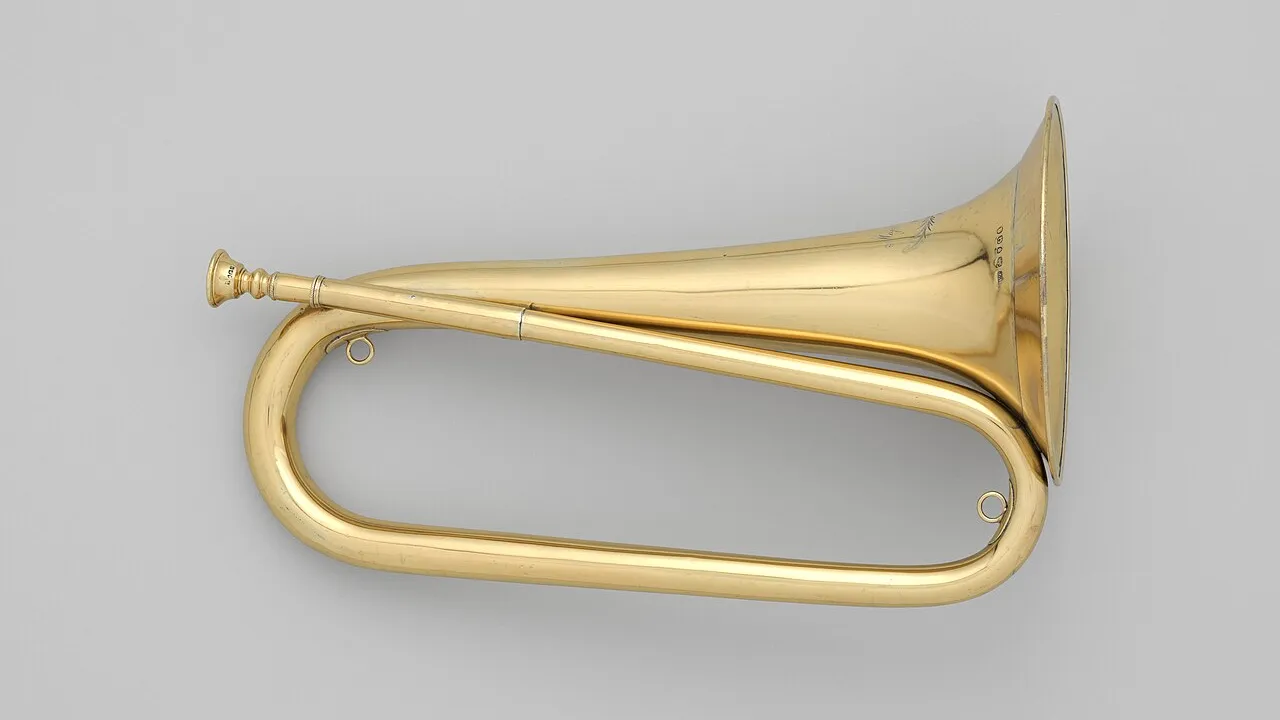
Bugle
Five Pure Notes Without a Button
Grade 5 • Advanced • 260 words
🎶 Instrument Family & OriginBrass family; evolved from medieval European ox-horn signals and standardized in 18th-century military regiments
🪵 Materials & RangeCopper or yellow brass; ~4.5 ft (1.37 m) of folded conical tubing sounding 5–6 natural harmonic pitches (~233–784 Hz)
🔊 How Sound Is MadePure changes in lip tension and breath speed leap between natural standing-wave overtones with zero valves or slides
⚡ Signature Sound SparkProjects unmistakable wake-up, parade, and ceremonial melodies across miles of open air using only five notes
🤯 Mind-Blowing Fact • Grade 1
The famous twenty-four-note evening melody 'Taps' is played from start to finish using only four different pitches!
✨ Word Sparks (Grade 1 Glossary)
Tap 🔊 to hear
valveless
Having zero buttons or keys to press
signal
Musical call sending a message far away
tight
Held firm to buzz very quickly
🪝
How can a shiny little horn play songs with zero buttons at all?
1
Wake Up, Camp!
Ta-da-da-DAA! Bright morning notes ring across the sleepy camp! Look closely at this small golden horn. There are no buttons, keys, or slides anywhere!
2
Magic in Your Lips
How does the player change the notes? Loose lips buzz slow for low notes. lips buzz fast to jump up high!
3
Five Clear Notes
Just five clear notes live inside this short brass loop. Yet those five notes play famous wake-up and bedtime tunes!
1. How many buttons or slides does a traditional bugle have?
2. How does a bugler jump from a low note up to a higher note?
🤯 Mind-Blowing Fact • Grade 2
Every Kentucky Derby horse race begins when a costumed bugler steps out to play the lively thirty-four-note 'Call to the Post' on a valveless horn!
✨ Word Sparks (Grade 2 Glossary)
Tap 🔊 to hear
fanfare
Short, bright horn tune announcing big moments
Reveille
Brisk morning bugle song waking everyone up
copper
Reddish metal giving warm tone to horns
🪝
Why does a bugle get its name from a young wild ox?
1
From Ox Horns to Shining Brass
Hear that crisp, sunny echo across the racetrack just before the horses run! Long ago in medieval Europe, watchmen blew hollow bullock horns, and the old French word bugle meant 'young ox.'
2
Riding the Invisible Ladder
Around the 1700s, metalworkers bent four and a half feet of and brass into one neat loop. Because the tube never changes length, the player climbs an invisible ladder of five natural notes using only lip muscles and air speed!
3
Calls Everyone Knows
Before radios or phones existed, crisp bugle tunes told scouts and soldiers when to wake up for ',' gather for dinner, or rest peacefully under the stars during 'Taps.'
1. Where did the English word *bugle* originally come from?
2. Which cheerful morning call wakes campers and soldiers at sunrise?
🤯 Mind-Blowing Fact • Grade 3
The mellow jazz flugelhorn is literally a valved bugle—its German name *Flügelhorn* comes from the hunting bugles carried on the 'wings' (*Flügel*) of royal hunts!
✨ Word Sparks (Grade 3 Glossary)
Tap 🔊 to hear
harmonic series
Natural ladder of overtones inside a tube
standing wave
Vibrating air pattern pulsing neatly in place
flugelhorn
Mellow three-valved cousin of the classic bugle
🪝
What invisible law of physics hides five musical pitches inside one plain brass pipe?
1
Pure Physics in One Brass Loop
Pick up a classic military bugle and you will find no pistons, rotors, or tone holes anywhere on its four-and-a-half-foot body! Everything you hear comes straight from nature's own musical rulebook: the .
2
Splitting the Air Column Into Halves and Thirds
When a bugler buzzes into the cup mouthpiece, air inside the conical brass tube forms . Relaxed lips vibrate the air in two sections for a low C; firmer lips split that exact same air column into three, four, five, or six vibrating segments to leap upward through G, middle C, E, and high G!
3
Why Conical Brass Cuts Through Wind
Unlike a trumpet's mostly straight pipe, a bugle widens steadily from mouthpiece to bell. That conical flare makes jumping smoothly between overtones easier while projecting a warm, ringing call across windy fields.
4
Ancestor of a Whole Brass Family
In the 1800s, inventors added keys and valves to bugles, giving birth to cornets, , and tubas!
1. How can one unmoving four-and-a-half-foot tube produce five different pitches?
2. Which modern jazz brass instrument evolved directly by adding valves to a bugle?
🤯 Mind-Blowing Fact • Grade 4
Before Adolphe Sax invented the woodwind saxophone, he designed a whole family of valved brass bugles called *saxhorns* that swept European and American bands!
✨ Word Sparks (Grade 4 Glossary)
Tap 🔊 to hear
triad
Three-note chord built from root, third, fifth
infantry
Soldiers who march and travel on foot
keyed bugle
Early 1810 bugle fitted with side tone-holes
🪝
Why did armies rely on conical copper bugles when loud drums were already marching beside them?
1
Clear Commands Above the Din
During the late 18th century, Hanoverian and British light units spread soldiers out across wooded hillsides where drumbeats muffled against trees and echoes blurred rhythms. Compact half-moon and single-coil copper bugles solved the problem instantly: bright pitched intervals sliced through fog, wind, and cannon smoke for more than a mile, letting commanders broadcast dozens of distinct musical orders.
2
Mathematics of the Five Bugle Partials
A standard regulation bugle pitched in B-flat (or G with a tuning slide pulled) uses roughly 1.37 meters of widening conical brass. Although a theoretical fundamental pitch (Partial 1) exists an octave below, narrow mouthpiece impedance makes Partials 2 through 6 the practical 'bugle notes.' Written in C for convenience, they form an open major : C4 (2x), G4 (3x), C5 (4x), E5 (5x), and G5 (6x).
3
The 1810 Keyed Bugle Revolution
In 1810, Irish bandmaster Joseph Halliday patented a bugle pierced with five leather-padded side keys like a saxophone. Suddenly, buglers could play soaring chromatic melodies! Though piston valves soon replaced padded keys, Halliday's breakthrough directly inspired Adolphe Sax's saxhorns, the euphonium, and the concert tuba.
4
Timeless Ceremonial Dignity
Composed during the American Civil War in 1862 by General Daniel Butterfield with bugler Oliver Wilcox Norton, the haunting twenty-four-note call 'Taps' endures worldwide as a solemn tribute.
1. Why did 18th-century hillside infantry adopt bugles alongside traditional field drums?
2. How did Irish inventor Joseph Halliday transform the bugle in 1810?
🤯 Mind-Blowing Fact • Grade 5
Because the fifth harmonic of a natural bugle vibrates at an exact 5:4 mathematical ratio above the fourth harmonic, its major third rings about fourteen cents flatter—and purer—than the compromised tuning of a modern keyboard!
✨ Word Sparks (Grade 5 Glossary)
Tap 🔊 to hear
just intonation
Pure whole-number frequency ratios without tuning beats
cent
Tiny pitch unit equaling one-hundredth of semitone
slotted
Locking securely into a clear resonant pitch
🪝
Why does nature's fifth harmonic make a bugle's high third sound subtly sweeter than a modern piano?
1
Organology of the Natural Conical Labrosone
Classified under Hornbostel-Sachs 423.121 as an end-blown conical natural labrosone without valves or tone holes, the military bugle represents brass acoustics stripped to pure physical essentials. Built in B-flat, G, or C from ~1.30 to 1.45 meters of high-copper red brass or yellow brass folded once or twice, it relies exclusively on embouchure tension and intra-oral air velocity to excite discrete standing-wave modes.
2
Harmonic Ratios and Just-Intonation Sweetness
On a B-flat bugle whose theoretical fundamental (f1) sits near B-flat2 (116.5 Hz), playable calls utilize modes two through six: B-flat3 (233.1 Hz), F4 (349.2 Hz), B-flat4 (466.2 Hz), D5 (582.7 Hz), and F5 (698.5 Hz). Notice D5—the fifth harmonic partial (5 × 116.54 Hz = 582.7 Hz). Compared to D5 on an equal-tempered piano (587.3 Hz), the bugle's natural major third sits 13.7 flatter, locking into beatless '' pure ratios (4:5:6) that give slow calls like 'Taps' an achingly resonant ring.
3
Conical Versus Cylindrical Natural Horns
Why isn't a bugle cylindrical like a natural baroque trumpet? A cylindrical closed-end pipe natively supports only odd harmonics (1, 3, 5) until rescued by mouthpiece volume and bell flare, requiring a seven-foot tube to place writable calls comfortably. By contrast, a bugle's continuous conical taper naturally aligns all integer harmonics (1, 2, 3, 4, 5, 6) in half the length (~4.5 feet), yielding wide, impedance peaks that resist cracking outdoors in freezing or blazing weather.
4
Genealogy of the Bugle-Horn Family
Organologists divide modern brasswinds into narrow-bore trumpets and wide-bore bugle-horns. From Joseph Halliday's 1810 Royal Kent keyed bugle and Heinrich Stölzel's 1814 valves sprang the flugelhorn, alto horn, euphonium, and contrabass tuba.
5
Drum and Bugle Corps Evolution
In North America, ceremonial G bugles gradually gained single pistons, rotors, and eventually three valves in competitive Drum Corps International ensembles, while military honor guards still preserve the pure valveless horn.