🇺🇸 U.S. HISTORY
🏛️ 42nd President of the United States (1993–2001)
VA History & Social Science SOL K.1, 1.2, 2.4, VS.1–VS.10, USI & USII
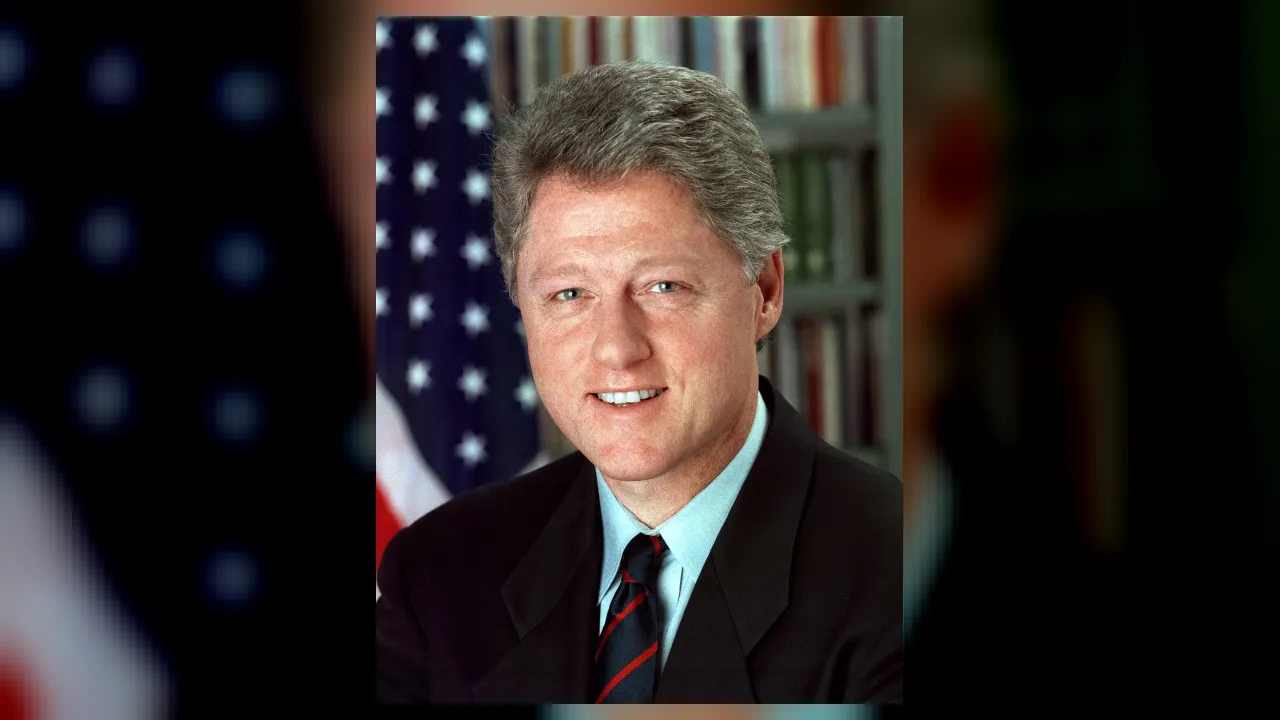
Bill Clinton
From Hope, Arkansas, to the Digital Nineties
Grade 5 • Advanced • 419 words
⏳ Era / StatehoodPresidential Term: 1993–2001 (Born Aug 19, 1946, Arkansas)
🗺️ Region / CapitalHope & Little Rock, Arkansas & Washington, D.C.
📜 Key Milestone1990s Digital Boom, Balanced Federal Budgets & AmeriCorps Service
⚡ Historical SparkPresided over the dawn of the everyday internet era and balanced federal budgets
🤯 Mind-Blowing Fact • Grade 1
Under President Bill Clinton in 1994, the White House launched its very first public website (whitehouse.gov) and sent the first presidential email—even to an astronaut orbiting in space!
✨ Word Sparks (Grade 1 Glossary)
Tap 🔊 to hear
saxophone
A curved brass musical instrument played by blowing
internet
The global network connecting computers around the world
volunteer
Someone who helps communities willingly
🪝
Can shaking hands with a president when you are sixteen inspire you to become president too?
1
A Boy From a Town Called Hope
Toot, jazz! Growing up in Arkansas—starting in a small town named Hope—young Bill loved reading books and playing his shiny brass !
2
Inspired by a Handshake
At age sixteen, Bill visited the White House Rose Garden and shook hands with President John F. Kennedy. Right then, he decided to serve his country!
3
Welcoming the Internet Age
As our forty-second president in the 1990s, he started AmeriCorps for young and helped connect schools and libraries to the brand-new !
1. What was the name of the Arkansas town where Bill Clinton's life began?
2. Which earlier president shook sixteen-year-old Bill Clinton's hand at the White House in 1963?
🤯 Mind-Blowing Fact • Grade 2
During the Clinton family's years at the White House, their tuxedo cat named Socks and chocolate Labrador dog named Buddy received so many letters from schoolchildren that First Lady Hillary Clinton compiled a whole book of kids' letters to them!
✨ Word Sparks (Grade 2 Glossary)
Tap 🔊 to hear
scholarship
An award paying for a strong student's college study
balanced budget
Not spending more money than the government collects
tutor
Someone who helps a student practice and learn
🪝
What was America like when families and classrooms connected to the World Wide Web for the very first time?
1
From Arkansas to Rhodes Scholar
Beep, dial, hum! Before smartphones existed, computers in the 1990s made funny beeping sounds to connect online! Raised in Hope and Hot Springs, Arkansas, Bill Clinton studied hard, won a Rhodes to Oxford University, and became America's youngest governor at age thirty-two.
2
Forty-Second President in a Booming Decade
Elected forty-second president in 1992, Clinton launched AmeriCorps so young adults could students and rebuild neighborhoods. During his two terms (1993–2001), millions of new jobs grew, and the U.S. government balanced its budget for the first time since 1969!
3
Peace Talks Around the World
Abroad, Clinton helped rival leaders negotiate landmark peace agreements in Northern Ireland and Southeastern Europe, and later teamed up with former president George H.W. Bush to aid disaster victims.
1. What national service program did President Clinton create so young adults could help schools and communities across America?
2. What rare financial milestone did the U.S. government achieve at the end of the 1990s under Clinton and Congress?
🤯 Mind-Blowing Fact • Grade 3
In November 1998, President Bill Clinton sent an email from a laptop straight to seventy-seven-year-old astronaut and Senator John Glenn orbiting Earth aboard the Space Shuttle Discovery!
✨ Word Sparks (Grade 3 Glossary)
Tap 🔊 to hear
surplus
Extra money left over after bills are paid
accord
An official peace or trade agreement
acquit
To vote not guilty in an official trial
🪝
How did the 1990s become a decade of classroom internet connections, global trade, and balanced federal budgets?
1
Inspired by Boys Nation
Picture traveling from Hot Springs, Arkansas, to Washington, D.C., as a sixteen-year-old student delegate and shaking hands with President John F. Kennedy! Born William Jefferson Blythe III in 1946—later taking his stepfather's surname, Clinton—he studied at Georgetown, Oxford, and Yale Law School before serving five terms as governor of Arkansas.
2
Family Leave, Trade, and AmeriCorps
Taking office in January 1993 as the first president born after World War II, Clinton signed the Family and Medical Leave Act so workers could care for newborn babies or sick relatives without losing their jobs. He also established AmeriCorps and won bipartisan approval for the North American Free Trade Agreement (NAFTA) with Canada and Mexico.
3
Digital Growth and Balanced Budgets
As personal computers and the World Wide Web transformed workplaces and schools, America enjoyed over twenty-two million new jobs. Working across party lines with a Republican-led Congress in 1997, Clinton signed a balanced-budget agreement and the Children's Health Insurance Program (CHIP).
4
Global Peacemaking and Constitutional Trial
Internationally, Clinton backed the 1995 Dayton ending war in Bosnia and the 1998 Good Friday Agreement bringing peace to Northern Ireland. In 1998–1999, following an investigation into personal misconduct, the House impeached Clinton, while the Senate acquitted him, so he completed his second term.
1. How did the Family and Medical Leave Act signed in 1993 help working American families?
2. Which two neighboring countries joined the United States in the 1993 NAFTA trade agreement?
🤯 Mind-Blowing Fact • Grade 4
In June 2000, President Bill Clinton stood beside top geneticists at the White House—connected by satellite to Britain's Prime Minister—to announce the historic first working draft map of the three-billion-letter Human Genome!
✨ Word Sparks (Grade 4 Glossary)
Tap 🔊 to hear
impeachment
Formal charges brought by the House against an official
innovation
Creating new tools, technology, or better methods
genome
The complete set of DNA instructions inside cells
🪝
How did Bill Clinton govern at the dawn of the Information Age while navigating divided government in Washington?
1
Arkansas Governor and First Baby-Boomer President
Born in Hope, Arkansas, in August 1946—three months after his father died in an auto accident—Bill Clinton grew up admiring public service. After earning degrees from Georgetown University and Yale Law School and studying at Oxford as a Rhodes Scholar, he became governor of Arkansas at thirty-two. Winning the three-way 1992 presidential election against President George H.W. Bush and Ross Perot, forty-six-year-old Clinton became the first president of the post-World War II 'Baby Boom' generation.
2
Economic Expansion and Bipartisan Compromises
Clinton's presidency coincided with rapid technological as fiber-optic networks, personal computers, and the commercial internet reshaped daily life—including major internet backbone hubs in Northern Virginia. Following a 1993 deficit-reduction bill and 1994 midterm elections that gave Republicans control of Congress under Speaker Newt Gingrich, both sides negotiated major bipartisan laws: 1996 welfare-to-work reform, the 1997 Balanced Budget Act, and the Children's Health Insurance Program (CHIP). From 1998 through 2001, the federal government recorded four consecutive budget surpluses.
3
Trade, Science, and Peacemaking Abroad
Championing global economic integration, Clinton won congressional approval for NAFTA (initially negotiated under George H.W. Bush) and creation of the World Trade Organization. He also celebrated the year-2000 first draft mapping of the Human at the White House, brokered the 1995 Dayton Peace Accords ending war in Bosnia, worked with NATO in Kosovo (1999), and helped achieve Northern Ireland's landmark 1998 Good Friday Agreement.
4
Constitutional Impeachment Process and Post-Presidency
Clinton's second term also tested constitutional checks and balances. In December 1998, he became only the second U.S. president (after Andrew Johnson in 1868) impeached by the House of Representatives, on charges of perjury and obstruction of justice arising from an investigation. Following a five-week trial in early 1999, the Senate fell short of the two-thirds vote required for removal, acquitting him. After leaving office in 2001, he focused on global health and disaster relief.
1. Under the U.S. Constitution, what are the separate roles of the House and the Senate in an impeachment process?
2. Which historic 1998 peace accord backed by U.S. diplomacy brought lasting peace after decades of conflict in Northern Ireland?
🤯 Mind-Blowing Fact • Grade 5
When Bill Clinton took office in January 1993, only about fifty websites existed on the entire World Wide Web—by the time he left office in January 2001, more than twenty-five million websites were online and 95 percent of U.S. public schools had internet access!
✨ Word Sparks (Grade 5 Glossary)
Tap 🔊 to hear
pragmatic
Focusing on practical solutions rather than strict theory
productivity
How efficiently workers and tools create useful goods
threshold
The minimum vote count required to take action
🪝
How did Bill Clinton navigate globalization, technological transformation, and divided government in the first post-Cold War presidency?
1
Generational Shift From Arkansas to Washington
Born in Hope, Arkansas, in August 1946, William Jefferson Clinton represented a generational handoff from World War II veterans to the postwar Baby Boom. Educated at Georgetown's School of Foreign Service, Oxford University on a Rhodes Scholarship, and Yale Law School—where he met future First Lady, U.S. Senator, and Secretary of State Hillary Rodham Clinton—he served twelve years as governor of Arkansas, chairing the National Governors Association and focusing on education standards before winning the 1992 three-way presidential race.
2
Fiscal Policy, Divided Government, and the Information Boom
Taking office in January 1993, Clinton prioritized deficit reduction through the Omnibus Budget Reconciliation Act of 1993 (expanding the Earned Income Tax Credit for low-wage workers) and signed the Family and Medical Leave Act and AmeriCorps Act. After the 1994 midterm elections ushered in the first Republican House and Senate majorities in forty years—and following brief 1995–1996 budget shutdowns—Clinton and congressional leaders practiced negotiation: enacting the 1996 Personal Responsibility and Work Opportunity Act, the 1997 Balanced Budget Act, and the bipartisan Children's Health Insurance Program (CHIP). Propelled by rising across semiconductors, telecommunications, and commercial internet hubs—including Northern Virginia's Dulles technology corridor—the U.S. economy achieved 115 consecutive months of expansion, unemployment below 4 percent, and federal budget surpluses from 1998 to 2001.
3
Judicial Appointments, Science, and Conservation
Clinton appointed two enduring voices to the U.S. Supreme Court—Justices Ruth Bader Ginsburg (1993, only the second woman appointed to the Court) and Stephen Breyer (1994)—promoted the 'E-Rate' initiative connecting 95 percent of American public schools to the internet by 2000, championed the international Human Genome Project, and protected more than six million acres of western lands as national monuments under the Antiquities Act.
4
Post-Cold War Trade and Diplomacy
Seeking to anchor open markets and regional stability after the Cold War, Clinton secured bipartisan ratification of the North American Free Trade Agreement (1993), supported creation of the World Trade Organization (1995), expanded NATO eastward to Poland, Hungary, and the Czech Republic (1999), mediated the 1995 Dayton Accords ending the Bosnian War, led NATO's 1999 Kosovo intervention, and appointed Senator George Mitchell to help broker Northern Ireland's landmark 1998 Good Friday Agreement—while later expressing deep regret that international powers had not intervened to halt the 1994 Rwandan genocide.
5
Constitutional Trial and Humanitarian Partnership
Following an independent counsel inquiry, the House of Representatives impeached Clinton in December 1998 on two articles (perjury and obstruction of justice), making him the second president tried by the Senate; on February 12, 1999, neither article received a majority—well short of the constitutional two-thirds —leaving him in office through January 2001. In retirement, he established a global health foundation and partnered frequently with former presidents George H.W. Bush and George W. Bush on bipartisan disaster recovery.