🪐 Scale / Diameter~660 million mi (1.06 billion km) wide • ~760× Sun's diameter • 16.5–19 solar masses
☄️ Composition & OrbitFusing heavy elements in an aging core • Pulses on 400-day & 2,100-day cycles
⚡ Cosmic SparkSo mind-bogglingly wide that parked at our Sun's spot, it would swallow Earth, Mars, and the Asteroid Belt
🤯 Mind-Blowing Fact • Grade 1
More than 400 million Suns could fit inside the puffy orange ball of Betelgeuse!
✨ Word Sparks (Grade 1 Glossary)
Tap 🔊 to hear
red supergiant
Enormous puffy star glowing cool red-orange
Orion
Famous winter star pattern shaped like a hunter
swallow
To wrap all the way around smaller things
🪝
Could one giant orange star swallow four whole planets at once?
1
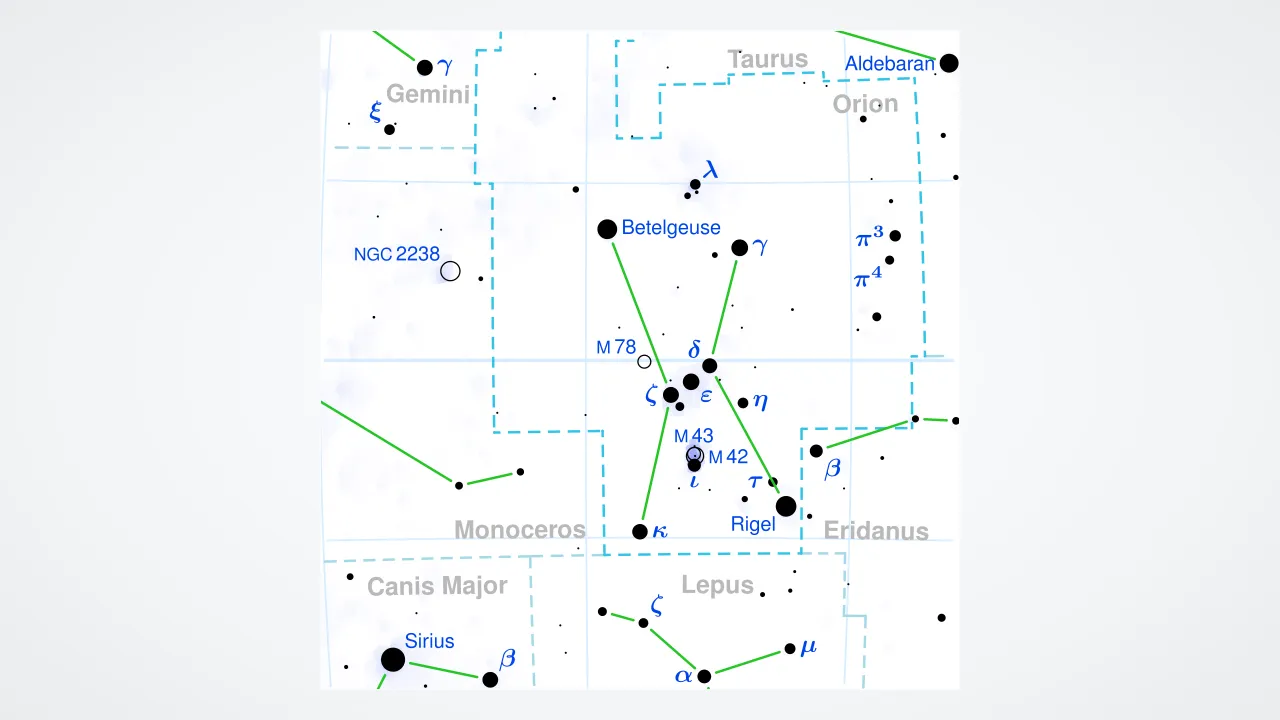
Glowing Orange in Orion
Spot the giant hunter in the winter night sky! Right on his top shoulder glows a bright pumpkin-orange star. Many people say its fun name out loud like 'Beetle-juice'!
2
A Puffy Monster Star
If you parked this where our Sun sits, it would gobble up Mercury, Venus, Earth, and Mars!
3
A Future Fireworks Show
Someday far in the future, this old giant will pop in a safe, bright star firework!
1. What color does Betelgeuse shine on Orion's shoulder in the night sky?
2. If Betelgeuse replaced our Sun, which planets would sit inside it?
🤯 Mind-Blowing Fact • Grade 2
In 1995, the Hubble Space Telescope snapped the first direct picture of another star's surface besides our Sun—and that star was Betelgeuse!
✨ Word Sparks (Grade 2 Glossary)
Tap 🔊 to hear
stardust
Tiny mineral grains cooled from a star's gas
core
Deep hot center where a star makes energy
Great Dimming
Famous 2019 event when dust shaded Betelgeuse
🪝
Why did one of the brightest stars in Orion suddenly turn dim like someone sneeze-dusted it?
1
Fast-Living Cosmic Giant
Our yellow Sun is middle-aged at 4.6 billion years old, yet Orion's orange shoulder star is a cosmic teenager racing toward old age! Only ten million years old and about 650 light-years away, massive Betelgeuse burned through its main fuel super fast and puffed up more than 700 times wider than our Sun.
2
The Mystery of the Great Dimming
Late in 2019, stargazers gasped when Orion's bright shoulder faded to less than half its normal glow! Hubble Space Telescope solved the mystery: the boiling star had burped out a gigantic hot gas bubble that cooled into a dark cloud of blocking our view.
3
Safe Front-Row Fireworks
Within the next 100,000 years, its will collapse into a dazzling supernova as bright as the half-Moon—completely harmless to Earth!
1. What caused Betelgeuse's famous 'Great Dimming' in late 2019 and early 2020?
2. About how old is massive Betelgeuse compared with our 4.6-billion-year-old Sun?
🤯 Mind-Blowing Fact • Grade 3
Although Betelgeuse packs nearly 18 times our Sun's mass, its outer envelope is puffed out so thin that physicists call it a 'red-hot vacuum' thinner than air on Earth!
✨ Word Sparks (Grade 3 Glossary)
Tap 🔊 to hear
convection cell
Giant rising bubble of hot churning star gas
helium
Second-lightest gas made when stars fuse hydrogen
vacuum
Space with almost no gas particles packed inside
🪝
How can a star be 100,000 times brighter than our Sun yet cooler on its surface?
1
Cooler Skin, Colossal Size
Touch a glowing red stove burner and you know red heat is cooler than blue-white flame! In the same way, Alpha Orionis—Betelgeuse—has a surface temperature near 6,000°F (3,600 K), thousands of degrees cooler than our 10,000°F yellow Sun. Yet because its swollen surface spans roughly 660 million miles across, all that vast glowing area radiates 100,000 times our Sun's total energy!
2
Boiling Bubbles as Wide as Earth's Orbit
Unlike our smooth, tidy Sun, this red supergiant churns with monster ! Giant blobs of hot gas wider than Earth's entire trip around the Sun rise, brighten, cool, and sink across its lumpy, shifting surface.
3
Heartbeat Pulses in the Sky
Even in normal years, British astronomer John Herschel noticed in 1836 that Orion's shoulder swells and shrinks like a slow heartbeat roughly every 400 days.
4
Cooking Elements for Future Worlds
Deep inside its furnace core, the star fuses into carbon and oxygen—the exact atoms that build rocks, oceans, and living creatures!
1. How does Betelgeuse shine 100,000 times brighter than our Sun even though its surface is cooler?
2. How dense is the puffy outer gas envelope of Betelgeuse?
🤯 Mind-Blowing Fact • Grade 4
Infrared telescopes spotted a giant curved 'bow shock' 4 light-years wide in front of Betelgeuse—created as this runaway supergiant plows through space at 67,000 mph!
✨ Word Sparks (Grade 4 Glossary)
Tap 🔊 to hear
bow shock
Curved wave piled up ahead of speeding star
photosphere
Visible outer surface layer of a shining star
mass ejection
Huge eruption flinging billions of tons of gas
🪝
What did a historic 20-foot steel beam on a mountaintop telescope reveal about Betelgeuse in 1920—and what secret buddy hides in its outer gas today?
1
First Star Width Ever Measured Beyond the Sun
On the frosty night of December 13, 1920, astronomers Albert Michelson and Francis Pease bolted a 20-foot steel interferometer beam across Mount Wilson's 100-inch Hooker Telescope in California. Combining two separated mirrors to create tiny light-wave interference fringes, they accomplished a scientific first: measuring the true angular width of a distant star! Alpha Orionis proved to be a staggering red supergiant hundreds of times wider than our Sun.
2
Anatomy of the 2019 Surface Mass Ejection
Nearly a century later, Hubble and Chile's Very Large Telescope watched Betelgeuse eject 400 billion times more mass than a typical solar coronal ! When a rising super-convection plume coincided with the star's 400-day outward pulse, a giant patch of ripped loose, leaving a cool dark scar and condensing silicate dust across its southern hemisphere.
3
The Mystery of 'Betelbuddy'
In addition to its 400-day fundamental pulse, Betelgeuse brightens and dims on a curious 2,100-day (~5.8-year) cycle. In 2024–2025, astrophysicists proposed and detected faint evidence of a close low-mass companion star—nicknamed 'Betelbuddy' (Alpha Orionis B)—plowing through Betelgeuse's dusty outer atmosphere like a snowplow clearing dust!
4
Runaway Star With a Bow Shock
Infrared space telescopes also revealed that Betelgeuse is a cosmic runaway, plowing through interstellar space at 67,000 miles per hour and pushing a glowing bow wave of gas ahead of itself!
1. What historic milestone did Albert Michelson and Francis Pease achieve with Betelgeuse in December 1920?
2. What may explain Betelgeuse's mysterious 2,100-day (~5.8-year) brightness cycle?
🤯 Mind-Blowing Fact • Grade 5
When Betelgeuse nears its final week of life, its core will fuse an entire Sun's worth of silicon into iron in roughly twenty-four hours before collapsing in less than a second!
✨ Word Sparks (Grade 5 Glossary)
Tap 🔊 to hear
nucleosynthesis
Forging heavier atomic nuclei inside hot star cores
Why can't astronomers measure an exact distance to one of the brightest stars in the sky—and how soon will its iron core collapse?
1
Arabic Star Lore to Optical Interferometry
Tracing its name through medieval translations of Arabic Yad al-Jauza ('Hand of the Central One'), Alpha Orionis anchors the upper left shoulder of Orion at roughly 650 light-years (~200 parsecs). Ironically, Betelgeuse is so luminous and bloated—subtending ~42 , larger than Neptune's apparent disk would look at 300 AU—that it blinds Gaia's sensitive detectors while its shifting convective hot spots jiggle its photocenter wider than its annual parallax angle! Astronomers therefore combine Very Large Array radio astrometry with asteroseismic modeling to constrain its radius near 764 solar radii (~3.5 AU).
2
Onion-Shell Nucleosynthesis and Countdown to Collapse
Born ~8 to 10 million years ago in the Orion OB1 association as a sizzling ~20-solar-mass O-type star, Betelgeuse was likely slung outward at 30 kilometers per second when a former binary sibling exploded. Today it fuses helium into carbon and oxygen inside its core. Once core carbon, neon, oxygen, and silicon burn sequentially in shorter and shorter 'onion shells'—silicon fusion lasting barely a single day!—an inert iron core will exceed the Chandrasekhar limit and implode inside milliseconds.
3
Anatomy of the 2019–2020 Great Dimming
Between October 2019 and February 2020, Betelgeuse plunged from magnitude +0.5 to +1.61—its faintest in modern photoelectric history. VLT/SPHERE direct images and Hubble ultraviolet spectra revealed a catastrophic surface mass ejection that ripped away a substantial fraction of the southern photosphere, ringing the star like an out-of-rhythm bell for years afterward as its 400-day fundamental pulsation temporarily sped up to ~200 days.
4
Speckle Imaging and Companion Candidate α Ori B
Long-standing puzzles over Betelgeuse's ~2,170-day long secondary period and rapid 5-km/s equatorial rotation led theorists to predict a ~1.5-solar-mass companion skimming just ~2.4 stellar radii from its center—detected tentatively via Gemini North speckle imaging in 2025 just before spiraling toward eventual tidal engulfment within 10,000 years.
5
A Safe Type II-P Supernova Spectacle
When Betelgeuse detonates as a within the next ~100,000 years, Earth sits 25 times farther than the ~25-light-year biosphere danger zone—promising harmless daytime visibility rivaling a quarter-Moon!