⚡ Everyday Impact SparkCares for millions of gentle honeybees that pollinate one out of every three bites of food we eat
🤯 Mind-Blowing Fact • Grade 1
One hardworking honeybee visits thousands of flowers in her life, yet all the honey she makes herself fills only one-twelfth of a teaspoon!
✨ Word Sparks (Grade 1 Glossary)
Tap 🔊 to hear
hive
busy home where a bee colony lives
nectar
sweet flower juice bees turn into honey
veil
fine mesh screen protecting a keeper's face
🪝
How can someone lift a wooden frame covered in thousands of buzzing bees and stay calm and safe?
1
Buzzing Boxes in the Meadow
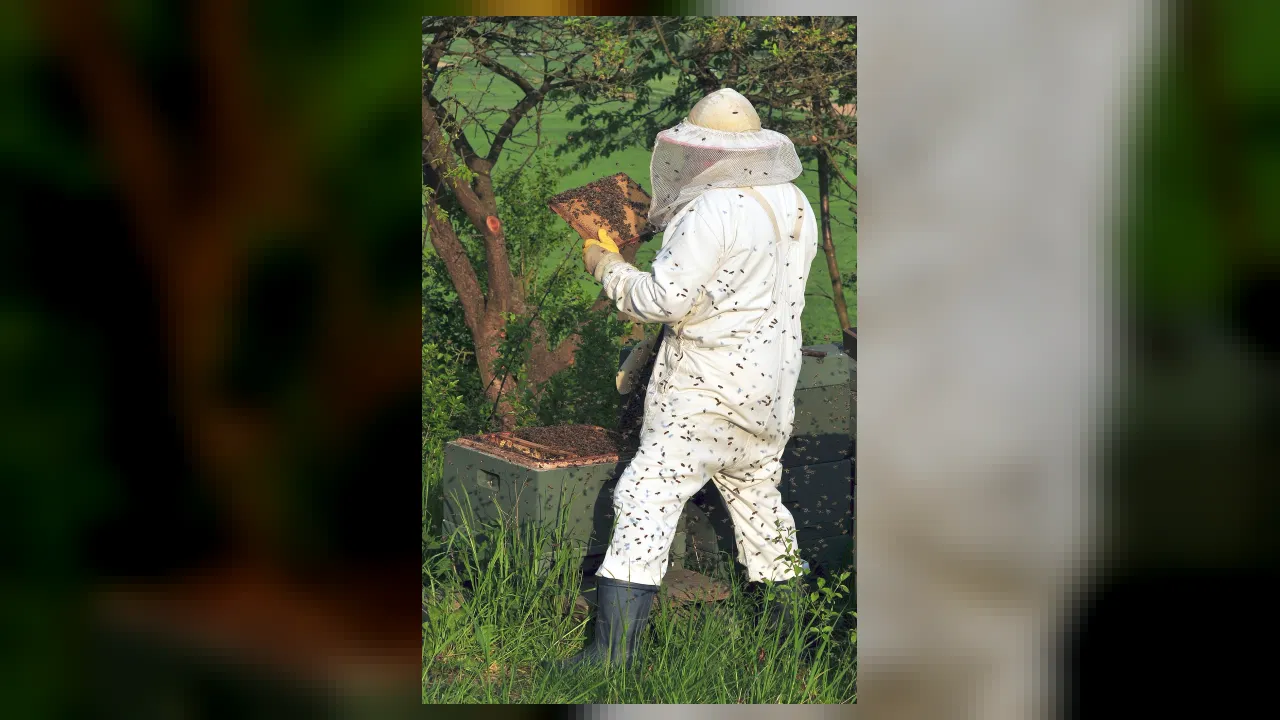
Bzzzz! Golden honeybees zoom in and out of white wooden boxes beside a sunny orchard. Wearing a white zip-up suit and mesh hat, a gentle caretaker lifts the lid slowly.
2
Cool Puffs and Sweet Honey
Puff! A little tin can blows cool pine-needle smoke. Calm bees sip honey while the keeper checks six-sided wax cells.
3
Helping Apples and Berries Grow
Visiting blossom after blossom, busy bees spread flower pollen so juicy apples, pumpkins, and berries grow!
1. Why does a keeper puff a tiny bit of cool smoke before opening a hive?
2. How do honeybees help orchard trees grow crunchy apples?
🤯 Mind-Blowing Fact • Grade 2
During summer bloom season, a single strong beehive can hold up to sixty thousand buzzing bees working together as one big family!
✨ Word Sparks (Grade 2 Glossary)
Tap 🔊 to hear
apiary
outdoor yard where beehives are kept
hexagon
six-sided shape forming every honeycomb cell
colony
thousands of bees living and working together
🪝
Why is every single cell inside a honeycomb shaped like a six-sided hexagon instead of a circle?
1
Inside the Bee Yard
Warm sunshine glows across an —a yard filled with stacked wooden hive boxes. Moving smoothly without jerky motions, an apiarist slides out one wooden frame to check that the 's single large queen bee is laying tiny rice-shaped eggs.
2
Nature's Best Geometry Builders
Worker bees mold beeswax into thousands of neat six-sided ! Circles would leave wasted gaps in between, whereas hexagons fit snugly wall-to-wall, holding the most golden honey using the least wax.
3
Sharing Only the Extra
Careful keepers spin capped frames in a drum to harvest surplus honey while always leaving plenty of winter food for the bees!
1. Why do honeybees build six-sided hexagons instead of round tubes?
2. Why do responsible keepers never take all the honey out of a hive in autumn?
🤯 Mind-Blowing Fact • Grade 3
To make just one single pound of golden jar honey, worker bees must fly a combined distance of 55,000 miles—more than twice around planet Earth—and tap two million flowers!
✨ Word Sparks (Grade 3 Glossary)
Tap 🔊 to hear
pollination
moving pollen between flowers to make seeds
larva
tiny pearly-white baby bee inside wax
propolis
sticky tree resin bees use as glue
🪝
How did a clever three-eighth-inch measurement called 'bee space' let humans inspect hives without breaking honeycomb?
1
Three Jobs Inside One Hive
Lift a frame from a thriving colony, and you can spot three distinct bee roles! One long-bodied queen lays up to 1,500 eggs a day; tens of thousands of female worker bees clean cells, nurse larvae, guard the entrance, and gather nectar; and a few hundred big-eyed male drones help new queens start future hives.
2
Langstroth's 'Bee Space' Discovery
Centuries ago, straw skep hives had to be broken open to reach honey! Then in 1851, American keeper Lorenzo Langstroth noticed 'bee space': leave a gap of exactly three-eighths of an inch around hanging wooden frames, and bees neither glue them shut with sticky tree resin nor fill them with comb!
3
Decoding the Waggle Dance
When a scout bee finds a field of blooming clover, she performs a figure-eight 'waggle dance' in the dark hive—showing sisters the exact compass angle relative to the Sun and distance to fly!
4
Guarding Colony Health
Keepers check hives regularly for tiny Varroa mites, plant pesticide-free wildflowers, and provide clean water dishes with pebble landing pads.
1. What does a scout bee's 'waggle dance' communicate to her sisters?
2. How did Lorenzo Langstroth's 1851 'bee space' frame invention help honeybees?
🤯 Mind-Blowing Fact • Grade 4
Sealed properly away from moisture, pure natural honey never spoils—archaeologists discovered jars of honey over three thousand years old in ancient Egyptian tombs that were still preserved!
✨ Word Sparks (Grade 4 Glossary)
Tap 🔊 to hear
superorganism
social colony functioning like one living body
enzyme
natural protein speeding up helpful chemical changes
forager
older worker bee gathering nectar and pollen
🪝
How do honeybees air-condition their hive in summer, heat it to 95 degrees in blizzards, and turn watery nectar into honey that never spoils?
1
Living Superorganism Climate Control
Apiarists marvel at a honeybee colony as a ''—thousands of insects regulating their home like one warm-blooded body! On ninety-five-degree Virginia afternoons, carry water droplets home while rows of fanner bees beat their wings at the entrance like miniature Swamp coolers. When January snow piles outside, bees form a tight winter cluster around the queen, shivering their flight muscles to hold the center at a cozy ninety-three degrees Fahrenheit!
2
Chemistry of Never-Spoiling Honey
Flower nectar starts out as eighty percent water—which would quickly ferment if left alone. Passing nectar mouth-to-mouth, house bees add natural that split complex sugars into glucose and fructose, then fan their wings day and night until water evaporates below eighteen percent! Once bees seal cells with airtight wax caps, low moisture and mild acidity stop bacteria completely—archaeologists even found edible honey inside 3,000-year-old Egyptian tombs!
3
Pollinating Orchards Coast to Coast
Roughly one-third of the human diet—including Shenandoah Valley apples, Tidewater watermelons, blueberries, squash, and California almonds—depends on insect pollination. Migratory commercial apiarists transport flatbeds of screened hives at night when bees are tucked inside, partnering with orchard growers as blooms open from south to north.
4
Supporting Native Wild Pollinators Too
Because European honeybees (Apis mellifera) arrived in Virginia with Jamestown colonists in the 1620s, thoughtful apiarists also plant diverse native meadows so wild bumblebees, mason bees, and butterflies flourish alongside managed hives.
1. How does a honeybee colony survive freezing snowstorms all winter without hibernating?
2. How do house bees turn watery flower nectar into thick honey that never spoils?
🤯 Mind-Blowing Fact • Grade 5
Honeybees must consume about eight pounds of energy-rich honey just to produce a single pound of beeswax scales—which is why spinning frames in a centrifugal extractor to reuse wax combs saves colonies enormous work!
✨ Word Sparks (Grade 5 Glossary)
Tap 🔊 to hear
epigenetics
switching genes on or off through diet
pheromone
chemical scent signal coordinating colony behavior
centrifugal
outward force spinning honey from intact comb
🪝
How does one spoonful of royal jelly rewrite a bee's destiny through epigenetics—and how are apiarists protecting global food security against colony collapse?
1
Epigenetics and Pheromone Architecture
Inside a Langstroth hive of Apis mellifera, a tiny fertilized egg can develop into either a sterile worker bee living six summer weeks or a fertile queen living up to five years—even though both carry identical DNA! Apicultural scientists discovered this dramatic split stems from : larvae fed exclusively protein-rich 'royal jelly' secreted by nurse bees silence DNA-methylation genes, unlocking ovarian development. Once crowned, the queen regulates social harmony across 50,000 daughters via Queen Mandibular , while age-polyethism shifts workers sequentially from cell cleaners and wax builders to guards and long-range foragers.
2
Comb Thermodynamics and Centrifugal Extraction
Secreting translucent wax scales from abdominal glands requires bees to consume roughly eight pounds of honey for every single pound of beeswax built! To conserve that immense energetic investment, modern apiarists never crush combs during harvest. Instead, they uncap only surplus upper 'super' boxes with heated knives and spin frames inside stainless-steel radial extractors—using force to sling liquid honey out while returning intact hexagonal combs straight back to the colony.
3
Epidemiology of Varroa destructor and Colony Losses
Over recent decades, apiarists and agricultural entomologists have confronted severe annual overwintering losses driven by four interacting stressors: habitat loss, sub-lethal neonicotinoid pesticide exposure that impairs waggle-dance navigation, climate bloom mismatches, and the parasitic mite Varroa destructor, which feeds on bee fat bodies while transmitting Deformed Wing Virus. Master beekeepers run monthly alcohol-wash or sugar-roll mite counts, breed 'Varroa Sensitive Hygiene' (VSH) bee stocks that detect and remove infested pupae naturally, and treat hives with organic acids found naturally in thyme and rhubarb.
4
Acoustic Smart Hives and Palynology
Twenty-first-century research apiaries integrate non-invasive IoT sensors: digital hive scales track daily nectar flows to the gram, thermal arrays map brood-nest health in winter without cracking propolis seals, and machine-learning microphones identify the distinct acoustic pitch shift ('piping') that warns a colony is preparing to swarm! In laboratories, melissopalynologists examine microscopic pollen grains trapped in honey to verify floral origins—distinguishing Appalachian sourwood or tupelo honey from adulterated syrups.
5
Agricultural Economics and Wild Apoidea Coexistence
Insect pollination adds more than twenty billion dollars annually to U.S. crop harvests and hundreds of billions globally. Ethical apiarists balance hive stocking densities so managed honeybees complement—rather than outcompete—Earth's 20,000 species of wild native bees, safeguarding fruitful orchards and resilient ecosystems alike.