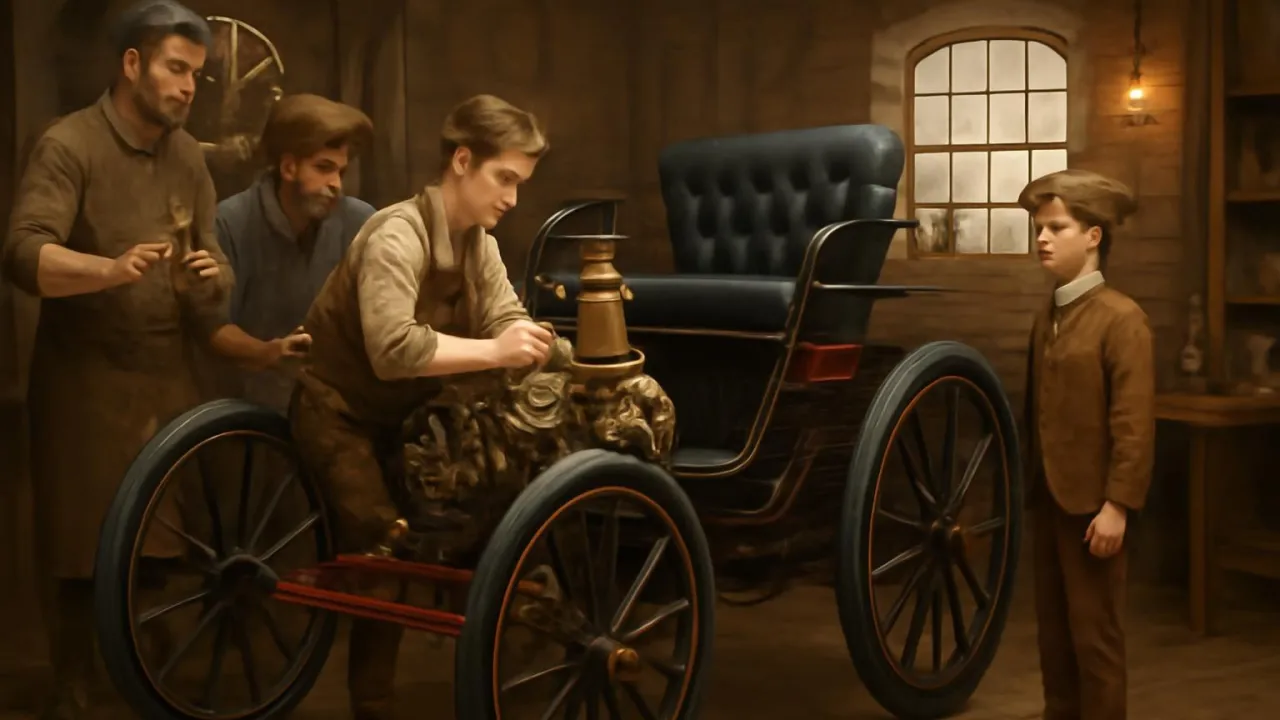
Early cars had to be started with a hand crank in the front!
✨ Word Sparks (Grade 2 Glossary)
Tap 🔊 to hear
carriage
A wagon pulled by horses
pedal
A part you push with your foot
crank
A handle used to start old cars
🪝
Can you imagine riding in a car before roads were busy?
1
Zooming Along
Long ago, people rode in pulled by horses, but cars changed everything. Cars use engines to go much faster, and people love the fun ride. Today, families take cars to school, parks, and stores.
2
How Cars Work
A car's engine burns gas, making energy to spin the wheels. The driver uses a steering wheel to turn and to stop or go. Cars can be small or big, and some are bright colors.
3
A World on Wheels
The first car was made in Germany by Karl Benz in 1885. It had three wheels and looked very different from cars today. Now, cars help people travel far and see new places.
Bertha Benz, Karl’s wife, made the first long car trip—over 60 miles—in 1888!
✨ Word Sparks (Grade 3 Glossary)
Tap 🔊 to hear
combustion
Burning fuel to make energy
prototype
The first working model of something
patent
A legal paper protecting an invention
🪝
What would it feel like to ride the world’s very first car?
1
A New Way to Move
Imagine the rumble of a strange machine rolling down a quiet street in 1885. People stared as Karl Benz drove his invention, a three-wheeled automobile, through Mannheim, Germany. Unlike noisy horse carts, this car used an engine to move. It marked the beginning of a new travel era.
2
The Engine’s Secret
The automobile’s engine uses a process called , burning gasoline to create power. This power turns the wheels, making the car move forward. Drivers control the car with a steering wheel, pedals, and brakes. Early cars were slow, but they amazed everyone with their vibration and speed.
3
Changing the World
Automobiles made it possible for people to travel farther and faster than ever before. Families could visit distant relatives or explore new towns in just a day. Over time, cars became safer and more comfortable, with strong frames and soft seats. Today, millions of cars zoom along busy roads around the world.
4
From Prototype to Everyday Ride
Karl Benz’s first car was a , meaning it was the very first working model. He received a for his invention, protecting his idea from being copied. Modern cars use advanced materials and technology, but they still work by turning fuel into motion. The automobile’s journey continues with electric and hybrid cars today.
The first long-distance road trip by car was a secret test drive by Bertha Benz in 1888.
✨ Word Sparks (Grade 4 Glossary)
Tap 🔊 to hear
internal combustion
Burning fuel inside an engine for power
pneumatic
Filled with air, like some tires
aerodynamics
How air moves around things
🪝
Close your eyes—can you hear the first engine chugging down a cobblestone street?
1
The Dawn of the Automobile Age
In the late 1800s, people were amazed to see a horseless carriage rattling along city streets. Karl Benz’s Motorwagen, built in 1885, was the world’s first true automobile powered by an engine. Instead of horses, the Motorwagen’s single-cylinder engine used gasoline to generate motion. Benz’s invention sparked a transportation revolution that changed how people lived, worked, and traveled.
2
Engineering Marvels Under the Hood
The first automobile’s engine worked by igniting a mixture of air and fuel, causing a controlled explosion called combustion. This force pushed a piston, turning gears and spinning the wheels. Early cars vibrated a lot and required careful steering with a lever or wheel. Over time, inventors improved the design, adding stronger frames, tires, and better brakes for safety and comfort.
3
From Workshop to World Roads
Benz’s Motorwagen was a prototype, and his wife Bertha famously drove it over 60 miles to prove its usefulness. As more inventors built automobiles, the patent system helped protect their ideas and encourage innovation. Soon, cars became more affordable, and roads were built to connect cities and towns. The automobile’s rise transformed daily life, making travel faster and more flexible than ever.
4
Driving the Future
Today’s automobiles use advanced materials, like lightweight steel and plastics, and many run on electricity instead of gasoline. Engineers study and acoustic resonance to make cars quieter and more efficient. The automobile’s impact is global, shaping cities, economies, and even the environment. As technology advances, cars continue to evolve, offering new ways to connect people and places.
1. How did the first car’s engine make the wheels move?
2. Why was Bertha Benz’s road trip important?
🤯 Mind-Blowing Fact • Grade 5
The Benz Patent-Motorwagen’s engine produced just 0.75 horsepower—less than most modern lawnmowers!
✨ Word Sparks (Grade 5 Glossary)
Tap 🔊 to hear
crankshaft
A rod that turns engine power into wheel motion
catalytic converter
A device that cleans car exhaust
regenerative braking
A way to save energy when stopping
🪝
Imagine the clang of tools and the sharp smell of oil as inventors race to build the first self-moving machine.
1
From Steam Dreams to Gasoline Reality
Before automobiles, inventors experimented with steam-powered vehicles, but these early machines were heavy and impractical for everyday use. In 1885, Karl Benz revolutionized transportation by creating the Benz Patent-Motorwagen, the first automobile powered by an internal combustion engine. This groundbreaking vehicle featured a single-cylinder four-stroke engine mounted on a lightweight steel frame, allowing it to achieve speeds up to 10 miles per hour. The Motorwagen’s innovative design set the foundation for all modern cars that followed.
2
The Science of Motion and Power
The internal combustion engine works by mixing gasoline vapor with air and igniting it inside a cylinder. This controlled explosion—known as combustion—forces a piston downward, turning a that ultimately spins the wheels. Early automobiles suffered from intense vibration and required manual cranking to start the engine, but each improvement, such as pneumatic tires and electric starters, made cars safer and easier to drive. Today, engineers use computer-aided design and advanced materials to optimize efficiency, safety, and acoustic comfort.
3
The Automobile’s Social and Economic Impact
The widespread adoption of automobiles transformed societies by shrinking distances and connecting rural and urban communities. Henry Ford’s introduction of the moving assembly line in 1913 made cars affordable for millions, fueling economic growth and changing the way people lived and worked. Roads, highways, and suburbs grew rapidly as people gained the freedom to travel farther and faster. The automobile also influenced culture, inspiring everything from drive-in theaters to global car races.
4
Innovation, Regulation, and the Environment
As automobiles became more common, governments developed traffic laws, safety standards, and environmental regulations to address challenges like accidents and air pollution. The invention of , seat belts, and airbags improved safety and reduced harmful emissions. Today, electric and hybrid vehicles are leading a new wave of innovation, using batteries and to reduce reliance on fossil fuels and lower carbon footprints.
5
The Road Ahead: Future of Automobiles
Modern automobiles are equipped with sensors, computers, and advanced driver-assistance systems, paving the way for self-driving cars. Engineers study aerodynamics, resonance, and materials science to create vehicles that are faster, quieter, and more energy-efficient. The journey from Karl Benz’s three-wheeled prototype to today’s electric and autonomous vehicles reflects humanity’s endless curiosity and drive to connect the world. The automobile’s story is far from over, as new technologies promise even greater changes in the decades to come.