1. Instead of swinging gears or hands, what does an atomic clock count?
2. How do atomic clocks riding inside space satellites help people every day?
🤯 Mind-Blowing Fact • Grade 2
Despite its scary-sounding name, an atomic clock is not radioactive at all—it simply counts harmless microwave vibrations inside calm metal atoms!
✨ Word Sparks (Grade 2 Glossary)
Tap 🔊 to hear
cesium
Soft silvery metal used inside atomic clocks
microwave
Invisible radio wave with very short ripples
accurate
Exact and free from any mistakes
🪝
If every regular clock speeds up or slows down a tiny bit, what sets the master beat for the whole world?
1
Nature's Perfect Metronome
Springs stretch out, gears wear down, and even Earth's daily spin wobbles by tiny fractions of a second! Scientists needed a timer that never grew tired, so they looked inside atoms themselves.
2
Nine Billion Ticks Per Second
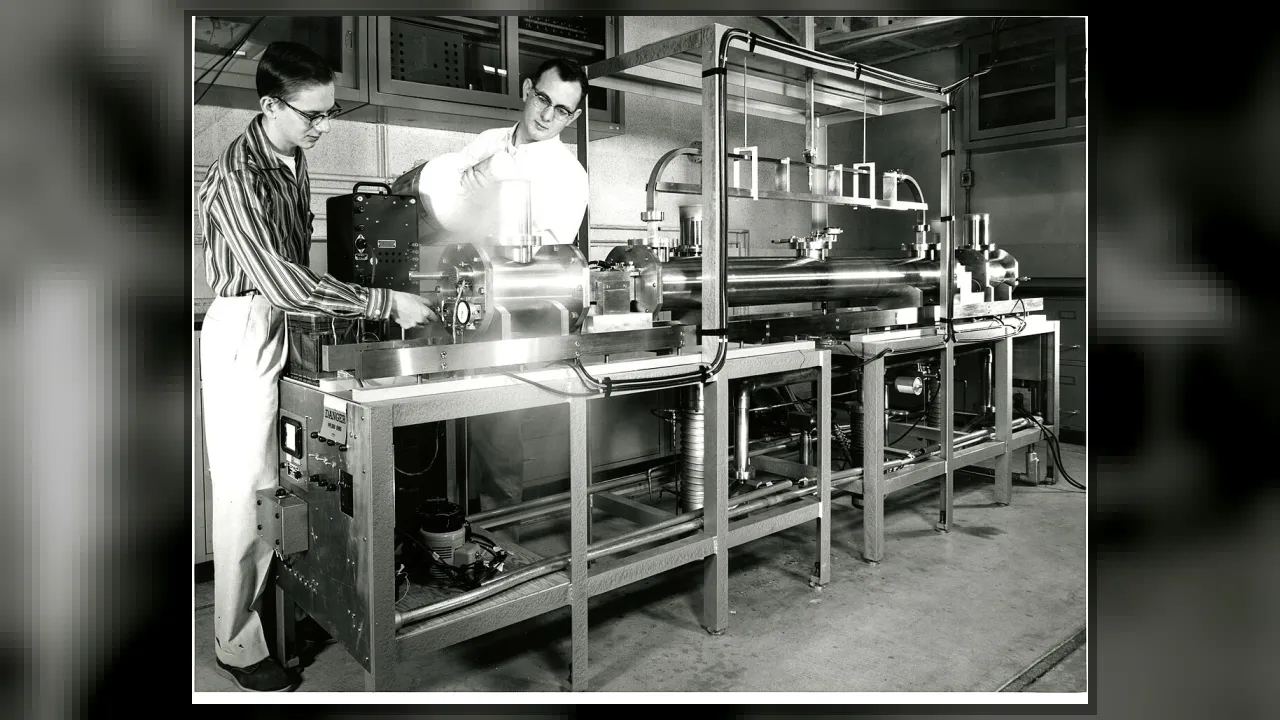
In 1955, British scientists Louis Essen and Jack Parry built the first super- clock. When bathed in gentle , cesium atoms flip back and forth more than nine billion times during every single second!
3
Running Maps and Computers
Today, teams of these clocks in science labs set official world time and ride aboard GPS satellites so phones can pinpoint your street corner within steps.
1. About how many times does a cesium atom tick during one single second?
2. Is a cesium atomic clock powered by dangerous nuclear radiation?
🤯 Mind-Blowing Fact • Grade 3
Albert Einstein predicted that clocks tick slightly faster high above Earth where gravity is weaker—and GPS atomic clocks in orbit prove him right every single day!
✨ Word Sparks (Grade 3 Glossary)
Tap 🔊 to hear
millisecond
One thousandth of a single second
frequency
Number of wave cycles each second
absolute zero
Coldest possible temperature where heat motion stops
🪝
What officially decides how long 'one second' lasts for every stopwatch, spacecraft, and computer on Earth?
1
When Earth Wasn't Steady Enough
For thousands of years, people defined one second as a slice of Earth's 24-hour spin. Then astronomers noticed a surprise: ocean tides, melting glaciers, and winds actually nudge Earth's spin faster or slower by !
2
From Ammonia to Cesium-133
Inspired by physicist Isidor Rabi, Harold Lyons built the first ammonia-molecule clock in the United States in 1949. Six years later in England, Louis Essen and Jack Parry unveiled a gleaming tube using cesium-133 atoms. It was so exact that in 1967, the entire world redefined one official second as 9,192,631,770 cesium vibrations!
3
Tossing Atoms Like a Water Fountain
Inside modern 'fountain' clocks, six laser beams chill a puff of cesium atoms almost to so they barely jiggle. Another laser tosses the cold ball of atoms gently upward through a microwave chamber and reads their glow as they fall back down.
4
Why Nanoseconds Matter
Every GPS satellite carries multiple atomic clocks; because radio signals move at light speed, an error of just one thousandth of a second would throw your map off by 300 kilometers!
1. Why do scientists use laser beams inside a modern cesium fountain clock?
2. Why did scientists stop using Earth's daily spin as the ultimate ruler for one second?
🤯 Mind-Blowing Fact • Grade 4
NASA has tested a toaster-sized Deep Space Atomic Clock using mercury ions so future spacecraft can steer themselves to Jupiter and beyond without waiting hours for radio signals from Earth!
✨ Word Sparks (Grade 4 Glossary)
Tap 🔊 to hear
resonance
Strong response when waves match natural frequency
nanosecond
One billionth of a single second
oscillator
Electronic circuit generating a steady repeating pulse
🪝
How can shining six laser beams onto a gas cloud freeze atoms cold enough to build the ultimate timekeeper?
1
The Quest for an Unchanging Beat
Every mechanical pendulum and quartz crystal differs slightly from its neighbor because no two pieces of metal or mineral are carved identically. Quantum physics, however, offers a miracle: every isolated cesium-133 atom in the universe—whether in London, Tokyo, or a distant galaxy—absorbs the exact same microwave frequency.
2
Rabi, Lyons, and Essen Build the Clock
Columbia University physicist Isidor Isaac Rabi suggested using atomic magnetic to keep time in 1945. Four years later, Harold Lyons demonstrated an ammonia-absorption clock at the U.S. National Bureau of Standards, and in 1955 Louis Essen and Jack Parry at Britain's National Physical Laboratory constructed Caesium Mk 1—immediately outperforming astronomical observatories! Since 1967, the International System of Units defines one second as exactly 9,192,631,770 cycles of cesium-133 radiation.
3
Inside a Laser-Cooled Fountain
At room temperature, cesium atoms whiz around at 300 meters per second, blurring measurements. Modern NIST-F2 and NPL fountain clocks intersect six tuned infrared lasers to push against moving atoms from all directions, chilling them within millionths of a degree of absolute zero! Tossed gently upward one meter through a vacuum microwave cavity, the cloud passes the microwaves on the way up and again on the way down. A feedback loop locks a quartz to the frequency that flips the maximum number of atoms.
4
Synchronizing Our Connected Planet
Power grids, high-speed internet fiber, financial networks, deep-space Mars navigation, and satellite positioning all rely on synchronized timestamps broadcast from roughly 450 national atomic clocks worldwide.
1. Why are cesium-133 atoms superior to man-made pendulums or cut crystals as a world time standard?
2. Why does a 'fountain' clock toss cold atoms upward so they fall back through the microwave chamber?
🤯 Mind-Blowing Fact • Grade 5
Modern optical lattice clocks are so sensitive to Einstein's theory of relativity that raising one clock just one millimeter higher than its twin makes it tick measurably faster!
✨ Word Sparks (Grade 5 Glossary)
Tap 🔊 to hear
hyperfine
Tiny magnetic energy split inside an atom
terahertz
One trillion wave cycles every single second
metrology
Scientific study of exact measurement standards
🪝
How can next-generation optical atomic clocks measure gravity changes when you lift the clock by a single centimeter?
1
Timekeeping at the Quantum Limit
In classical physics, time flowed uniformly everywhere; in modern , time is our most precisely measured quantity in all of science, tracked to eighteen decimal places. That extraordinary precision comes from locking macroscopic electronics directly to quantum energy transitions inside isolated atoms.
2
From Rabi's Beam to the SI Second
Following Isidor Isaac Rabi's Nobel-winning molecular-beam magnetic resonance technique and Harold Lyons's 1949 ammonia clock at the U.S. National Bureau of Standards, British physicists Louis Essen and Jack Parry inaugurated practical atomic horology in June 1955 with their cesium-beam standard at Teddington. Comparing cesium ticks against astronomical ephemeris time for three years established the benchmark adopted globally in 1967: one SI second equals 9,192,631,770 periods of the microwave radiation linking the two ground-state levels of cesium-133.
3
Ramsey Interferometry and Laser Cooling
Precision hinges on how long and how calmly atoms can be probed without Doppler shifts from thermal motion. Utilizing Nobel-laureate Steven Chu's optical molasses technique, modern primary standards such as NIST-F2 trap cesium vapor in six counter-propagating laser beams, cooling the cloud to ~1 microkelvin. Launched ballistically upward inside a magnetically shielded vacuum column, the atoms traverse a microwave cavity twice—implementing Norman Ramsey's separated oscillatory fields method—before fluorescence detectors count state transitions and discipline a master oscillator to within $10^{-16}$ fractional uncertainty.
4
Optical Lattice Clocks and Relativistic Geodesy
Today's frontier optical lattice clocks suspend thousands of strontium or ytterbium atoms inside 'egg-carton' standing waves of laser light, probing visible-light transitions that oscillate around 430 —roughly 50,000 times faster than cesium microwaves! Subdividing each second into hundreds of trillions of ticks achieves accuracy equivalent to losing less than one second in 30 billion years.
5
Testing Einstein and Powering Global Infrastructure
Beyond steering GNSS satellite constellations—which must correct 38 microseconds per day of general and special relativistic drift—optical clocks now detect Einstein's gravitational redshift across height changes under one millimeter, promising sensors that spot volcanic magma rising underground.