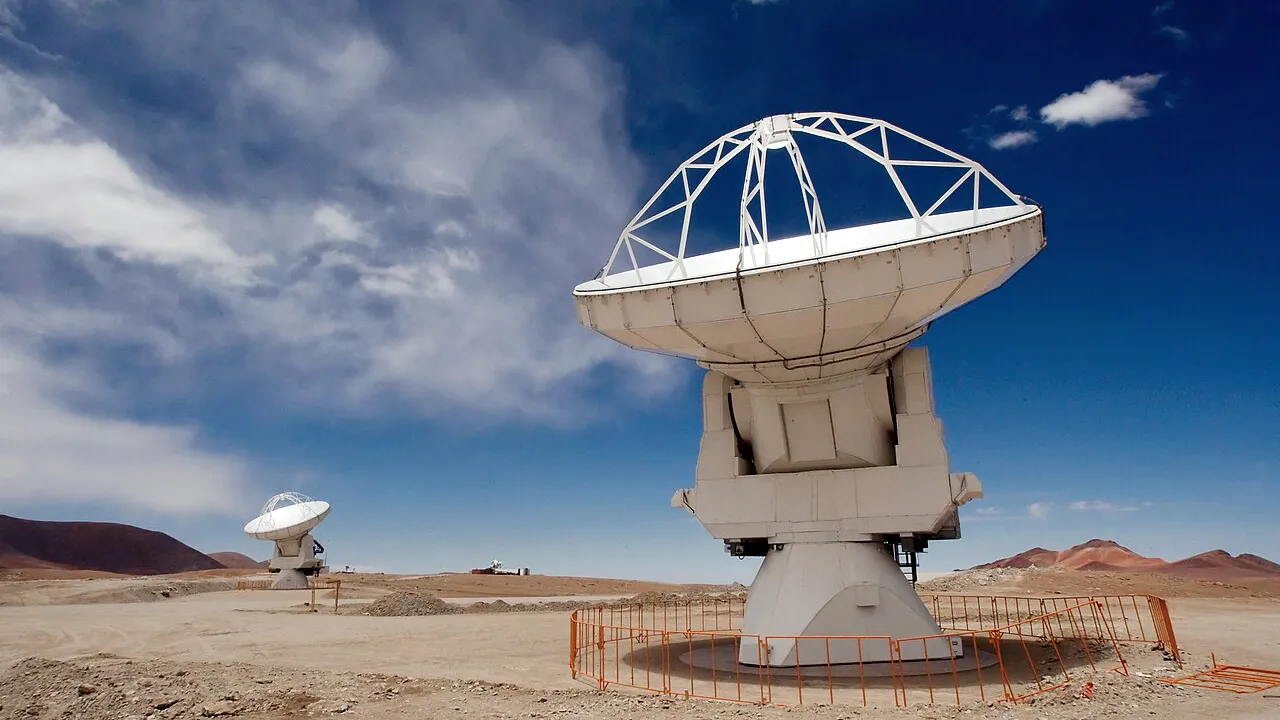
🪐 Scale / Diameter66 Precision Dish Antennas (39 ft & 23 ft Wide) • Up to 10 mi Span
☄️ Composition & OrbitMillimeter & Submillimeter Radio Waves • Ultra-Dry High Altitude
⚡ Cosmic SparkSees inside freezing dark star-birth clouds to photograph newborn planets forming
🤯 Mind-Blowing Fact • Grade 1
Two giant 28-wheel yellow trucks named Otto and Lore gently carry ALMA's heavy telescope dishes across the mountain!
✨ Word Sparks (Grade 1 Glossary)
Tap 🔊 to hear
plateau
high, flat land up in mountains
dust
tiny specks floating in deep space
ring
a round circle around a star
🪝
Why did scientists put sixty-six shiny space dishes near the top of a super dry mountain?
1
High Above the Clouds
Brrr! High in the Andes mountains of Chile sits the driest desert on Earth. Sixty-six white telescope dishes stand together there under crystal-clear skies!
2
Seeing Through Dark Dust
Space has cold, dark clouds of where baby stars hide. Regular telescopes only see black shadows, so ALMA catches special waves from cold dust.
3
Baby Planets!
Giant yellow trucks carry the dishes to new spots. Together, they snap amazing where brand-new planets are growing!
1. How many telescope antennas work together at ALMA?
2. What hides inside the cold, dark space clouds that ALMA studies?
🤯 Mind-Blowing Fact • Grade 2
At 16,570 feet high, the air at ALMA has only half the oxygen at sea level, so engineers run the telescopes remotely from a lower base camp!
✨ Word Sparks (Grade 2 Glossary)
Tap 🔊 to hear
water vapor
invisible moisture floating in the air
millimeter
tiny length about pencil-tip wide
disk
flat spinning swirl of dust and gas
🪝
What does the driest desert on Earth have to do with watching baby planets form in space?
1
Keeping Away from Water Vapor
Climb more than three miles high onto Chile's Chajnantor Plateau, and the air feels thin, freezing, and bone-dry! Scientists built the Atacama Large Array—called ALMA—way up here because moisture in normal air blocks faint millimeter waves from space.
2
Sixty-Six Dishes in Sync
Opened in 2013 by nations across the globe, ALMA links fifty-four large 39-foot dishes and twelve smaller 23-foot dishes. A supercomputer combines all sixty-six signals into one super-sharp eye.
3
Glowing Cold Universe
Even space clouds chilled hundreds of degrees below zero give off faint waves. ALMA captures those waves, revealing swirling of gas and dust around young stars!
1. Why did astronomers build ALMA high up in the super-dry Atacama Desert?
2. Why do ALMA's scientists mostly work at a lower base camp instead of up beside the dishes?
🤯 Mind-Blowing Fact • Grade 3
ALMA detected sweet simple sugar molecules floating in the gas swirling around a young Sun-like star 400 light-years away!
✨ Word Sparks (Grade 3 Glossary)
Tap 🔊 to hear
submillimeter
radio waves shorter than one millimeter
protoplanetary disk
spinning dust ring where planets form
nursery
cosmic cloud where newborn stars grow
🪝
If optical telescopes see bright hot stars, what kind of telescope sees the dark, icy nurseries where stars are born?
1
Unlocking the Cold Universe
Look at a starry photograph of the Milky Way and you will notice dark ink-black lanes cutting across the glow. Those shadows aren't empty space—they are frigid clouds of gas and dust chilled near minus 400 degrees Fahrenheit! Optical light cannot escape them, yet these clouds shine softly in millimeter and waves.
2
Global Teamwork in Chile
To catch those waves before Earth's atmospheric moisture absorbs them, Europe, North America, East Asia, and Chile teamed up to build ALMA at 16,570 feet in the Atacama Desert. Its sixty-six antennas have metal surfaces polished smoother than the thickness of a human hair!
3
Meet Otto and Lore
Two custom 130-ton yellow transporters named Otto and Lore lift the 100-ton antennas onto their backs and drive them among 192 concrete pads spread up to ten miles apart.
4
Rings of Newborn Worlds
In 2014, ALMA stunned astronomers with a crystal-clear portrait of young star HL Tauri, showing dark concentric gaps carved in a dusty disk by baby planets sweeping up material!
1. What caused the dark rings ALMA photographed inside the dusty disk around young star HL Tauri?
2. Why must ALMA's metal dish surfaces be crafted smoother than a human hair?
🤯 Mind-Blowing Fact • Grade 4
When ALMA joined the global Event Horizon Telescope network, its massive collecting area acted as the 'anchor station' that made humanity's first black hole photographs possible!
✨ Word Sparks (Grade 4 Glossary)
Tap 🔊 to hear
absolute zero
coldest possible temperature where heat stops
superconductor
material carrying electricity with zero resistance
interstellar
located in the space between stars
🪝
How can sixty-six mountain-top antennas read the chemical fingerprints of organic molecules floating light-years away?
1
Bridging Infrared and Radio Light
Between long radio waves and short infrared heat waves lies a frontier of the electromagnetic spectrum with wavelengths around one millimeter. Virtually every cold molecule floating in space—from carbon monoxide to water and complex organic compounds—tumbles end-over-end and broadcasts a signature frequency right inside this band! Built on northern Chile's 5,050-meter Chajnantor Plateau, the Atacama Large Millimeter Array opens a razor-sharp window onto this chemical cosmos.
2
Precision Under Harsh Skies
Unlike protected optical telescopes, ALMA's fifty-four 12-meter dishes and twelve closely packed 7-meter Morita Array dishes stand exposed to fierce Andean winds, ultraviolet glare, and freezing nights. Carbon-fiber support struts prevent thermal warping while superconducting receivers chilled to minus 269 degrees Celsius—just four degrees above —detect signals weaker than a billionth of a billionth of a watt.
3
Atomic Timing and Supercomputing
A hydrogen maser atomic clock synchronizes all sixty-six antennas to a trillionth of a second before optical fibers carry digitized signals to the ALMA Correlator—one of the highest-altitude supercomputers on Earth. Spreading antennas across 16 kilometers yields angular resolution ten times sharper than the Hubble Space Telescope!
4
Cosmic Chemistry to Ancient Galaxies
From mapping planet-forming dust traps and prebiotic molecules like glycolaldehyde to spotting star-forming galaxies glowing less than a billion years after the Big Bang, ALMA reveals how cold dust builds stars, worlds, and life's ingredients.
1. How do astronomers use ALMA to identify specific chemicals like carbon monoxide or sugars in distant space clouds?
2. Why are ALMA's receivers cooled to just four degrees above absolute zero?
🤯 Mind-Blowing Fact • Grade 5
Thanks to a quirk of cosmic expansion called the 'negative K-correction,' a dusty star-forming galaxy 12 billion light-years away can appear nearly as bright to ALMA as an identical galaxy 2 billion light-years away!
✨ Word Sparks (Grade 5 Glossary)
Tap 🔊 to hear
cryostat
super-insulated chamber keeping sensors near absolute zero
redshift
stretching of light wavelengths by cosmic expansion
milliarcsecond
tiny sky angle like dime across country
🪝
Why did three continents unite at 5,050 meters altitude to build a telescope sensitive to signals chilled just ten degrees above absolute zero?
1
Defeating Tropospheric Opacity
Across Earth's sea-level atmosphere, rotational transitions of water vapor and oxygen molecules act like a brick wall against cosmic radiation between 0.3 and 3.6 millimeters in wavelength. Only by ascending above half of Earth's atmosphere onto the hyper-arid Chajnantor Plateau in Chile's Atacama Desert—where annual precipitation falls below 100 millimeters—can ground observatories access submillimeter atmospheric windows. Inaugurated in March 2013 through an unprecedented partnership uniting Europe (ESO), North America (NRAO), East Asia (NAOJ), and Chile, ALMA represents the largest ground-based astronomical venture of its era.
2
Hybrid Interferometric Design
ALMA merges two complementary sub-arrays totaling 66 Cassegrain antennas engineered to 25-micrometer surface accuracy. Fifty-four 12-meter dishes reconfigurable from 150 meters out to 16 kilometers deliver 4- resolution at highest frequencies, while the Atacama Compact Array—comprising twelve 7-meter dishes plus four 12-meter total-power dishes—preserves large-scale extended emission that wide baselines alone would resolve out. Dual 28-wheel diesel-electric transporters, Otto and Lore, reposition antennas across 192 GPS-indexed concrete stations while carrying onboard power to keep liquid-helium at 4 kelvins during transit.
3
Rotational Spectroscopy and Astrochemistry
Equipped with ten modular superconductor-insulator-superconductor (SIS) receiver bands spanning 35 to 950 gigahertz, ALMA excels at rotational spectroscopy. Cold dust grains and gas molecules at 10 to 50 kelvins radiate thermal continuum and sharp spectral lines as molecules drop between quantized rotational states, mapping velocity fields via Doppler shifts and cataloging over a hundred prebiotic interstellar species—including branched carbon chains and methyl isocyanate.
4
Revolutionizing Planet Formation and High-Redshift Cosmology
Before ALMA, theorists debated how microscopic dust coalesces without spiraling rapidly into young stars. High-resolution portraits of HL Tauri and PDS 70 revealed pressure-bump rings, kinematic kinks from embedded protoplanets, and even a circumplanetary moon-forming disk! Simultaneously, cosmic expansion far-infrared dust glow from ancient galaxies straight into ALMA's millimeter sweet spot—a boon called the negative K-correction.
5
Tracing Cosmic Origins
Detecting ionized oxygen and carbon lines from galaxies over 13 billion light-years away, ALMA charts galactic assembly from cosmic dawn to modern planetary systems.