1. Why do space explorers zip into sleeping bags tied to the wall?
2. What happens to a drop of water squeezed out inside a space station?
🤯 Mind-Blowing Fact • Grade 2
Astronauts temporarily grow up to two inches taller in space because their backbone disks stretch out without Earth's gravity pressing down!
✨ Word Sparks (Grade 2 Glossary)
Tap 🔊 to hear
weightlessness
Floating freely as a spacecraft falls in orbit
spacewalk
Working outside a spacecraft in a protective suit
capsule
The crew cabin riding atop a space rocket
🪝
Why do space travelers practice fixing equipment at the bottom of a giant swimming pool on Earth?
1
Practicing Underwater First
Splash! Wearing a bulky white spacesuit, an explorer sinks into a giant indoor pool holding a full-size model of a space station. Floating underwater feels a lot like , helping an astronaut rehearse tricky repairs before rocket launch!
2
Busy Days in Orbit
Two hundred fifty miles above our heads, crews aboard the International Space Station stay busy from morning to night. They test how crystals, flames, and lettuce roots grow without gravity pulling down, helping doctors invent better medicines back home.
3
Staying Strong in Zero-G
Because floating takes almost no muscle effort, crew members strap onto special treadmills and bikes for two hours every day so their bones and hearts stay strong.
1. Why do astronauts train in spacesuits inside a giant swimming pool on Earth?
2. Why must astronauts exercise for about two hours every single day in orbit?
🤯 Mind-Blowing Fact • Grade 3
Wait—don't bring crumbly bread to space! Astronauts wrap sandwiches in soft flour tortillas instead so stray crumbs never float into air filters or someone's eye!
✨ Word Sparks (Grade 3 Glossary)
Tap 🔊 to hear
microgravity
Near-weightless conditions inside an orbiting spacecraft
Cupola
A dome-shaped space station window overlooking Earth
neutral buoyancy
Neither sinking nor rising while floating underwater
🪝
What is a spacesuit really—just fancy clothes, or a miniature one-person spacecraft?
1
Scientists, Pilots, and Teammates
Look down through the seven windows of the space station's , and whole continents glide past at five miles per second! Becoming an astronaut takes years of teamwork, combining skills from pilots, doctors, geologists, oceanographers, and engineers.
2
Wearing a Personal Spacecraft
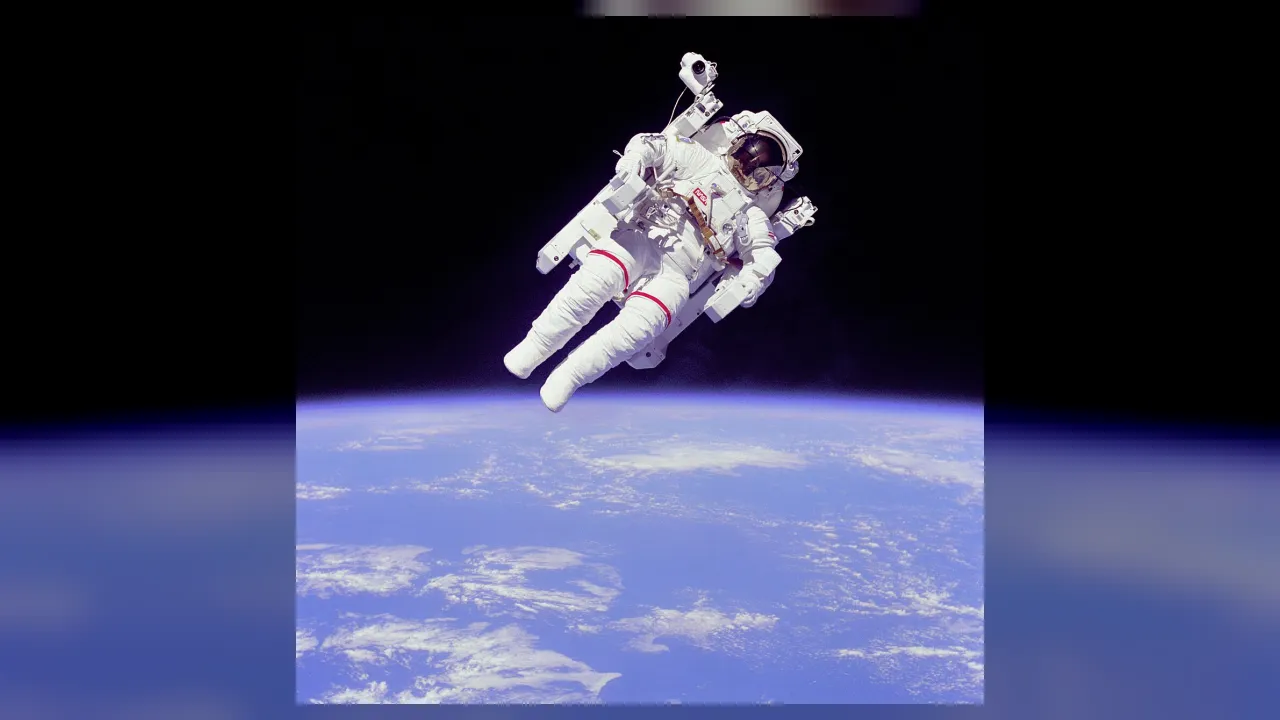
Stepping outside for an orbital repair—called a spacewalk—means facing boiling sunlight on one side and freezing shadow on the other, with zero breathable air. Each white spacesuit acts like a personal spacecraft with fourteen protective layers, pure oxygen tanks, radio headsets, and cooling water tubes woven into long underwear!
3
Microgravity Discoveries
Inside the orbiting laboratory, reveals secrets hidden on Earth. Protein crystals grow larger and cleaner in weightlessness, helping scientists design targeted treatments for diseases, while 3D printers test making tools in orbit.
4
Next Stop: Moon and Mars
Through NASA's Artemis program, today's astronauts are training in rocky desert craters to explore the Moon's south pole and prepare humanity for Mars.
1. How does a spacewalk suit keep an astronaut cool while working hard in bright sunlight?
2. Why do astronauts eat soft flour tortillas instead of crusty bread loaves?
🤯 Mind-Blowing Fact • Grade 4
The word 'astronaut' combines two ancient Greek roots—'astron' (star) and 'nautes' (sailor)—literally meaning 'star sailor'!
✨ Word Sparks (Grade 4 Glossary)
Tap 🔊 to hear
Extravehicular Activity
Scientific or repair work performed outside a spacecraft
life support
Systems providing clean air, water, and safe temperature
Mercury Seven
America's first astronaut group trained in Virginia
🪝
How did seven brave test pilots training in Hampton, Virginia, launch human spaceflight—and how has the job changed today?
1
From Virginia Hangars to Orbit
In 1959, America's first space explorers—the —reported for training right at NASA's Langley Research Center in Hampton, Virginia, practicing capsule landings in giant steel gantries. Back then, every candidate had to be a military jet test pilot. Today, an astronaut might also start out as a marine biologist, medical doctor, geophysicist, or robotics engineer!
2
Years of Intense Preparation
Once selected from thousands of applicants, astronaut candidates spend two years mastering orbital mechanics, emergency medical care, international languages, T-38 jet flying, and operating the space station's fifty-seven-foot robotic arm. Inside Houston's six-million-gallon Neutral Buoyancy Laboratory pool, pairs rehearse Extravehicular Activities (EVAs) bolt by bolt.
3
Closed-Loop Life Support
Living 250 miles up requires recycling nearly everything. Environmental life-support racks split water molecules with electricity to make fresh breathing oxygen, scrub carbon dioxide out of cabin air, and purify over ninety percent of moisture—even crew sweat—back into ultra-clean drinking water!
4
Exploring Lunar Craters Again
Modern crews also study field geology alongside volcanologists so that when lunar landers touch down near icy craters at the Moon's south pole, astronauts will know exactly which ancient rocks hold clues to the early solar system.
1. How has astronaut selection expanded since the Mercury Seven trained in Virginia in 1959?
2. Why do space station life-support systems recycle over ninety percent of cabin water?
🤯 Mind-Blowing Fact • Grade 5
Twin astronauts Scott and Mark Kelly participated in NASA's landmark Twins Study—while Scott spent 340 days in orbit and Mark stayed on Earth, scientists discovered spaceflight temporarily lengthened chromosomal telomeres and altered gene expression!
✨ Word Sparks (Grade 5 Glossary)
Tap 🔊 to hear
convection
Warm air or liquid rising under gravity's pull
bone density
How tightly minerals pack inside strong human bones
decompression
Safely adjusting pressure so nitrogen bubbles never form
🪝
What happens to human bones, eyeballs, and cells during six months of continuous free-fall—and how are astronauts solving it for Mars?
1
Humanity's Off-World Laboratory
Orbiting at 28,000 kilometers per hour in perpetual free-fall, an astronaut serves simultaneously as spacecraft operator, systems mechanic, laboratory scientist, and human test subject! Every expedition aboard the International Space Station gathers physiological and physical data vital both for deep-space exploration and for healthcare on Earth.
2
Adapting to Microgravity Physiology
Human bodies evolved under a steady 1-g downward pull. In microgravity, blood and bodily fluids shift upward toward the chest and head, sometimes subtly flattening the back of the eyeball, while weight-bearing bones can lose roughly one percent of their mineral density per month if unchallenged. Astronauts counter this using vacuum-cylinder resistive exercise machines and harnessed treadmills while tracking ultrasound scans for aerospace doctors.
3
Science Impossible on Earth
Removing buoyancy-driven and sedimentation unlocks remarkable physics. Crew members sequence DNA microbes in orbit, test fiber-optic glass manufacturing free of microscopic crystal flaws, study cool spherical flames to improve clean engine combustion, and cultivate bioprinted human tissue scaffolds that would sag under their own weight on the ground.
4
Mastering Extravehicular Operations
During grueling seven-hour spacewalks outside the station's solar truss, astronauts work inside pressurized Extravehicular Mobility Units held at roughly four-point-three pounds per square inch of pure oxygen—pre-breathing beforehand to flush nitrogen from their blood and prevent sickness, just like deep-sea divers surfacing safely. Wearing stiff pressurized gloves in 250-degree temperature swings from blazing orbital noon to pitch-black eclipse shadow, partners tether carefully to handrails while replacing solar-array batteries and cosmic-ray detectors.
5
From Low Earth Orbit to Deep Space
Venturing onward to shadowed craters at the lunar south pole and eventually to Mars—a round-trip voyage spanning more than two years and hundreds of millions of kilometers—demands unprecedented self-reliance. Astronauts are testing water-filled storm shelters against solar radiation bursts, ultrasound-guided autonomous medical care, lunar ice-drilling rovers, and closed-loop hydroponic gardens, transforming star sailors into humanity's deep-space pioneers.