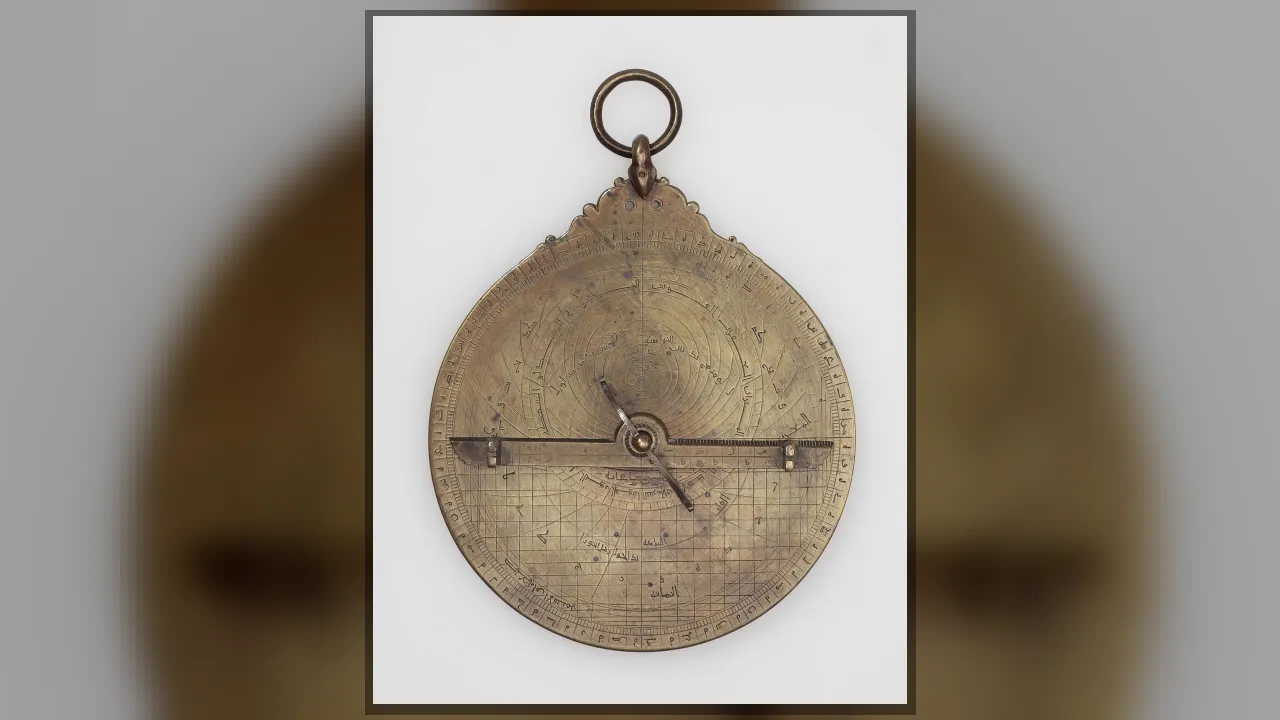
2. What could a traveler figure out by lining an astrolabe up with the stars?
🤯 Mind-Blowing Fact • Grade 2
Tenth-century astronomer Mariam al-Astrulabi crafted brass astrolabes in Syria that were prized by rulers for their beauty and accuracy!
✨ Word Sparks (Grade 2 Glossary)
Tap 🔊 to hear
horizon
The line where earth seems to meet sky
pinhole
A tiny hole for aiming light straight
astronomer
A scientist who studies stars and planets
🪝
Before wristwatches or smartphones existed, how did desert travelers know the exact minute of midnight?
1
A Pocket Computer Made of Brass
Hold a heavy brass ring by your thumb so the round disk hangs straight down toward the ground! Over a thousand years ago, this gleaming tool worked like a pocket smartphone for reading the sky.
2
Sighting the Sun or a Star
First, you turn a pointer bar on the back until a sunbeam or starlight shines neatly through two tiny . Marks along the edge tell you how high that star sits above the .
3
Spinning the Star Web
Flip it over, and you see a carved metal web full of curved pointers for famous stars. Spin that web to match your measurement, and the dial reveals the hour, sunrise time, and your place on Earth!
1. Why did you let an astrolabe hang loosely from a thumb ring before measuring?
2. Why did users let sunlight shine through two pinholes instead of looking straight at the Sun?
🤯 Mind-Blowing Fact • Grade 3
In 1391, famous English poet Geoffrey Chaucer wrote the first instruction manual in English just to teach his ten-year-old son Lewis how to use an astrolabe!
✨ Word Sparks (Grade 3 Glossary)
Tap 🔊 to hear
latitude
Distance north or south of Earth's equator
altitude
Height angle above the flat horizon
rete
Cut-out star map wheel on an astrolabe
🪝
How do you flatten the giant dome of the sky onto a brass disk no bigger than a pancake?
1
Flattening a Round Sky
Peeling an orange flat without tearing it is tough, and mapping the curved dome of night stars onto a flat plate is just as tricky! Around 150 BCE, Greek thinkers like Hipparchus figured out geometry rules to project the round sky onto a flat circle.
2
Perfected in the Golden Age
During the Islamic Golden Age from the 800s onward, scholars in Baghdad, Damascus, and Cordoba turned that Greek idea into a masterwork of science and art. Makers such as Muhammad al-Fazari and Mariam al-Astrulabi added prayer-time curves, direction finders toward Mecca, and dozens of star pointers.
3
Layers That Work Together
An astrolabe stacks snug brass parts inside a rimmed tray called the mater. Beneath a cut-out star web called the sits a swappable plate etched with sky lines for a specific city's . On the back, a rotating sighting bar called the alidade measures angles.
4
A Thousand Uses in One Disk
One Tenth-Century astronomer listed nearly a thousand problems an astrolabe could solve—from telling when dawn would break to measuring the height of a castle tower from its shadow!
1. Why did travelers swap out the flat brass plate underneath the star web when visiting a new city?
2. Besides watching stars, what earthly job could an astrolabe help engineers do?
🤯 Mind-Blowing Fact • Grade 4
Tenth-century Persian astronomer Abd al-Rahman al-Sufi wrote a 386-chapter book describing 1,000 distinct scientific calculations you could perform with a single astrolabe!
✨ Word Sparks (Grade 4 Glossary)
Tap 🔊 to hear
stereographic
Projecting a round sphere onto flat surface
ecliptic
Apparent yearly path of Sun among stars
alidade
Pivoting sighting bar used to measure angles
🪝
Why did medieval scientists carry a layered stack of brass plates everywhere like an ancient Swiss Army knife?
1
An Observatory in a Saddlebag
Suppose you are a twelfth-century navigator crossing Caravan trails from Cairo to Samarkand. You have no magnetic GPS, no mechanical clock, and no printed almanac, yet by sighting a single bright star like Vega for thirty seconds, you announce both your latitude and the exact minute before sunrise.
2
Greek Geometry Meets Islamic Craft
Mathematicians Apollonius of Perga and Hipparchus developed projection in Hellenistic Greece, discovering that circles on a sphere remain true circles when projected onto a flat plane from the South Celestial Pole. Centuries later, astronomers across the Islamic world—including al-Fazari in Baghdad, Mariam al-Astrulabi in Aleppo, and al-Zarqali in Spain—engineered universal plates, trigonometric shadow squares, and precision degree scales that spread across Europe and India.
3
Anatomy of an Analog Computer
Suspended vertically from its throne ring, the instrument uses gravity as a plumb line. Sighting a star or solar pinhole through the rear yields its altitude in degrees. On the front, a skeletal brass rete holds curved daggers marking fixed stars along with an off-center ring tracing the Sun's yearly path, the . Rotating the rete until your star's pointer touches its measured altitude curve on the underlying tympan instantly recreates the entire visible sky!
4
Adapting for Stormy Oceans
Delicate solid plates caught too much wind on pitching ship decks, so fifteenth-century Portuguese shipwrights stripped away the star maps and cast heavy pierced-wheel 'mariner's astrolabes' purely to measure solar latitude at sea.
1. Why did ocean sailors redesign the astrolabe with heavy cut-out spokes instead of solid flat plates?
2. What special geometric property makes stereographic projection work so cleanly on a brass plate?
🤯 Mind-Blowing Fact • Grade 5
The rotating hands and round dial of modern analog clocks originally copied the astrolabe—where a Sun pointer turned steadily around Earth at the center!
✨ Word Sparks (Grade 5 Glossary)
Tap 🔊 to hear
almucantar
Engraved circle showing equal height above horizon
azimuth
Compass direction angle measured along the horizon
clinometer
Instrument used to measure tilt or elevation
🪝
How could a palm-sized disk of engraved brass solve spherical trigonometry problems in seconds without writing a single equation?
1
Solving Spherical Triangles by Hand
Calculating when Sirius will set or finding local solar time from a star's altitude normally demands pages of spherical trigonometry. Yet for more than fifteen centuries, astronomers solved those equations mechanically in moments—simply by rotating one pierced brass disk across another.
2
Cross-Cultural Lineage of Discovery
Rooted in the stereographic geometry of Apollonius and Hipparchus around 150 BCE and described by Theon of Alexandria in the fourth century CE, the planispheric astrolabe flourished across the medieval Islamic world. Eighth-century scholar Muhammad al-Fazari built early Arabic models in Abbasid Baghdad, tenth-century artisan Mariam al-Astrulabi crafted intricate court instruments in Aleppo, and eleventh-century Andalusian astronomer Abu Ishaq Ibrahim al-Zarqali invented the 'safiha' universal astrolabe, which functioned at any latitude without swapping plates.
3
Mechanics of Stereographic Projection
Imagine placing a flat plane along Earth's equatorial circle and drawing straight sightlines from the South Celestial Pole through every northern star and coordinate circle. This conformal mapping preserves both angles and circular shapes. Inside the recessed brass body (mater) rests a latitude-specific plate (tympan) engraved with (altitude circles) and arcs. Pinned atop the North Celestial Pole pivot rotates the open-work rete, carrying flame-shaped star pointers and an eccentric ecliptic ring calibrated by zodiacal solar longitudes.
4
From Night Sky to Terrestrial Surveying
By measuring a celestial body's altitude angle through the rear alidade's pinnules, aligning that star pointer with its matching , and laying a rule from the center through the Sun's date on the ecliptic, an observer reads exact local time on the 24-hour limb. Flipping the instrument reveals tangent and cotangent 'shadow squares,' converting the disk into a precision for surveying fortress walls or well depths.
5
Bridge to Modern Clocks and Navigation
Astronomical clockmakers in medieval Europe modeled their earliest geared dials directly after rotating astrolabe retes, making our round 12-hour clock face a direct descendant of this ancient sky computer.