2. What kind of invisible space waves did Arecibo catch?
🤯 Mind-Blowing Fact • Grade 2
In 1992, Arecibo discovered the very first confirmed planets ever found outside our solar system, orbiting a spinning pulsar!
✨ Word Sparks (Grade 2 Glossary)
Tap 🔊 to hear
sinkhole
a natural bowl-shaped hollow in rock
radar
bouncing radio signals to map objects
asteroid
a rocky body orbiting the Sun
🪝
How do you steer a telescope when its 1,000-foot dish is built right into the ground?
1
Built Inside a Sinkhole
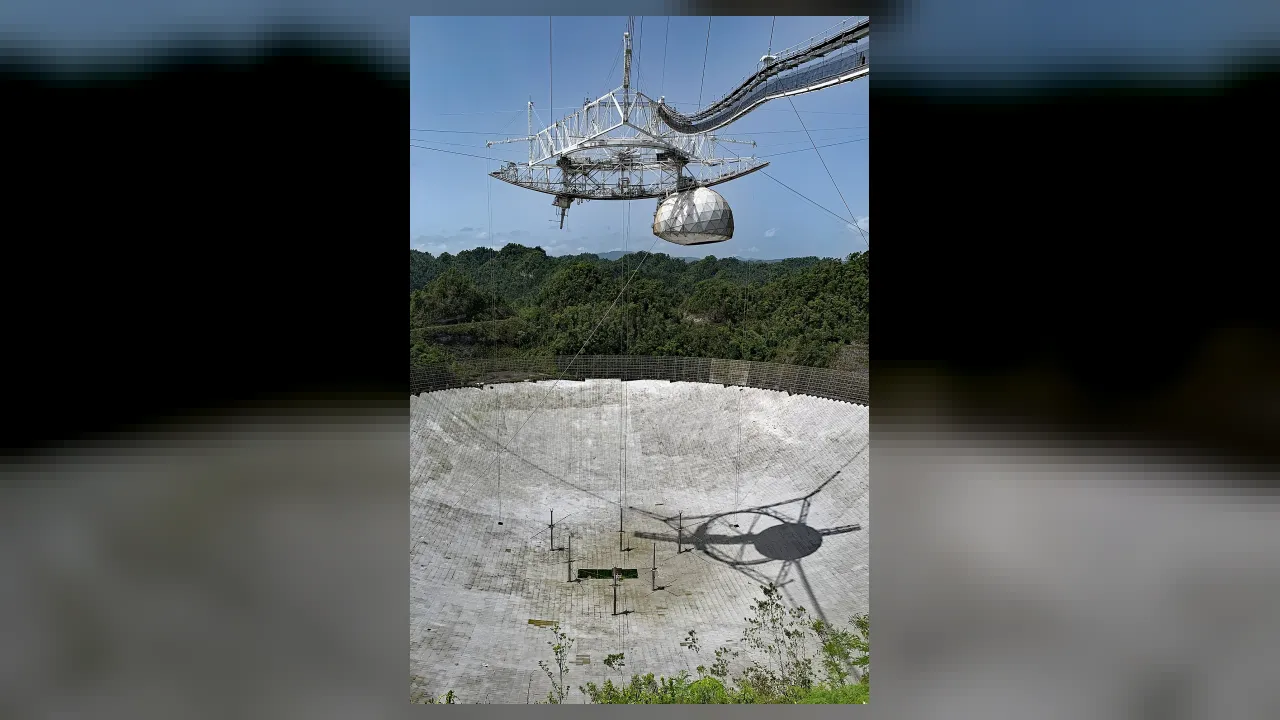
Look down from an airplane over Puerto Rico's misty hills, and for fifty-seven years you would spot a breathtaking sight! A 1,000-foot silver dish rested inside a natural limestone .
2
Moving the Receiver Above
Because the giant dish sat still in the ground, Arecibo could not tilt like a small backyard telescope. Instead, three tall concrete towers held a 900-ton platform 492 feet in the air. Motors slid the receiver along a curved track to aim at different parts of the sky!
3
Radar for Asteroids
Arecibo did more than just listen—it also beamed strong signals at passing to measure their exact shapes, speeds, and paths.
1. Since Arecibo's huge dish could not tilt, how did scientists aim it at different stars?
2. How did Arecibo help protect Earth from near-Earth asteroids?
🤯 Mind-Blowing Fact • Grade 3
Holes punched in Arecibo's aluminum panels let rain drain straight through and allowed sunlight down so native rainforest plants prevented soil erosion underneath!
✨ Word Sparks (Grade 3 Glossary)
Tap 🔊 to hear
spherical
curved evenly like a round ball
perforated
pierced with rows of tiny holes
transmitter
equipment that sends out radio signals
🪝
How did a giant dish in a tropical rainforest solve mysteries about Mercury, pulsars, and distant worlds?
1
Cradled by Karst Limestone
Deep in the tropical karst hills of northern Puerto Rico, rainwater dissolved soft limestone over millions of years to carve a nearly round bowl. Opening in 1963, the Arecibo Observatory lined that natural hollow with 38,778 aluminum panels spanning 1,000 feet across—holding the record as Earth's largest single-dish telescope for more than five decades!
2
A Spherical Mirror Trick
Most satellite dishes are shaped like parabolas that focus waves to one fixed spot. Arecibo's dish was shaped like part of a sphere! That clever geometry meant radio waves from many sky angles focused along an overhead curve, where movable antennas glided beneath a 900-ton suspended platform.
3
Breakthroughs Across Space
Just a year after opening, Arecibo bounced radar off Mercury and proved the scorching planet rotates once every 59 days—not 88 days as textbooks claimed! Later, astronomers Russel Hulse and Joseph Taylor used Arecibo to find the first binary pulsar, winning a Nobel Prize.
4
The Famous 1974 Broadcast
In 1974, Arecibo's powerful megawatt beamed a 1,679-bit binary radio greeting—the Arecibo Message—toward 300,000 stars in cluster M13.
1. What textbook mistake about the planet Mercury did Arecibo's radar fix in 1964?
2. Why did engineers punch tiny holes in all 38,778 aluminum dish panels?
🤯 Mind-Blowing Fact • Grade 4
Arecibo's planetary radar revealed water ice hiding inside permanently shadowed craters at the poles of scorching-hot Mercury!
✨ Word Sparks (Grade 4 Glossary)
Tap 🔊 to hear
ionosphere
charged upper layer of Earth's atmosphere
binary pulsar
a pulsar orbiting a companion star
azimuth
compass direction measured around the horizon
🪝
How could one stationary dish in Puerto Rico test Einstein's theory of gravity AND map tumbling asteroids millions of miles away?
1
Engineering an Icon in the Hills
High above a lush Puerto Rican sinkhole, three reinforced concrete towers—the tallest rising 365 feet—anchored eighteen thick steel cables supporting a triangular 900-ton instrument platform 492 feet above a gleaming 305-meter spherical reflector. Conceived by Cornell University physicist William E. Gordon in the late 1950s to study Earth's upper , the Arecibo Observatory quickly evolved into humanity's premier multi-purpose radio, radar, and atmospheric laboratory.
2
Correcting Spherical Aberration
Because a spherical dish focuses parallel radio waves along a vertical line rather than a single point, engineers first used long hanging line feeds, and in 1997 added a 90-foot dome called the Gregorian reflector. Inside that suspended dome, secondary and tertiary mirrors focused faint signals from billions of light-years away with razor-sharp sensitivity while rolling along a rotating arm to track objects up to twenty degrees from directly overhead.
3
Pulsars, Exoplanets, and Planetary Defense
In 1974, Russell Hulse and Joseph Taylor discovered PSR B1913+16, two dense neutron stars whipping around each other every 7.75 hours. Over years of timing its radio ticks, they proved the orbit was shrinking at the exact rate Albert Einstein's general relativity predicted for escaping gravitational waves! Eighteen years later, Aleksander Wolszczan and Dale Frail timed another millisecond pulsar at Arecibo to uncover the first confirmed exoplanets in history.
4
End of an Era
After weathering hurricanes, earthquakes, and decades of tropical humidity, aging support cables snapped in late 2020, causing the historic platform to collapse—yet Arecibo's vast data archive still powers discoveries today.
1. What major prediction of Einstein's general relativity did Hulse and Taylor confirm using Arecibo's binary pulsar?
2. What upgrade inside a 90-foot hanging dome boosted Arecibo's sensitivity in 1997?
🤯 Mind-Blowing Fact • Grade 5
Because 1,679 is the product of two prime numbers—73 rows by 23 columns—scientists designed the 1974 Arecibo Message so any mathematically minded civilization could arrange its bits into a picture showing DNA, a human figure, and the telescope itself!
✨ Word Sparks (Grade 5 Glossary)
Tap 🔊 to hear
delay-Doppler
radar mapping using echo timing and frequency
cryogenic
chilled to ultra-low temperatures reducing electronic noise
karst
limestone landscape sculpted into sinkholes and caves
🪝
How did a Cold War ionospheric radar nestled in tropical karst topography become one of history's most productive astrophysical engines?
1
From Ionospheric Scatter to Cosmic Titan
When Cornell engineer William E. Gordon proposed building a 305-meter (1,000-foot) reflector in the late 1950s, his immediate goal was incoherent scatter radar—measuring electron densities in Earth's ionosphere hundreds of kilometers overhead. Geologists scouted limestone terrain near Arecibo, Puerto Rico, located at 18 degrees north latitude where solar-system planets pass directly overhead along the ecliptic. Completed in November 1963 across 20 acres of perforated aluminum mesh accurate to millimeters, Arecibo combined three scientific disciplines under one dish: passive radio astronomy, upper-atmospheric aeronomy, and active megawatt planetary radar.
2
Optics of a Fixed Spherical Reflector
Unlike steerable paraboloids limited to roughly 100 meters by structural sag under gravity, a stationary spherical bowl distributes its weight directly into bedrock. Furthermore, any axis passing through the sphere's center of curvature behaves identically, allowing engineers to steer the telescope's beam up to 19.7 degrees from zenith simply by slewing feed antennas along a bowed azimuth arm suspended 150 meters above the primary surface. The 1997 Gregorian dome upgrade replaced narrow-band line feeds with dual sub-reflectors and receivers cooled near absolute zero, vastly expanding spectral bandwidth for neutral hydrogen surveys of distant galaxies.
3
Relativistic Laboratories and Pulsar Planets
Arecibo's sheer collecting area—73,000 square meters—made it unmatched at timing faint, rapid radio pulses from neutron stars. In 1968 it clocked the 33-millisecond spin of the Crab Nebula pulsar, cementing proof that pulsars are magnetized neutron stars rather than pulsating white dwarfs. Six years later came PSR B1913+16, whose orbital decay of 76.5 microseconds per year verified quadrupole gravitational radiation to within fractions of a percent. Then in 1992, microsecond timing residuals in pulsar PSR B1257+12 unveiled three rocky-mass worlds—including one tiny moon-mass body—four years before astronomers detected the first exoplanet around a Sun-like star.
4
Planetary Radar and the 1974 Interstellar Broadcast
Equipped with a 20-trillion-watt effective isotropic S-band radar transmitter, Arecibo reconstructed three-dimensional shape models of potentially hazardous near-Earth asteroids like Bennu (guiding NASA's OSIRIS-REx sample mission), revealed hydrocarbon seas beneath Titan's haze, and transmitted Frank Drake and Carl Sagan's famous 1,679-bit pictorial message toward globular cluster M13, 25,000 light-years away.
5
Collapse and Enduring Scientific Heritage
Following Hurricane Maria, seismic tremors, and progressive zinc-socket fatigue, cable failures brought the 900-ton platform crashing down on December 1, 2020—yet petabytes of archived NANOGRAV pulsar-timing and ALFALFA galaxy-survey records continue fueling discoveries worldwide.