🪐 Scale / Diameter22 million mi (35 million km) diameter • 25.4× Sun's width • 1.08 solar masses
☄️ Composition & Orbit170× Sun-luminous ancient giant • Dives through our Milky Way disk at 273,000 mph
⚡ Cosmic SparkBrightest star in the northern half of Earth's sky and an ancient 7-billion-year-old cosmic speedster
🤯 Mind-Blowing Fact • Grade 1
Light from Arcturus traveled for 40 years to turn on the electric floodlights of the 1933 Chicago World's Fair!
✨ Word Sparks (Grade 1 Glossary)
Tap 🔊 to hear
arc
A smooth curved line like a rainbow
amber
Warm golden-orange color like sweet honey
Big Dipper
Seven bright stars shaped like a ladle
🪝
How can the curved handle of the Big Dipper lead you straight to a bright golden star?
1
Follow the Curved Handle
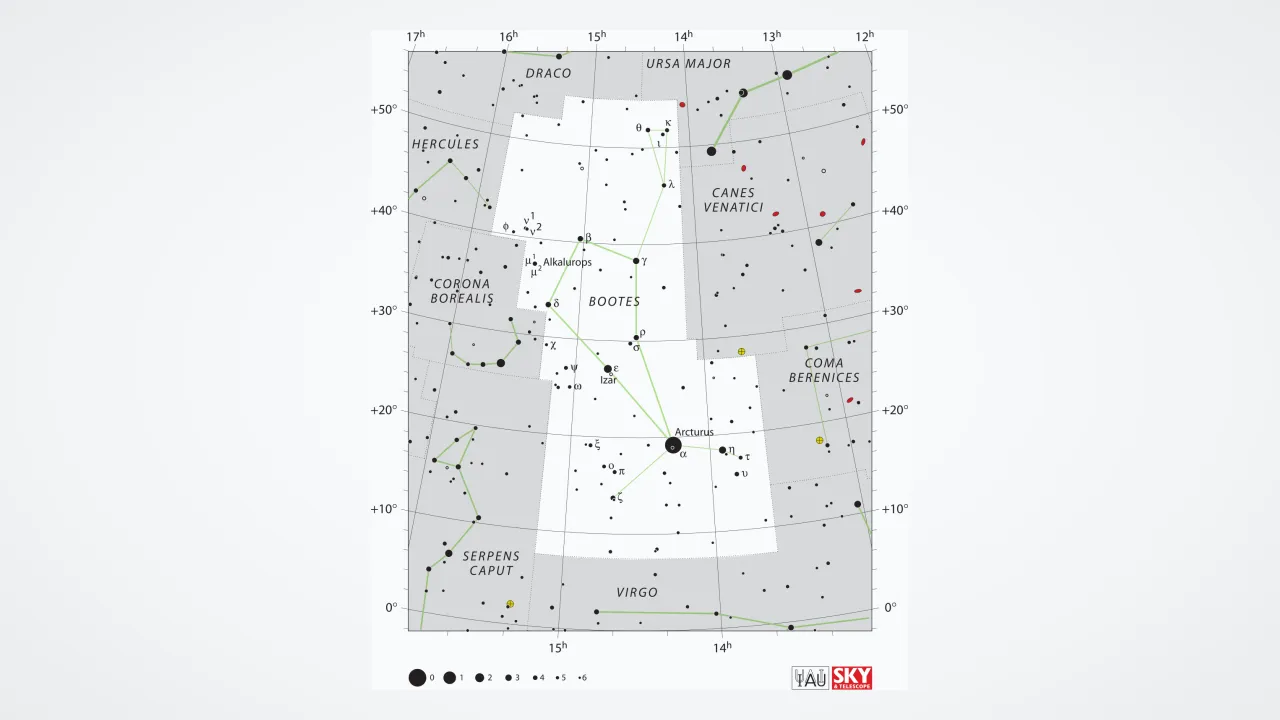
Step outside on a warm spring night and find the ! Trace the curved of its handle across the sky. Remember the fun rhyme 'Arc to Arcturus,' and you will land on a bright golden-orange star!
2
Northern Sky Champion
In the whole northern half of the sky, no star shines brighter than this warm lantern!
3
Zooming Fast Through Space
Even though it looks still tonight, this old giant star zooms past our neighborhood super fast!
1. What easy sky rhyme helps stargazers find Arcturus using the Big Dipper's handle?
2. What brightness crown does Arcturus wear in the northern half of Earth's sky?
🤯 Mind-Blowing Fact • Grade 2
Arcturus was the very first nighttime star ever spotted during broad daylight through a telescope—by French astronomer Jean-Baptiste Morin way back in 1635!
✨ Word Sparks (Grade 2 Glossary)
Tap 🔊 to hear
Boötes
Kite-shaped spring constellation holding bright Arcturus
light sensor
Device turning incoming light into electric current
daylight
Bright daytime sky lit by our Sun
🪝
How did starlight from trillions of miles away flip the power switch for a giant World's Fair?
1
Starlight Opens the 1933 World's Fair
On opening night of the 1933 Chicago World's Fair, organizers wanted a science-powered way to switch on the fairground lights! Because the previous Chicago World's Fair had taken place 40 years earlier in 1893—and astronomers then estimated Arcturus sat 40 light-years away—telescopes focused its golden beam onto to flip the master switch!
2
Guardian of the Bear
Shining today at a refined measurement of 36.7 light-years away in the Herdsman, this orange giant's Greek name means 'Guardian of the Bear' because it trails right behind Ursa Major, the Great Bear.
3
Older Than Earth and the Sun
At over seven billion years old, ancient Arcturus formed billions of years before Earth or our Sun even existed!
1. Why did organizers of the 1933 Chicago World's Fair choose starlight from Arcturus to turn on the lights?
2. Roughly how old is Arcturus compared with our 4.6-billion-year-old Sun?
🤯 Mind-Blowing Fact • Grade 3
Arcturus moves across Earth's sky so fast that every 800 years it shifts by the full width of the Moon—fast enough that ancient Hawaiian navigators named it Hōkūleʻa, the 'Star of Gladness,' steering straight over Hawaii!
✨ Word Sparks (Grade 3 Glossary)
Tap 🔊 to hear
stellar stream
Group of stars sharing an unusual galaxy path
Hōkūleʻa
Hawaiian name for Arcturus—Star of Gladness
galactic disk
Flat spinning pancake of stars in Milky Way
🪝
Why is bright Arcturus diving sideways across our Milky Way instead of cruising along with our Sun?
1
Traffic Rebel in the Galaxy
Most neighbor stars near our Sun orbit calmly around the Milky Way's center like cars cruising in the same highway lane. Not Alpha Boötis! Located 36.7 light-years away, golden Arcturus plunges steeply downward through the Milky Way's flat disk at a blistering 273,000 miles per hour (122 km/s) relative to our Sun!
2
Traveling With the Arcturus Stream
Even better, Arcturus isn't diving alone! Over fifty other ancient, low-iron stars share its steep, speedy path—a moving family called the Arcturus Stream that may have come from an ancient dwarf galaxy swallowed by our Milky Way billions of years ago or been kicked outward by galactic waves.
3
Twenty-Five Suns Wide
Weighing nearly the same as our Sun (1.08 solar masses), this 7.1-billion-year-old elder puffed into a 22-million-mile-wide red giant shining 170 times brighter than our Sun.
4
Just Passing Through!
Right now Arcturus is near its closest swoop past our Solar System; inside half a million years it will zoom too far south and dim to see without binoculars!
1. How does Arcturus's motion through the Milky Way differ from our Sun's calm orbit?
2. Why did Polynesian voyagers call Arcturus Hōkūleʻa ('Star of Gladness')?
🤯 Mind-Blowing Fact • Grade 4
Humans live at a super lucky cosmic moment: speedy Arcturus only became visible to unaided eyes ~500,000 years ago and will zoom out of naked-eye sight again in another ~500,000 years!
✨ Word Sparks (Grade 4 Glossary)
Tap 🔊 to hear
alpha elements
Oxygen, magnesium, silicon forged in massive supernovae
thick disk
Older, puffed-up star layer wrapping Milky Way
zenith star
Star passing straight overhead at specific latitude
🪝
Could the brightest star in the northern sky actually be a cosmic immigrant from another galaxy swallowed billions of years ago?
1
Chemical Clues of an Ancient Origin
When astronomers split golden starlight from Alpha Boötis (-0.05 visual magnitude, fourth-brightest star in Earth's night sky) through a high-resolution spectrograph, its chemical recipe tells a fascinating backstory. Arcturus contains only about one-third as much iron as our Sun, yet holds extra supplies of '' like oxygen, magnesium, and silicon forged in ancient core-collapse supernovae! That chemical fingerprint proves Arcturus formed ~7.1 billion years ago in an ancient environment before Type Ia white-dwarf supernovae enriched the Milky Way with extra iron.
2
Immigrant Galaxy or Galactic Bar Resonance?
In 1971, astronomer Olin Eggen identified dozens of fellow metal-poor stars slicing steeply across the solar neighborhood alongside Arcturus at ~122 km/s. For years, astrophysicists suspected this 'Arcturus Stream' was the shredded fossil of a satellite dwarf galaxy cannibalized by our young Milky Way—though recent Gaia data also tests whether resonant gravitational kicks from the Milky Way's spinning central bar flung ancient thick-disk stars outward!
3
First Non-Solar Star With Measured X-Rays? Surprisingly Quiet!
Unlike our magnetically active Sun, bloated 25.4-solar-radius Arcturus buries its magnetic activity deep inside a cool stellar wind—emitting barely a ten-thousandth of a typical star's X-rays until hypersensitive Chandra exposures caught a whispers-faint X-ray glow!
4
Brief Encounter in Cosmic Time
Passing closest to our Sun right about now in cosmic terms, Arcturus crossed within naked-eye visibility only half a million years ago and will fade below naked-eye view half a million years hence.
1. What chemical clue in Arcturus's light shows it formed over seven billion years ago?
2. Why won't stargazers ten million years in the future see Arcturus shining brightly in Boötes?
🤯 Mind-Blowing Fact • Grade 5
Since ancient astronomer Ptolemy charted the stars 1,900 years ago, speedy Arcturus has raced across Earth's sky by more than two full Moon widths—faster than any other solitary bright star!
✨ Word Sparks (Grade 5 Glossary)
Tap 🔊 to hear
galactic archaeology
Reconstructing Milky Way history from ancient star chemistry
coronal dividing line
Boundary separating X-ray-hot stars from cool-wind giants
arcsecond
Tiny angle—one thirty-six-hundredth of single degree
🪝
How do iron-deficient alpha-enhanced spectra, 2.3-arcsecond-per-year proper motion, and non-coronal wind physics make Alpha Boötis the Rosetta Stone of ancient red giants?
1
Daylight Discovery, Halley's Proper Motion, and Photometric Rank
Shining at apparent visual magnitude −0.05 from 36.7 light-years (11.26 parsecs) in Boötes, Arcturus outshines every star north of the celestial equator—ranking fourth overall behind Sirius, Canopus, and the combined glare of Alpha Centauri AB. After Jean-Baptiste Morin achieved history's first daytime telescopic observation of a nighttime star on Arcturus in 1635, Edmond Halley discovered in 1718 that Arcturus had plunged a full degree—twice the Moon's diameter!—southward since Ptolemy's Almagest. Indeed, at 2.28 per year across the sky and 122 km/s space velocity relative to the Sun, Arcturus outpaces every other first-magnitude star besides nearby Alpha Centauri.
2
Spectroscopic Atlas Benchmark for Metal-Poor Giants
Classified specifically as K1.5IIIFe−0.5, Arcturus serves as astrophysics' premier high-signal-to-noise spectral reference for evolved cool giants—rivaled in line-by-line atlas resolution only by our Sun! With iron abundance [Fe/H] ≈ −0.52 (~30% solar) alongside enhanced [α/Fe] ≈ +0.3–0.4 ratios of oxygen, magnesium, silicon, and titanium, its ~7.1-billion-year-old, 1.08-solar-mass bulk preserves pristine nucleosynthetic yields from early Type II core-collapse supernovae.
3
Galactic Archaeology of the Arcturus Moving Group
Kinematics place Arcturus on an eccentric galactic orbit plunging steeply across the midplane at ~100+ km/s lag behind local circular rotation. Whether Olin Eggen's Arcturus moving group represents tidal debris accreted from an ancient disrupted dwarf satellite or a dynamical phase-space ridge sculpted by resonant perturbations from the Milky Way's central bar and spiral arms remains a vibrant testbed for Gaia .
4
Crossing the Linsky-Haisch Coronal Dividing Line
Spanning 25.4 solar radii (~35.3 million km) at ~4,286 kelvins and radiating ~170 bolometric solar luminosities—powered either near the tip of the hydrogen-shell red-giant branch or on the core-helium-burning horizontal clump—Arcturus sits coolward of the Linsky-Haisch ',' trading million-degree magnetic X-ray loops for a cool, Alfvén-wave-driven chromospheric wind.
5
Periastron Flyby Past the Sun
Having passed within ~4,000 astronomical units of its closest 36.6-light-year solar approach just a few millennia ago, Arcturus now recedes steadily southward toward Virgo on its multi-billion-year galactic trek.