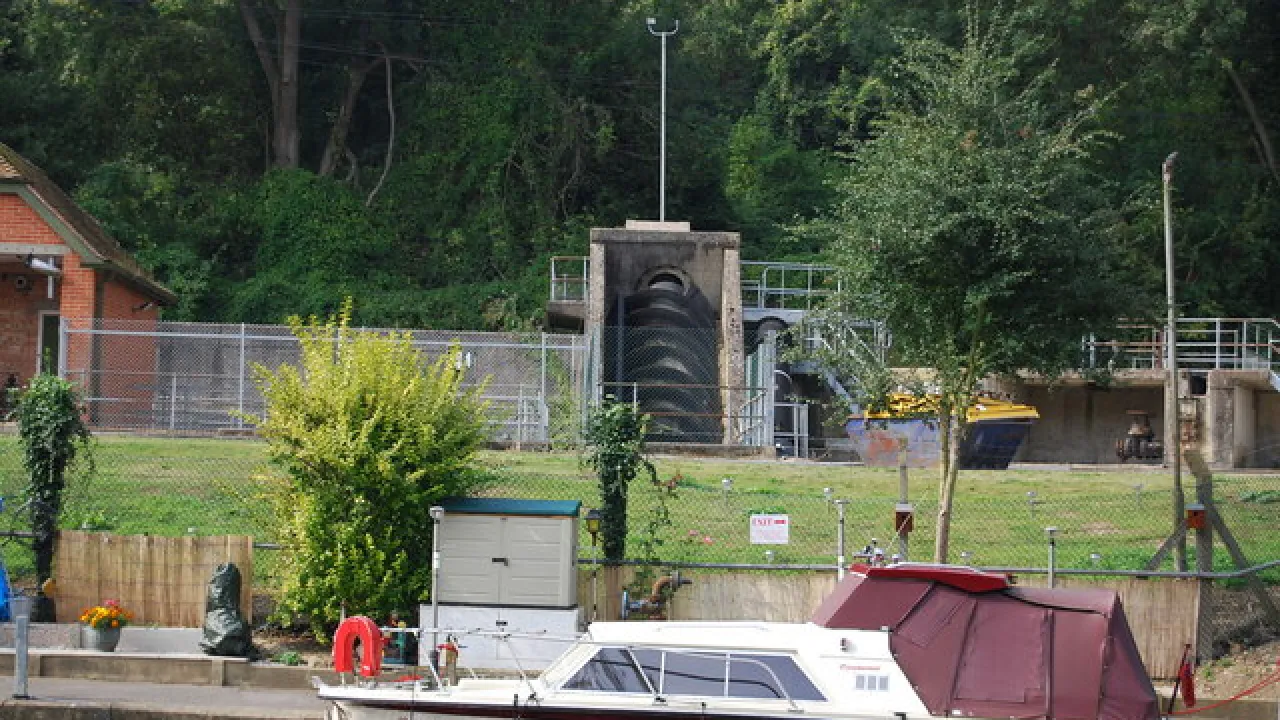
1. What shape hides inside the slanted tube to lift water up?
2. Besides lifting river water, what else do modern farm machines move with spinning spirals?
🤯 Mind-Blowing Fact • Grade 2
Fisheries and zoos love Archimedes' screws because swimming fish can ride right up inside the calm pockets of water without getting bumped!
✨ Word Sparks (Grade 2 Glossary)
Tap 🔊 to hear
corkscrew
Twisting spiral shape like a spring
irrigate
Bring water through channels to dry crops
valve
Flap gate controlling one-way liquid flow
🪝
How did one clever inventor bail leaky seawater out of the biggest wooden ship of the ancient world?
1
Saving a Giant Royal Ship
Creak, slosh! Over two thousand years ago in Sicily, King Hieron II built a palace-sized wooden ship so huge that seawater leaked constantly into the bottom hold. Hauling heavy buckets up ladders wore out whole crews—until inventor Archimedes stepped aboard!
2
Gravity Helps Water Climb!
Archimedes built a tilted wooden tube wrapped internally around a -shaped blade. Oddly enough, the water never climbs up by itself—each pocket of water actually sits at the bottom of its curved loop while the spinning spiral pushes that loop uphill!
3
Never Clogs With Mud
Because it has zero tiny to jam, towns still use giant steel versions to pump muddy floodwater, leaves, and even live fish safely without harm!
1. Why did King Hieron II ask Archimedes for help with his giant wooden ship?
2. Why can fish ride safely inside a spinning Archimedes' screw pump without getting hurt?
🤯 Mind-Blowing Fact • Grade 3
In 2001, engineers used an Archimedes' screw in reverse—sucking soggy soil carefully out from underneath Italy's Leaning Tower of Pisa to keep the famous tower from toppling over!
✨ Word Sparks (Grade 3 Glossary)
Tap 🔊 to hear
helix
Three-dimensional spiral winding around a cylinder
tambour
Traditional Egyptian hand-cranked wooden water screw
auger
Spiral screw tool that moves soil or grain
🪝
How can gravity—the exact force that pulls water downhill—be tricked into pushing water uphill?
1
Follow One Marble on a Corkscrew!
Picture dropping a marble into a clear plastic tube coiled around a slanted broomstick. Gravity pulls the marble to the lowest dip of the bottom loop. Now slowly twist the stick: the marble keeps rolling toward the bottom of its loop, yet the loop itself slides steadily up the stick!
2
Along the Nile and in Ancient Assyria
Greek mathematician Archimedes of Syracuse made this machine famous around 250 BCE during a visit to Egypt, where farmers still turn wooden hand-screws called to lift Nile water onto fields. Historians have even found bronze clues suggesting earlier screw pumps watered royal gardens in ancient Assyria four hundred years before Archimedes!
3
Why the Tilt Angle Matters
Set the tube completely upright like a flagpole, and no bottom pockets form—all the water just splashes back down! Engineers tilt the cylinder around 30 to 38 degrees so deep crescent-shaped pockets trap plenty of water on every turn.
4
Pumping Marshes and Chocolate
From draining Dutch lowlands in the 1600s to moving melted chocolate in candy factories and snow in snowblowers, this simple works everywhere!
1. What happens if you stand an Archimedes' screw straight up vertically at 90 degrees instead of tilting it?
2. How did engineers help stabilize the famous Leaning Tower of Pisa using Archimedes' idea?
🤯 Mind-Blowing Fact • Grade 4
Archaeologists exploring ancient Roman copper and silver mines in Rio Tinto, Spain, found preserved 2,000-year-old wooden Archimedes' screws stacked like staircases to lift groundwater up step by step!
✨ Word Sparks (Grade 4 Glossary)
Tap 🔊 to hear
positive displacement
Moving trapped fixed pockets on each turn
flight
One continuous helical blade wrapped around shaft
impeller
Fast-spinning bladed rotor inside modern pumps
🪝
What happens when you pour a river DOWN into the top of an Archimedes' screw instead of cranking water up?
1
Running Ancient Genius in Reverse!
For twenty-two centuries, people cranked spiral screws to lift water uphill. Then modern clean-energy engineers asked a brilliant 'what if': what if river water poured into the top of a giant steel screw? Gravity pushes the spiral blades around, spinning an electric generator while letting migrating salmon swim right through unharmed!
2
Sennacherib, Archimedes, and Roman Mines
Cuneiform inscriptions from King Sennacherib of Assyria around 700 BCE describe casting bronze spirals inside cedar trunks to water palace terraces in Nineveh. Around 250 BCE, Greek polymath Archimedes mathematically perfected the helical screw in Alexandria and Syracuse, and Roman architect Vitruvius recorded exact construction blueprints using eight strips of willow pitched around an oak core sealed in pitch. Roman miners lined up chains of foot-powered wooden screws deep underground in Spain to pump flooded silver mines dry!
3
Positive-Displacement Reliability
Centrifugal pumps spin at thousands of revolutions per minute and choke instantly if rags, branches, or gravel enter the intake. An Archimedes' screw is a 'positive-displacement' lifter: turning slowly in an open semicircular concrete trough at 20 to 40 revolutions per minute, each helical carries whatever enters—stormwater, twigs, slush, or grain—smoothly to the top regardless of flow changes.
4
Inside Plastic Factories and Combine Harvesters
Look inside a 3D-printer filament extruder, injection-molding machine, meat grinder, or snowblower, and you will find Archimedes' helical geometry pushing thick materials forward.
1. Why do city storm-flood and wastewater plants rely on giant steel Archimedes' screws instead of fast propeller pumps?
2. What happens when river water flows downward through an Archimedes' screw connected to a generator?
🤯 Mind-Blowing Fact • Grade 5
Heart surgeons implant tiny titanium cousins of Archimedes' screw—no bigger than an AA battery—inside patients' chests as ventricular assist pumps that gently move blood without needing mechanical heart valves!
✨ Word Sparks (Grade 5 Glossary)
Tap 🔊 to hear
hydrostatic
Relating to pressure exerted by resting fluids
extrusion
Pushing softened material through a shaped nozzle
bilge
Lowest inner hull compartment where water collects
🪝
How does the geometry of a cylindrical helix balance tilt angle, pitch, and blade count to move massive volumes at over 80 percent efficiency?
1
Geometry That Defies Intuition
Watch an open-trough steel Archimedes' screw lifting 5,000 liters of floodwater per second at a Dutch polder station, and your eyes play a trick: water appears to climb a spinning ramp. In reality, no fluid parcel ever climbs over a blade crest; instead, gravity holds each crescent-shaped 'bucket' of water at its local potential-energy minimum while rotation translates that geometric trough axially upward along the inclined shaft!
2
Assyrian Bronze, Hellenistic Math, and Dutch Polders
While Assyriologist Stephanie Dalley traced cast-bronze water-lifting screws back to King Sennacherib's seventh-century BCE palace gardens at Nineveh, Syracuse mathematician Archimedes (c. 287–212 BCE) formulated the geometry of helices and spirals during studies in Alexandria and engineered pumps for King Hieron II's 4,000-ton ship Syracusia. Vitruvius documented eight-bladed timber screws tilted at a 3-4-5 Pythagorean triangle slope (~36.9 degrees), a blueprint Roman engineers deployed in underground relays across Iberian mines. Centuries later in 1634, Dutch millwright Symon Hulsbos coupled wind-driven crown gears to open wooden 'vijzel' screws, tripling the lifting height of single drainage windmills to four meters!
3
Optimization of Slope, Pitch, and Flight Number
Mathematical optimization—refined as recently as the 2000s by mathematician Chris Rorres—shows that volumetric capacity depends on four coupled ratios: outer radius R, inner shaft radius r (ideally r/R near 0.54), helical pitch Lambda, number of intertwined blades N (typically two or three flights in modern steel screws), and installation tilt angle beta (usually 22 to 38 degrees). If tilt beta exceeds the helix angle of the outer rim, isolated pockets vanish and water cascades backward; within the sweet spot, open-trough screws achieve 75 to 85 percent mechanical efficiency across wildly varying inflow depths without priming or suction limits.
4
Rheology, Extrusion, and Reversible Hydro Power
Because shear forces inside helical channels remain gentle and predictable, polymer engineers use heated Archimedes' screws to melt and meter thermoplastics in injection molders and 3D printers, while biomedical engineers build miniature magnetically levitated axial screw pumps as gentle artificial hearts (LVADs) that propel blood without crushing fragile red blood cells!
5
Clean Micro-Hydro on Low-Head Rivers
Operated in reverse across low one-to-five-meter river weirs since the 1990s, hydrodynamic Archimedes' screw turbines convert pressure on each blade face into smooth torque at ~85% efficiency—allowing eels, trout, and sediment to pass downstream unharmed.