1. What was the name of the lunar lander that carried Neil Armstrong and Buzz Aldrin down to the Moon?
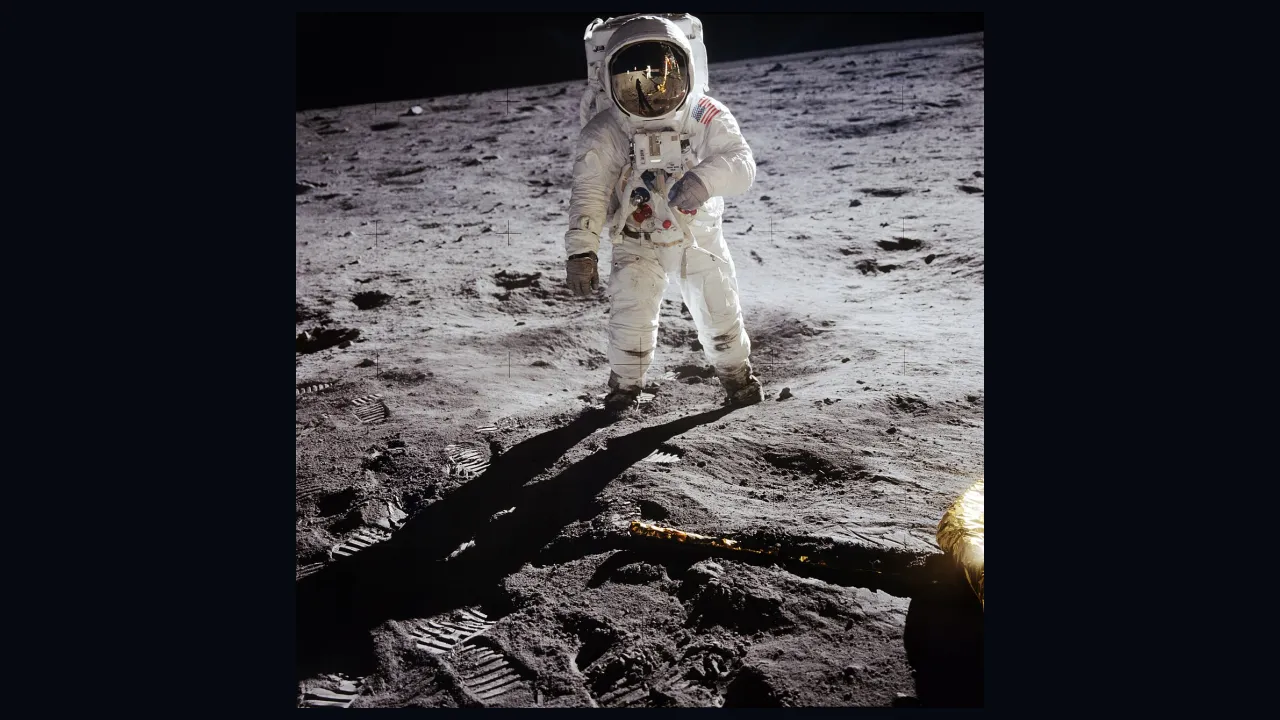
2. Why are the Apollo 11 bootprints still on the Moon decades later?
🤯 Mind-Blowing Fact • Grade 2
Scientists on Earth still bounce laser beams off a special mirror left on the Moon by Apollo 11 to measure the Moon's exact distance within millimeters!
✨ Word Sparks (Grade 2 Glossary)
Tap 🔊 to hear
Saturn V
giant three-stage Moon rocket built by NASA
capsule
cone-shaped crew cabin for space travel
boulder
large heavy rock on the ground
🪝
How did three astronauts fly 240,000 miles to walk on another world for the first time?
1
Taller Than the Statue of Liberty
Imagine standing miles away and still feeling the ground shake under your shoes! On July 16, 1969, a 363-foot rocket blasted Neil Armstrong, Buzz Aldrin, and Michael Collins off toward the Moon.
2
Dodging Boulders at the Last Second
Four days later, Michael Collins orbited overhead in Columbia while Armstrong and Aldrin steered the spidery lander Eagle downward. Spotting sharp ahead, Armstrong flew Eagle by hand to a smooth spot with less than thirty seconds of landing fuel left!
3
One Giant Leap
Hundreds of millions of people watched live on television as Armstrong stepped onto the Sea of Tranquility, collected ancient Moon rocks, and set up science gear!
1. What job did astronaut Michael Collins do while Armstrong and Aldrin walked on the Moon?
2. Why did Neil Armstrong take manual control of Eagle right before touching down?
🤯 Mind-Blowing Fact • Grade 3
With Moon gravity six times weaker than Earth's, an astronaut's 180-pound spacesuit and backpack felt like carrying just 30 pounds on the Moon!
✨ Word Sparks (Grade 3 Glossary)
Tap 🔊 to hear
seismometer
sensor that measures ground shakes and quakes
basalt
dark volcanic rock cooled from lava
dock
link two spacecraft tightly in space
🪝
How did smart computer code save the Apollo 11 Moon landing when warning alarms started flashing?
1
A Four-Day Voyage Across Space
Picture riding atop 7.5 million pounds of fiery rocket thrust! Launched from Florida on July 16, 1969, Apollo 11 coasted nearly a quarter-million miles before slipping into orbit around the Moon. Two spacecraft traveled nose-to-nose: the cone-shaped Command Module Columbia and the four-legged Lunar Module Eagle.
2
Computer Alarms During Descent
On July 20, as Eagle swooped down toward the flat Sea of Tranquility, loud '1202' computer alarms flashed in the cabin! Extra radar signals were flooding the tiny guidance computer. Thankfully, software team leader Margaret Hamilton had programmed smart priority rules: the computer automatically dropped minor tasks and kept flying the landing!
3
Science on the Sea of Tranquility
For two and a half hours outside in one-sixth Earth gravity, Armstrong and Aldrin deployed a moonquake , a laser reflector, and a solar-wind collector, packing 47.5 pounds of volcanic Moon .
4
Fiery Reentry and Splashdown
Blasting off the Moon's surface, Eagle docked with Columbia, and all three heroes parachuted safely into the Pacific Ocean on July 24!
1. How did Margaret Hamilton's computer software save Eagle when '1202' overload alarms went off?
2. How strong is gravity on the Moon compared to Earth?
🤯 Mind-Blowing Fact • Grade 4
Laser pulses bounced off Apollo 11's retroreflector array prove the Moon is slowly spiraling away from Earth by about 1.5 inches—3.8 centimeters—every single year!
✨ Word Sparks (Grade 4 Glossary)
Tap 🔊 to hear
rendezvous
planned meeting of two craft in orbit
regolith
layer of powdery crushed Moon soil
retroreflector
corner-mirror array bouncing light straight back
🪝
Why did Apollo 11 carry two separate spacecraft instead of landing one giant rocket straight onto the Moon?
1
The Genius of Lunar Orbit Rendezvous
Early rocket designers imagined flying one colossal spaceship from Earth straight down to the Moon and back—requiring a rocket bigger than a skyscraper! NASA engineer John Houbolt championed a far lighter plan called Lunar Orbit : leave the heavy heat-shielded Command Module orbiting the Moon while sending down a featherweight, foil-wrapped Lunar Module built solely for airless space.
2
Twelve Minutes of High-Stakes Descent
During Apollo 11's powered descent on July 20, 1969, 26-year-old guidance officer Steve Bales in Houston recognized within seconds that Eagle's 1202 computer alarms were safe priority resets, calling 'Go!' Seconds later, Armstrong glided past West Crater's house-sized boulders, touching down at Tranquility Base with just 25 seconds of descent propellant remaining.
3
Clues Locked in Lunar Regolith
Radioisotope dating of the 21.55 kilograms of Apollo 11 rocks revealed ancient lava plains 3.6 to 3.9 billion years old—chemically akin to Earth's mantle yet bone-dry, supporting the discovery that our Moon formed from a giant planetary collision early in Solar System history!
4
A Broken Switch Fixed with a Felt-Tip Pen
Back inside Eagle after their historic moonwalk, Buzz Aldrin noticed a snapped plastic knob on the vital circuit breaker needed to ignite the ascent engine home! Thinking calmly, he waited for Mission Control's check and pressed the recessed metal switch safely inward using a non-conductive plastic felt-tip marker pen—blasting Eagle cleanly back to orbit!
1. Why made Lunar Orbit Rendezvous much more practical than landing one giant return rocket on the Moon?
2. What everyday tool did Buzz Aldrin use to press a broken circuit breaker and arm Eagle's ascent engine?
🤯 Mind-Blowing Fact • Grade 5
The five F-1 engines at the base of Apollo 11's Saturn V first stage generated 160 million horsepower during liftoff—more power than eighty-five Hoover Dams combined!
✨ Word Sparks (Grade 5 Glossary)
Tap 🔊 to hear
trans-lunar injection
rocket burn sending spacecraft toward Moon
extravehicular activity
astronaut spacewalk outside a spacecraft cabin
ablative heat shield
protective layer charring away reentry heat
🪝
How did 400,000 engineers, scientists, and machinists turn eight years of bold physics into humanity's first footsteps on another world?
1
Saturn V Propulsion and Trans-Lunar Injection
Towering 110.6 meters above Kennedy Space Center's Pad 39A on July 16, 1969, Apollo 11's Saturn V rocket weighed 2.9 million kilograms—nearly 90 percent propellant. Five kerolox F-1 engines in the first stage gulped fifteen metric tons of kerosene and liquid oxygen every second to lift off, followed by two liquid-hydrogen upper stages that boosted Columbia and Eagle to 10.8 kilometers per second for .
2
Real-Time Computing and Powered Descent
Navigating across 384,400 kilometers relied on ground tracking plus the compact Apollo Guidance Computer, built from early silicon integrated circuits with rope-core read-only memory woven by hand and 4 kilobytes of magnetic-core RAM. When an inadvertently active rendezvous radar stole 13 percent of processor cycles during descent on July 20, Margaret Hamilton's asynchronous executive architecture shed low-priority display routines while preserving throttle and attitude control until Neil Armstrong touched down at Mare Tranquillitatis.
3
Tranquility Base Experiments and Geochemistry
During their 2-hour-31-minute , Armstrong and Buzz Aldrin erected the Early Apollo Scientific Experiments Package: a passive seismometer that detected shallow moonquakes and meteoroid impacts, a Swiss aluminum foil sheet that trapped solar-wind noble gases, and a 100-prism fused-silica laser ranging retroreflector. Laboratory mass spectrometry of Tranquility's titanium-rich mare basalts established absolute radiometric ages for cratered planetary surfaces across the inner Solar System.
4
Ascent, Rendezvous, and 11-km/s Reentry
Lifting off in Eagle's ascent stage while leaving the gold-draped descent stage behind as a launchpad, Armstrong and Aldrin executed a four-hour radar rendezvous with Michael Collins aboard Columbia. Returning home on July 24, Columbia's ablative phenolic-epoxy heat shield endured 2,760-degree-Celsius plasma before splashing down 24 kilometers from recovery carrier USS Hornet.
5
Planetary Science Legacy
Apollo 11 proved human planetary exploration achievable and unlocked the giant-impact origin of the Earth-Moon system, laying the scientific foundation for twenty-first-century Artemis lunar missions.