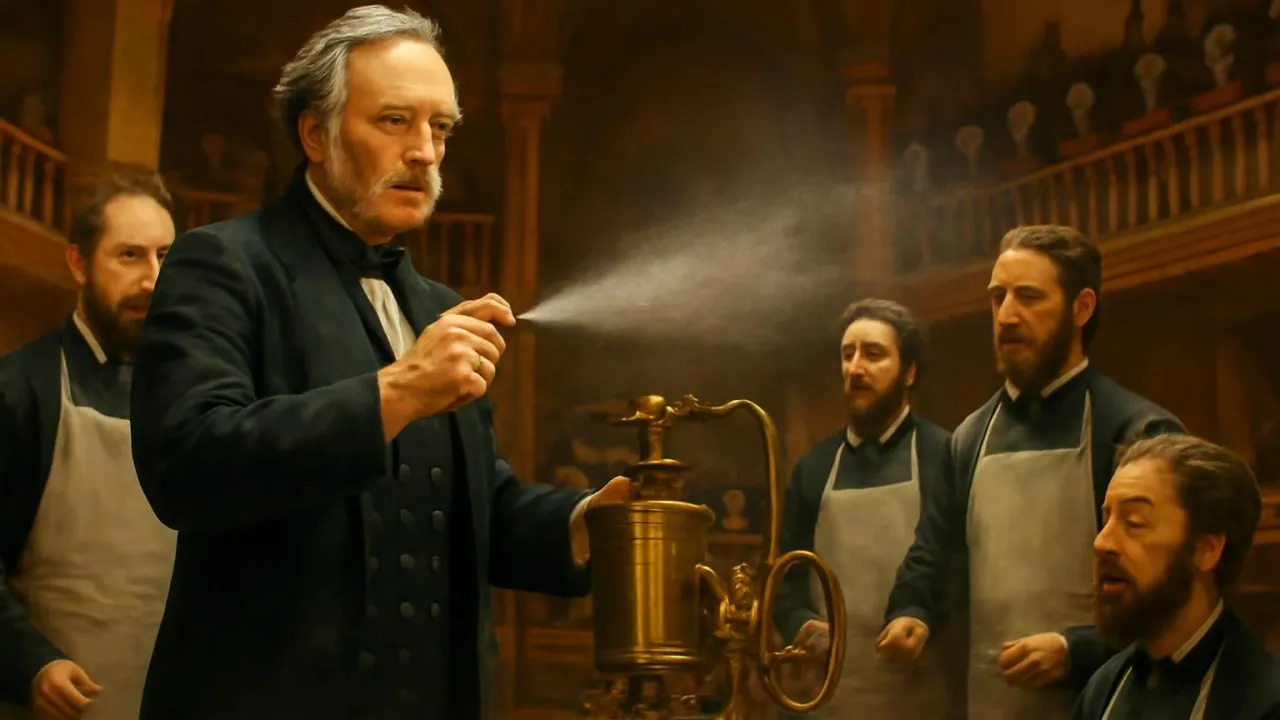
Before the spray, many people got sick after surgery.
✨ Word Sparks (Grade 2 Glossary)
Tap 🔊 to hear
surgery
When doctors fix your body
acid
A strong liquid that can clean things
hospital
A place where doctors help people
🪝
Imagine a doctor spraying a gentle mist before fixing a cut—what could it do?
1
The Mist That Helped
Doctors sprayed a special mist in rooms, and it floated everywhere. The mist was made of carbolic , and it kept germs away. It helped stop sickness from spreading to patients.
2
A Doctor’s Bright Idea
Joseph Lister wanted to help people heal better, so he invented the spray. He saw that many people got sick after , and he wanted to stop that. His spray made surgeries much safer for everyone.
3
How the Spray Worked
The spray made a fine cloud over wounds, and it killed germs. Doctors used it before and during , and fewer people got sick. This idea changed all around the world.
Lister’s spray cut surgery deaths in half at his hospital.
✨ Word Sparks (Grade 3 Glossary)
Tap 🔊 to hear
bacteria
Tiny germs that can cause sickness
infection
When germs make you sick
antiseptic
Something that kills germs
🪝
Can you picture a doctor spraying a cool mist that stops infections during surgery?
1
A Cloud That Saved Lives
In the 1800s, surgeries were very risky because of germs. Joseph Lister noticed that many patients died from after surgery. He created a special spray that used carbolic acid to kill germs in the air and on wounds. This fine mist helped doctors keep their patients much safer.
2
How Did It Work?
The spray released a cloud of tiny droplets during surgery. The carbolic acid in the spray destroyed before they could cause . Doctors sprayed it over wounds and tools to keep everything clean. This process is called antiseptic technique.
3
A New Way of Healing
Lister’s invention changed medical practice around the world. Hospitals started using sprays and cleaning methods to prevent disease. The spray’s main feature was its ability to stop from entering the body. This helped patients heal faster and survive surgery.
4
Science Words in Action
Words like , , and became important in medicine. The spray worked by killing bacteria, which are tiny living things that cause infection. Lister’s prototype spray was a big step in medical hygiene. Today, antiseptic methods are used in every hospital.
Lister’s antiseptic spray inspired the use of sterile gloves and clean tools in surgery.
✨ Word Sparks (Grade 4 Glossary)
Tap 🔊 to hear
sterilize
To make something totally free of germs
prototype
The first working model of an invention
hygiene
Keeping things clean to stay healthy
🪝
What if a simple spray could turn a dangerous operation into a safe one?
1
A Revolutionary Medical Mist
In the 1860s, Joseph Lister noticed that many patients died from infection after surgery, even when the operation itself went well. He was inspired by Louis Pasteur’s germ theory, which explained that invisible bacteria caused disease. Lister developed a spray that released carbolic acid into the air and onto wounds, killing bacteria and reducing deadly infections. This invention marked the beginning of modern antiseptic surgery.
2
How the Antiseptic Spray Worked
The spray used a mechanical pump to turn carbolic acid into a fine mist, which doctors directed over surgical areas. The acid’s chemical properties broke down bacterial cell walls, stopping infection before it could start. Doctors also cleaned tools and bandages with carbolic acid, creating a full antiseptic environment. This method was called antiseptic technique and soon spread to hospitals worldwide.
3
Changing Hospitals Forever
Before Lister’s invention, hospitals were dangerous places where infections spread quickly. After the spray was introduced, surgery survival rates improved dramatically, and hospital became a priority. Doctors and nurses learned to wash their hands, tools, and use antiseptic sprays to protect patients. Lister’s work inspired new inventions in medical safety and hygiene.
4
The Science Behind the Spray
Carbolic acid, also called phenol, was the key ingredient in Lister’s spray. It was effective at killing bacteria but needed careful handling because it could irritate skin and lungs. The spray was an early that led to safer, more advanced antiseptics used today. Lister’s invention proved that understanding science could save countless lives and change the world.
Lister’s antiseptic spray led to a 70% drop in deaths from surgical infections within a decade.
✨ Word Sparks (Grade 5 Glossary)
Tap 🔊 to hear
atomizer
A tool that turns liquid into a fine mist
mortality
The number of people who die from something
aseptic
Completely free of germs or bacteria
🪝
What if a single invention could transform surgery from a dangerous gamble into a life-saving science?
1
The Deadly Challenge of Surgery
In the mid-19th century, surgery was often a last resort because infection claimed so many lives after operations. Surgeons worked in unsterile conditions, unaware that invisible bacteria were the true culprits behind deadly post-surgical infections. Joseph Lister, a British surgeon, was deeply troubled by the high rates and began searching for a scientific solution.
2
Germ Theory Sparks a Revolution
Inspired by Louis Pasteur’s germ theory, which proved that microorganisms caused disease, Lister hypothesized that surgical wounds became infected due to airborne and surface bacteria. He experimented with carbolic acid (phenol), a chemical already used to treat sewage, to see if it could destroy these harmful microbes. Lister’s experiments led him to develop a mechanical spray device that dispersed a fine mist of carbolic acid into the air and onto wounds during surgery.
3
Engineering the Antiseptic Spray
Lister’s spray apparatus consisted of a hand-pumped , which forced carbolic acid solution through a nozzle to create a visible mist. This innovation allowed surgeons to coat wounds, instruments, and even the air in the operating room with antiseptic protection. The physical principle at work was atomization, where liquid is broken into tiny droplets, maximizing surface area for germ-killing action.
4
Transforming Medical Practice Globally
The introduction of the antiseptic spray led to a dramatic decrease in surgical rates, with Lister’s own hospital seeing deaths from infection drop from nearly 50% to under 15%. Surgeons worldwide adopted antiseptic techniques, including sterilizing hands, instruments, and dressings, fundamentally changing the culture of medicine. This shift paved the way for surgery, where the goal became total elimination of germs from the environment.
5
Legacy and Scientific Impact
Lister’s antiseptic spray was a prototype for modern infection control, inspiring the development of safer chemicals and sterile techniques. Although carbolic acid was eventually replaced by less irritating antiseptics, the engineering principles and scientific reasoning behind Lister’s invention remain central to medicine today. The global impact is evident in every hospital, where millions of lives are saved annually through rigorous hygiene, sterilization, and infection prevention.