🇺🇸 U.S. HISTORY
🏛️ 7th President of the United States (1829–1837)
VA History & Social Science SOL K.1, 1.2, 2.4, VS.1–VS.10, USI & USII
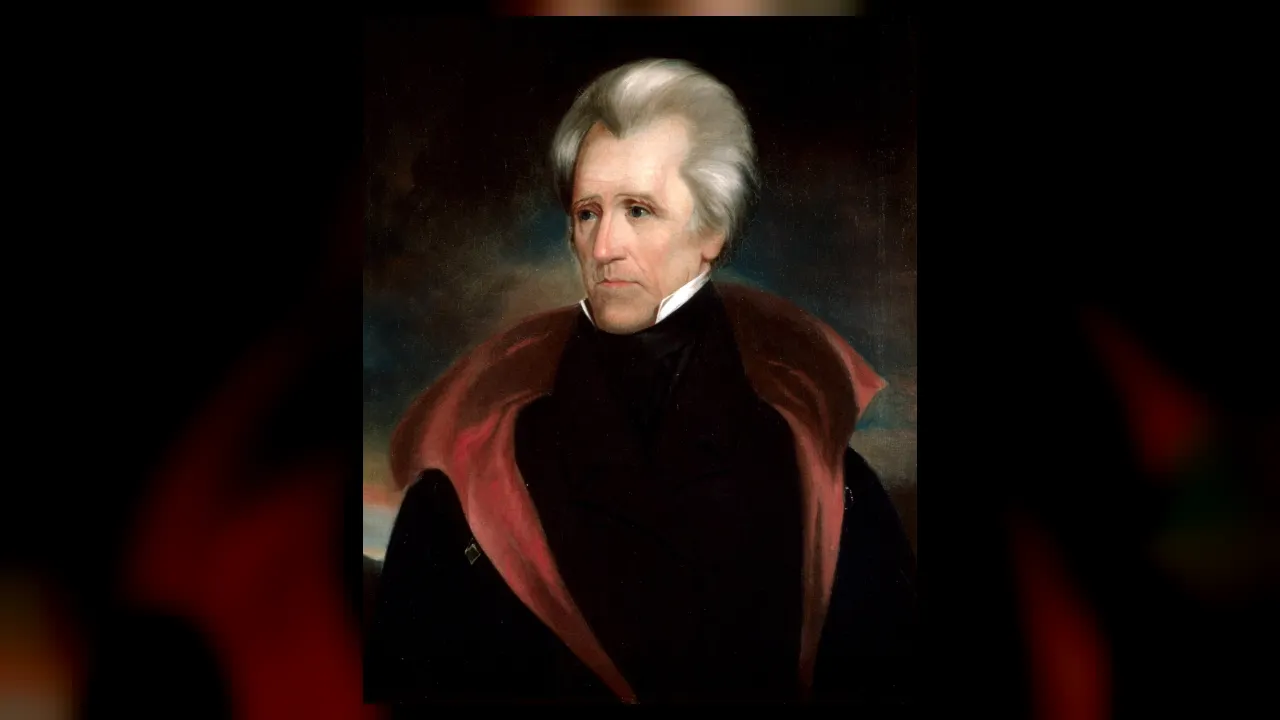
Andrew Jackson
The Frontier General Who Reshaped Voting
Grade 5 • Advanced • 329 words
⏳ Era / StatehoodPresidential Term: 1829–1837 (Born 1767, Waxhaws Frontier)
🗺️ Region / CapitalNashville, Tennessee (The Hermitage) & Washington, D.C.
📜 Key MilestoneExpanded Everyday Voter Turnout & Paid Off National Debt (1835)
⚡ Historical SparkFirst U.S. president elected from a frontier state west of the Appalachian Mountains
🤯 Mind-Blowing Fact • Grade 1
At one White House open house, Andrew Jackson displayed a giant fourteen-hundred-pound wheel of cheddar cheese for visitors to taste!
✨ Word Sparks (Grade 1 Glossary)
Tap 🔊 to hear
frontier
Wild border land where few settlers lived yet
hickory
A tall American tree with very hard wood
era
A special period of years in history
🪝
How did a boy from a log cabin grow up to become our seventh president?
1
Up From the Frontier
Imagine growing up in a small log cabin in the woods! Earlier presidents came from wealthy families in Virginia or Massachusetts. Our seventh president grew up poor on the .
2
Tough Like Hickory Wood
He worked hard to become a lawyer, judge, and army general in Tennessee. Soldiers called him 'Old ' because he was as tough as strong hickory wood!
3
Votes for Everyday People
When he became president in 1829, crowds cheered outside the White House. During his , many more everyday workers and farmers gained the right to vote.
1. Why did soldiers give Andrew Jackson the nickname 'Old Hickory'?
2. How was Andrew Jackson's childhood different from the six presidents before him?
🤯 Mind-Blowing Fact • Grade 2
In January 1835, under President Andrew Jackson, the United States completely paid off its entire national debt to zero dollars for the only time in history!
✨ Word Sparks (Grade 2 Glossary)
Tap 🔊 to hear
orphaned
Left without parents while still a young child
volunteer
Someone who chooses to help or serve willingly
excluded
Left out or kept from taking part
🪝
Why did thousands of cheering citizens travel to Washington, D.C., when the seventh president took office?
1
A Self-Made Leader
Clip-clop! Young Andrew Jackson rode horses through the Carolina woods as a messenger boy during the Revolutionary War. by age fourteen, he taught himself law, moved west to Tennessee, and became a congressman, senator, and judge.
2
Fame at New Orleans
During the War of 1812, General Jackson led an army of frontier , city citizens, and soldiers to defend the port of New Orleans in 1815. Overnight, 'Old Hickory' became a famous national figure.
3
Changing American Elections
Elected as our seventh president in 1828, Jackson opened the White House doors to ordinary citizens. Across states, voting rules changed so men no longer needed to own land to vote, though women, African Americans, and Native Americans were still .
1. Which 1815 battle made General Andrew Jackson famous across the United States?
2. Which state became Andrew Jackson's adult home and political base?
🤯 Mind-Blowing Fact • Grade 3
In 1833, Andrew Jackson became the very first sitting U.S. president to ride on a steam-powered railroad train, traveling twelve miles in Maryland!
✨ Word Sparks (Grade 3 Glossary)
Tap 🔊 to hear
turnout
The share of eligible citizens who cast votes
veto
A president's constitutional power to reject a bill
tariff
A tax placed on goods imported from abroad
🪝
How did the presidency of Andrew Jackson bring both wider voting participation and painful turning points in American history?
1
From Waxhaws Cabin to Tennessee
Picture a thirteen-year-old courier galloping along muddy forest trails during the American Revolution! Raised in the Waxhaws region along the Carolina border, Andrew Jackson lost his entire immediate family during the war. Determined to succeed, he studied law and helped write Tennessee's state constitution.
2
Rise of 'Jacksonian Democracy'
By 1828, most states had dropped rules requiring male voters to own property. Campaigning as a champion of farmers and craftworkers, Jackson won a landslide victory, and voter more than doubled! Still, voting rights had not yet reached women, enslaved people, or Native nations.
3
Preserving the Union and Paying the Debt
As president from 1829 to 1837, Jackson strongly used the presidential , closed the Second Bank of the United States, and paid off the federal debt in 1835. When South Carolina threatened to ignore federal laws, Jackson firmly insisted that the Union must remain united.
4
The Indian Removal Act
Historians also examine a tragic decision of Jackson's presidency: signing the Indian Removal Act of 1830. This law pressured Cherokee, Choctaw, Chickasaw, Creek, and Seminole nations to leave their southeastern homelands for territory west of the Mississippi River along routes remembered as the Trail of Tears.
1. Why did voter participation jump sharply in the Election of 1828?
2. What happened when South Carolina tried to reject federal tariff laws during Jackson's presidency?
🤯 Mind-Blowing Fact • Grade 4
Andrew Jackson was the last president who had served in the American Revolutionary War, carrying a scar from a British officer's sword from age thirteen!
✨ Word Sparks (Grade 4 Glossary)
Tap 🔊 to hear
nullify
To declare a law invalid or without legal force
sovereignty
A nation's authority and right to govern itself
compromise
An agreement where each side gives up part
🪝
Why do historians study Andrew Jackson's presidency as a major turning point in presidential power and American politics?
1
Frontier Roots and National Fame
At age thirteen, Andrew Jackson served as a Patriot messenger in the Carolinas and survived capture by British soldiers—making him the last U.S. president who was a veteran of the Revolutionary War. Relocating to frontier Nashville, he served as Tennessee's first U.S. Representative before commanding diverse American forces to a decisive victory at the Battle of New Orleans in January 1815.
2
Transforming Campaigns and the Presidency
After losing the contested House vote of 1824 despite leading the popular tally, Jackson and his supporters built the modern Democratic Party and swept the 1828 election. Whereas earlier presidents saw Congress as the main voice of the people, Jackson argued that the president—elected nationwide—directly represented citizens. He vetoed twelve bills, more than all six prior presidents combined.
3
The Nullification Crisis and Bank Debate
Jackson's two terms tested constitutional boundaries. In 1832, he vetoed rechartering the Second Bank of the United States, arguing it favored wealthy investors over everyday workers, and by 1835 his administration eliminated the national debt. Simultaneously, during the Nullification Crisis of 1832–1833, when South Carolina claimed the right to '' federal tariffs, Jackson proclaimed disunion unconstitutional while Senator Henry Clay brokered a peaceful .
4
Indigenous Sovereignty and Historical Legacy
A full historical view also confronts the Indian Removal Act of 1830. Despite the Cherokee Nation's written constitution and Supreme Court rulings recognizing tribal , federal treaties and forced relocations uprooted tens of thousands of Native people westward, culminating in the devastating Trail of Tears. Studying Jackson helps students see how expanding democracy for some existed alongside grave injustices for others.
1. How did Andrew Jackson change the way presidents used the constitutional veto power?
2. Which 1830 law signed by Jackson led to the forced relocation of Southeastern Native American nations?
🤯 Mind-Blowing Fact • Grade 5
In 1861, President Abraham Lincoln carefully studied Andrew Jackson's 1832 Nullification Proclamation while drafting his own First Inaugural Address arguing that the Union is perpetual!
✨ Word Sparks (Grade 5 Glossary)
Tap 🔊 to hear
suffrage
The legal right to vote in public elections
tribune
A leader who claims to champion everyday citizens
precedent
An earlier action used as an example afterward
🪝
How did the 'Age of Jackson' redefine executive authority, party politics, and constitutional debates in the young republic?
1
Orphan of the Revolution to Western Statesman
Imagine being the sole surviving member of your immediate family at fourteen after war and illness swept the Carolina Waxhaws! That harsh beginning forged Andrew Jackson's fierce independence. Crossing the Appalachians into Tennessee in 1788, he served as prosecutor, constitutional convention delegate, Tennessee's lone U.S. Representative, U.S. Senator, and state supreme court justice before his 1815 triumph at New Orleans elevated him into a national symbol of western grit.
2
Mass Politics and the Second Party System
Between 1824 and 1828, states abolished most property qualifications for white male and shifted presidential elector selection from state legislatures to popular votes. Voter participation surged from roughly 27 percent in 1824 to 57.6 percent in 1828, then nearly 80 percent by 1840. Jackson's allies organized grassroots rallies, newspapers, and conventions—sparking the 'Second Party System' as opponents led by Henry Clay formed the rival Whig Party.
3
Executive Power and Economic Debates
Viewing the presidency as the people's direct , Jackson reshaped executive-legislative balance. He introduced rotation in federal civil-service appointments and wielded twelve vetoes, including his landmark 1832 veto of the Second Bank of the United States. While his fiscal policies and Western land sales retired the entire federal debt in January 1835, shifting federal deposits to state banks and issuing the 1836 Specie Circular contributed to financial turbulence during the Panic of 1837.
4
Federal Supremacy in the Nullification Crisis
Even as an advocate of limited federal reach, Jackson drew an unyielding line when South Carolina attempted to nullify the Tariffs of 1828 and 1832. Declaring in his December 1832 Nullification Proclamation that 'disunion by armed force is treason,' he backed the Force Bill alongside Clay's Compromise Tariff of 1833—a constitutional Abraham Lincoln later cited in 1861 to preserve the Union.
5
Indian Removal and Complex Historical Memory
Jackson's legacy remains deeply shaped by his championship of the Indian Removal Act of 1830 and the institution of slavery. Despite Chief Justice John Marshall's ruling in Worcester v. Georgia (1832) affirming Cherokee legal autonomy from state law, federal pressure relocated approximately 60,000 Choctaw, Creek, Chickasaw, Seminole, and Cherokee citizens to Indian Territory, costing thousands of lives. Historians therefore study the Jacksonian era for both its expansion of popular politics and its profound human contradictions.