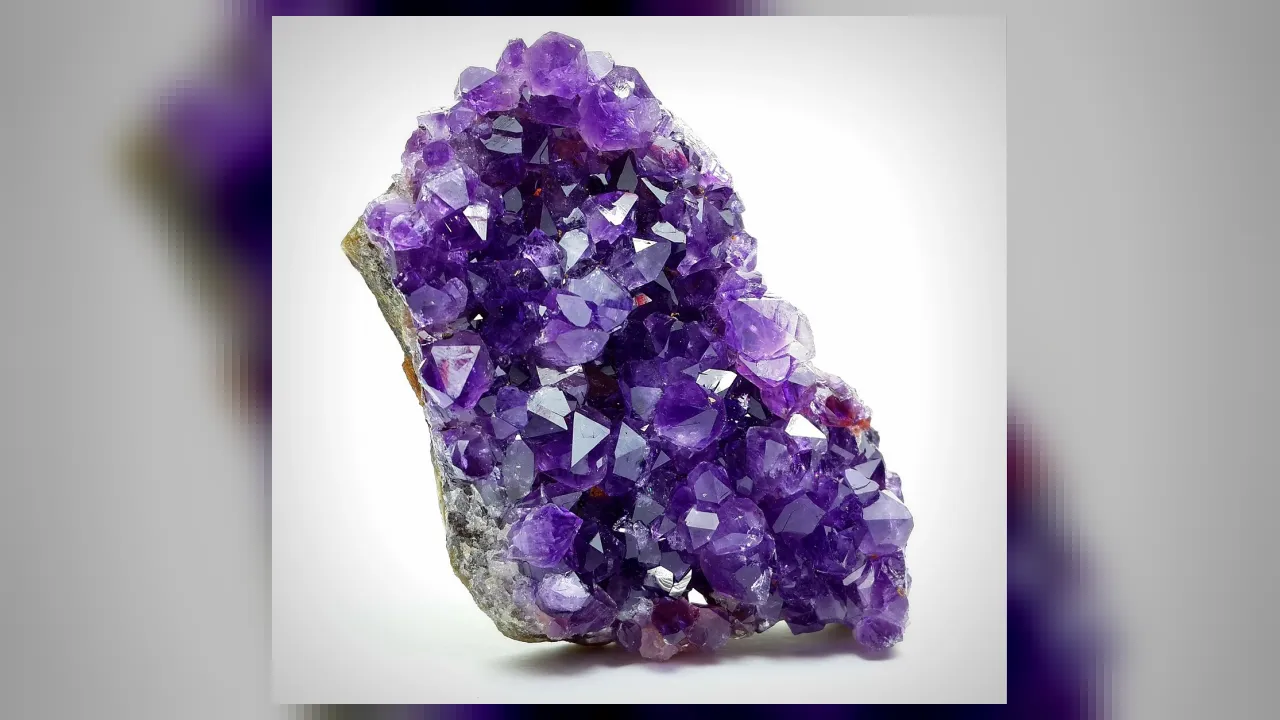
1. Where do sparkling amethyst crystals often hide?
2. What can happen if you leave an amethyst in bright, hot sunlight for a long time?
🤯 Mind-Blowing Fact • Grade 2
Before giant amethyst deposits were discovered in Brazil in the 1800s, amethyst was considered just as rare and expensive as ruby and emerald!
✨ Word Sparks (Grade 2 Glossary)
Tap 🔊 to hear
quartz
A common hard mineral with six-sided crystals
silica
A natural mineral ingredient in sand and quartz
violet
A rich purple color between blue and red
🪝
How do trapped lava bubbles turn into cathedral-sized purple crystal caves?
1
Frozen Bubbles in Lava
Imagine thick, bubbly lava cooling into hard black rock. Trapped gas pockets leave hollow caves inside the stone, shaped like giant eggs waiting for a makeover.
2
Purple Member of the Quartz Club
Over millions of years, mineral-rich groundwater seeps into those hollow spaces. Tiny building blocks of stack into six-sided points. Trace bits of iron and natural Earth energy turn the clear quartz bright !
3
Once Rare as Rubies
Long ago, kings and queens prized amethyst alongside diamonds and rubies. Then explorers discovered huge crystal-lined geodes in Brazil and Uruguay, allowing rock collectors everywhere to enjoy them.
1. Which big mineral family does purple amethyst belong to?
2. Why did amethyst become easier for everyday collectors to own after the 1800s?
🤯 Mind-Blowing Fact • Grade 3
Some of North America's deepest purple amethyst crystals have been discovered right in Virginia's Piedmont soil across Amherst and Nelson counties!
✨ Word Sparks (Grade 3 Glossary)
Tap 🔊 to hear
basalt
Dark fine-grained rock formed from cooled lava
Piedmont
Rolling foothills region east of the Blue Ridge
cavity
An empty hollow space inside solid rock
🪝
Why does it take both iron AND natural underground energy to turn clear quartz purple?
1
A Two-Step Recipe for Purple
Hold a clear quartz crystal beside a rich grape amethyst and their chemistry is almost identical: silicon dioxide, or SiO2. To turn purple, growing quartz first traps tiny traces of iron. Next, gentle natural radiation from surrounding rocks nudges those iron atoms into light-absorbing color centers!
2
Cathedral Geodes of South America
More than 130 million years ago, giant floods of lava poured across southern Brazil and Uruguay. Gas pockets up to ten feet tall slowly filled with silica-rich water, lining each wall with inward-pointing purple pyramids called cathedral geodes.
3
Hardness Seven Durability
On the Mohs Hardness Scale, amethyst sits right at number seven. That means an amethyst point easily scratches window glass or a steel pocketknife!
4
Virginia's Own Purple Treasures
You do not have to travel to South America to find gem amethyst. Rock hounds and geologists have unearthed deep royal-purple amethyst crystals in Virginia's counties, including Nelson, Amherst, and Prince Edward!
1. What two things work together to give amethyst its purple color?
2. In which Virginia region have deep purple amethyst crystals been found?
🤯 Mind-Blowing Fact • Grade 4
In Bolivia, natural underground temperature zones created 'ametrine'—a single natural quartz crystal split cleanly into purple amethyst and golden-yellow citrine!
✨ Word Sparks (Grade 4 Glossary)
Tap 🔊 to hear
conchoidal
Curved shell-like ripples where quartz chips break
ametrine
A single crystal combining purple amethyst and citrine
macrocrystalline
Having crystals big enough to see clearly
🪝
What happens if you bake a purple amethyst crystal inside a hot geological oven?
1
Color Centers in Silicon Dioxide
Mineralogists classify amethyst as violet quartz (SiO2). During slow hydrothermal growth inside rock cavities, ferric iron ions (Fe3+) replace a tiny fraction of silicon atoms in the crystal framework. Over millions of years, natural gamma rays emitted by trace potassium or uranium in neighboring volcanic rocks knock an electron off those iron ions, creating Fe4+ color centers that absorb greenish-yellow light and transmit regal violet.
2
Reversing the Color With Heat
Because amethyst's color comes from shifted electrons rather than permanent pigment, heat can undo the work! When volcanic magma reheats an amethyst vein—or when jewelers warm purple quartz in a kiln to about 450 degrees Celsius—electrons snap back into place and iron nanoparticles turn the gem golden-orange citrine or rare pale green prasiolite.
3
Half-Purple, Half-Gold Ametrine
At the famous Anahi mine in Bolivia, natural temperature differences across single growing crystals created ''—striking gems divided sharply into purple amethyst zones and sunny golden citrine zones inside one crystal!
4
Conchoidal Fracture Instead of Cleavage
Virginia Earth science students test mineral breakage to identify quartz varieties. Unlike calcite or feldspar, amethyst lacks flat cleavage planes; if chipped, it breaks along curved, shell-like ripples called fracture—just like thick glass.
1. What happens when purple amethyst is heated to around 450 degrees Celsius?
2. How does an amethyst crystal break if struck hard?
🤯 Mind-Blowing Fact • Grade 5
Under polarized microscope filters, natural amethyst displays distinctive 'tiger-stripe' patterns caused by left-handed and right-handed atomic spirals growing together inside the same crystal!
✨ Word Sparks (Grade 5 Glossary)
Tap 🔊 to hear
vesicle
A gas bubble cavity preserved in volcanic rock
twinning
Symmetrical intergrowth of two crystal orientations together
piezoelectric
Generating electric charge when squeezed under pressure
🪝
How did continental-scale flood basalts from the breakup of Gondwana build ten-foot-tall amethyst cathedrals?
1
Paraná Flood Basalts and Vesicular Cavities
Roughly 134 million years ago, as South America began rifting apart from Africa during the breakup of supercontinent Gondwana, colossal fissures erupted more than one million cubic kilometers of Paraná flood basalts across Brazil and Uruguay. Rising volatile gases expanded inside cooling lava flows to leave streamlined, almond-shaped up to several meters tall. Later, low-temperature silica-rich groundwater percolated upward from underlying sandstone aquifers—First coating each cavity with protective green celadonite and banded agate rinds, then precipitating inward-pointing purple amethyst terminations.
2
Solid-State Physics of Fe4+ Color Centers
Within quartz's trigonal framework of corner-sharing SiO4 tetrahedra, trace Fe3+ ions (often just 10 to 100 parts per million) substitute for Si4+. Natural ionizing gamma radiation emitted over geological timescales by radioactive potassium-40, thorium, and uranium in the host basalt strips an electron from Fe3+ to generate rare tetravalent iron, [FeO4]0. This defect center absorbs wavelengths around 545 nanometers (yellow-green), producing hues from pale lilac to deep Siberian-grade royal violet.
3
Brazil-Law Twinning and Optical Spirals
Quartz tetrahedra twist into either left-handed or right-handed atomic spirals along the crystal's c-axis. Natural amethyst almost invariably intergrows alternating microscopic wedges of left-handed and right-handed quartz—a feature called Brazil-law that gemologists view under polarized light as crisp tiger-stripe interference patterns to distinguish natural stones from untwinned lab crystals.
4
Thermal Bleaching and Color Zoning
Because [FeO4]0 centers are thermally unstable above 300 to 450 degrees Celsius, episodes of geothermal heating convert Fe4+ back into submicroscopic ferric oxide clusters, turning violet quartz into golden citrine. Meanwhile, prolonged ultraviolet sunlight gradually triggers photo-bleaching at room temperature.
5
Greek Etymology and Piezoelectric Heritage
The word amethyst derives from ancient Greek 'amethystos,' meaning 'not intoxicated.' Beyond folklore, amethyst shares quartz's lack of a center of symmetry, giving every crystal behavior—generating measurable electrical voltage when mechanically squeezed.