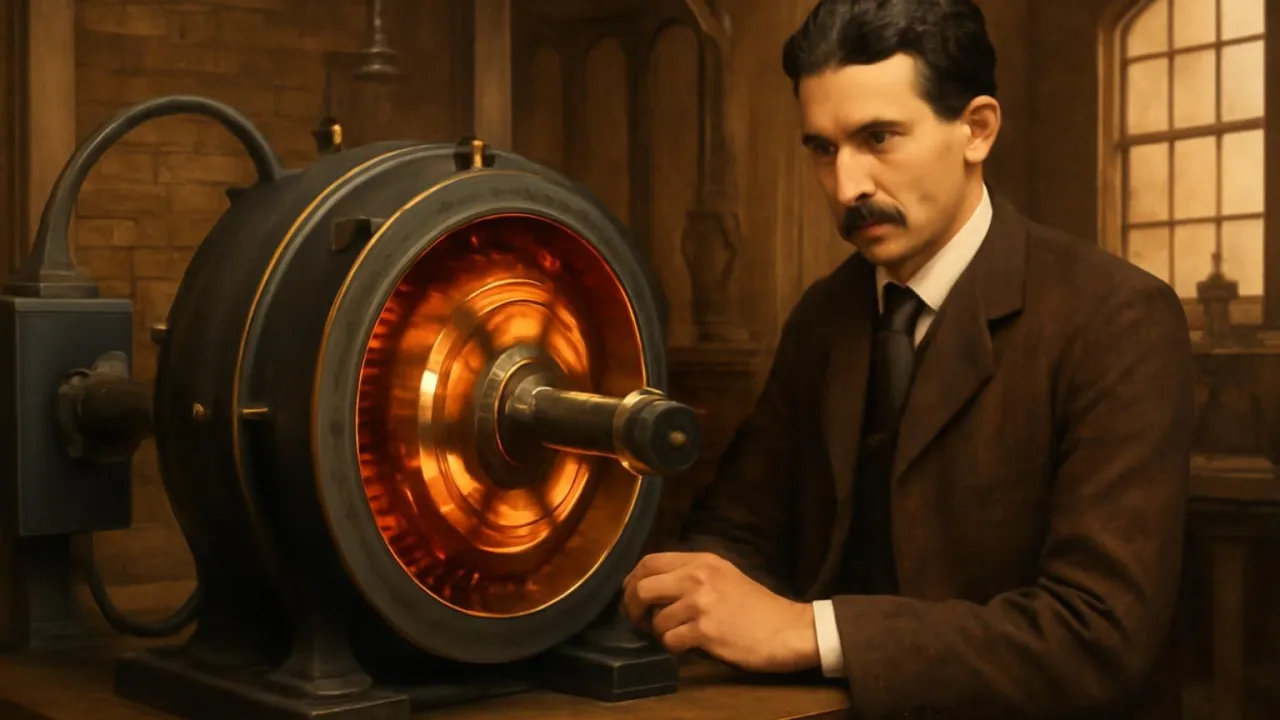
Nikola Tesla invented the AC motor over 130 years ago!
✨ Word Sparks (Grade 2 Glossary)
Tap 🔊 to hear
coil
Wire twisted into a loop
force
A push or pull on something
invent
To make something new
🪝
What would happen if your refrigerator’s motor stopped spinning?
1
Motors Make Things Move
When you turn on a fan, a motor makes the blades spin fast. Motors use electricity and magnets to turn things around. Without motors, many machines would not work.
2
How Do Motors Work?
A motor has of wire and a magnet inside. When electricity flows, the wires create a that pushes the magnet. This force makes the motor spin and do work.
3
Motors in Everyday Life
Motors help us wash clothes, keep food cold, and cool our rooms. They are hidden in many machines we use every day. Motors make life easier and more fun.
1. What happens when electricity flows through a motor?
2. Who invented the AC motor?
🤯 Mind-Blowing Fact • Grade 3
Some giant AC motors can lift elevators up skyscrapers over 1,000 feet tall!
✨ Word Sparks (Grade 3 Glossary)
Tap 🔊 to hear
alternating current
Electricity that changes direction quickly
rotor
The spinning part inside a motor
rotation
Turning around in a circle
🪝
Have you ever wondered how your washing machine spins your clothes so fast?
1
The Spinning Secret
When you hear a gentle hum from a fan or washing machine, you are hearing an electric motor at work. These motors use , or AC, which changes direction many times each second. The changing current creates a moving magnetic field inside the motor. This field makes a part called the spin quickly.
2
How Does an AC Motor Work?
Inside the motor, coils of wire called windings are wrapped around an iron core. When AC electricity flows through these coils, it produces a magnetic field that vibrates and moves. The , which sits inside the coils, is pushed by this field and begins to turn. This turning motion is called , and it is what powers many machines.
3
Tesla’s Brilliant Idea
Nikola Tesla invented the AC motor in the late 1800s, changing how people used electricity. Before this, most motors used direct current, or DC, which could not travel far. Tesla’s AC motor allowed electricity to move over long distances and power cities. His invention made modern life possible.
4
Motors Everywhere
Today, AC motors are found in homes, schools, and factories all over the world. They help run elevators, refrigerators, and even roller coasters. Without motors, many of our favorite machines would not work. The AC motor’s invention sparked a new age of technology.
1. What does the magnetic field inside a motor do?
2. Why was Tesla’s AC motor important?
🤯 Mind-Blowing Fact • Grade 4
The world’s largest AC motors can move ships weighing over 100,000 tons!
✨ Word Sparks (Grade 4 Glossary)
Tap 🔊 to hear
electromagnetic induction
Making motion using magnetic fields and electricity
efficiency
Doing a job with little waste
vibrating
Moving back and forth quickly
🪝
What if every elevator, fan, and washing machine suddenly stopped spinning—how would our world change?
1
The Power of Spinning Electrons
When you flip a switch and a fan starts to hum, you’re witnessing the magic of the AC motor. Alternating current, or AC, reverses direction many times per second, creating a changing magnetic field inside the motor. This field interacts with coils of wire and a central rotor, causing the rotor to spin rapidly. The spinning rotor turns mechanical energy into useful work—like blowing air or spinning a drum.
2
Nikola Tesla’s Game-Changing Invention
In 1887, Nikola Tesla developed the first practical AC motor, transforming the way people used electricity. Before Tesla’s design, most motors used direct current (DC), which could not travel far without losing power. Tesla’s AC motor allowed electricity to be sent over long distances, making it possible to power entire cities and factories. His invention sparked the modern electric age.
3
How AC Motors Work
Inside an AC motor, electricity flows through copper windings, creating a magnetic field. This field pushes and pulls on the rotor, making it spin with great speed and force. The process uses a principle called , where moving magnetic fields create motion. AC motors are reliable, efficient, and can be made in many sizes for different jobs.
4
Motors in Our World
AC motors are found in almost every part of daily life, from tiny fans in computers to giant machines in factories. They help run elevators, subway trains, and even roller coasters at amusement parks. The invention of the AC motor made modern cities possible, powering everything from lights to refrigerators. Without it, our world would look—and sound—very different!
The fastest industrial AC motors can spin at over 36,000 revolutions per minute—nearly 600 times every second!
✨ Word Sparks (Grade 5 Glossary)
Tap 🔊 to hear
stator
The stationary part of a motor with coils
frequency
How many times something repeats each second
torque
A twisting force that makes things turn
🪝
Imagine a world where every conveyor belt, subway train, and cooling fan suddenly stopped—what would happen to our daily lives?
1
The Birth of the AC Motor Revolution
Step into Nikola Tesla’s 19th-century laboratory, where the air crackles with the buzz of invention and spinning copper coils. In 1887, Tesla designed the first practical alternating current (AC) motor, forever changing how electricity powered machines. Unlike earlier direct current (DC) motors, which struggled with energy loss over long distances, Tesla’s AC motor used a clever principle: alternating current reverses direction many times per second, generating a rotating magnetic field. This breakthrough allowed energy to be transmitted efficiently across entire cities, sparking the electrification of the modern world.
2
Inside the AC Motor: Engineering Marvels
At the heart of every AC motor are two key parts: the and the rotor. The stator contains tightly wound copper coils, which produce a rapidly changing magnetic field when energized by AC electricity. This field induces a current in the rotor, causing it to spin due to electromagnetic induction. The speed of rotation depends on the of the AC supply—typically 60 times per second (60 Hz) in the United States. This precise engineering enables AC motors to deliver reliable, efficient power for countless applications.
3
Physics in Motion: How It Works
The AC motor’s operation relies on Faraday’s law of electromagnetic induction, which states that a changing magnetic field can induce an electric current in a conductor. As alternating current flows through the windings, it creates a rotating magnetic field. This field sweeps past the rotor, inducing a current that causes the rotor to turn. The result is smooth, continuous rotation, which can be harnessed to drive fans, pumps, elevators, and more. Engineers can adjust the speed and by changing the or voltage of the AC supply.
4
Impact on Industry and Society
The invention of the AC motor enabled the widespread use of electricity in homes, factories, and transportation systems. Factories could now use powerful machines to mass-produce goods, while cities used AC motors to run subways and elevators. Tesla’s design made it possible to build large power plants far from cities, transmitting energy efficiently via power lines. Today, AC motors are essential for everything from air conditioning and refrigeration to robotics and electric vehicles.
5
From Tesla’s Workshop to the World
Over the past century, AC motors have evolved into many types, including induction motors, synchronous motors, and variable- drives. Each type uses similar principles but is optimized for specific tasks, such as precise speed control or high starting . The largest AC motors can move ships and power entire factories, while tiny versions run inside computer fans and household appliances. Tesla’s AC motor remains a cornerstone of modern technology, quietly spinning behind the scenes to keep our world moving.