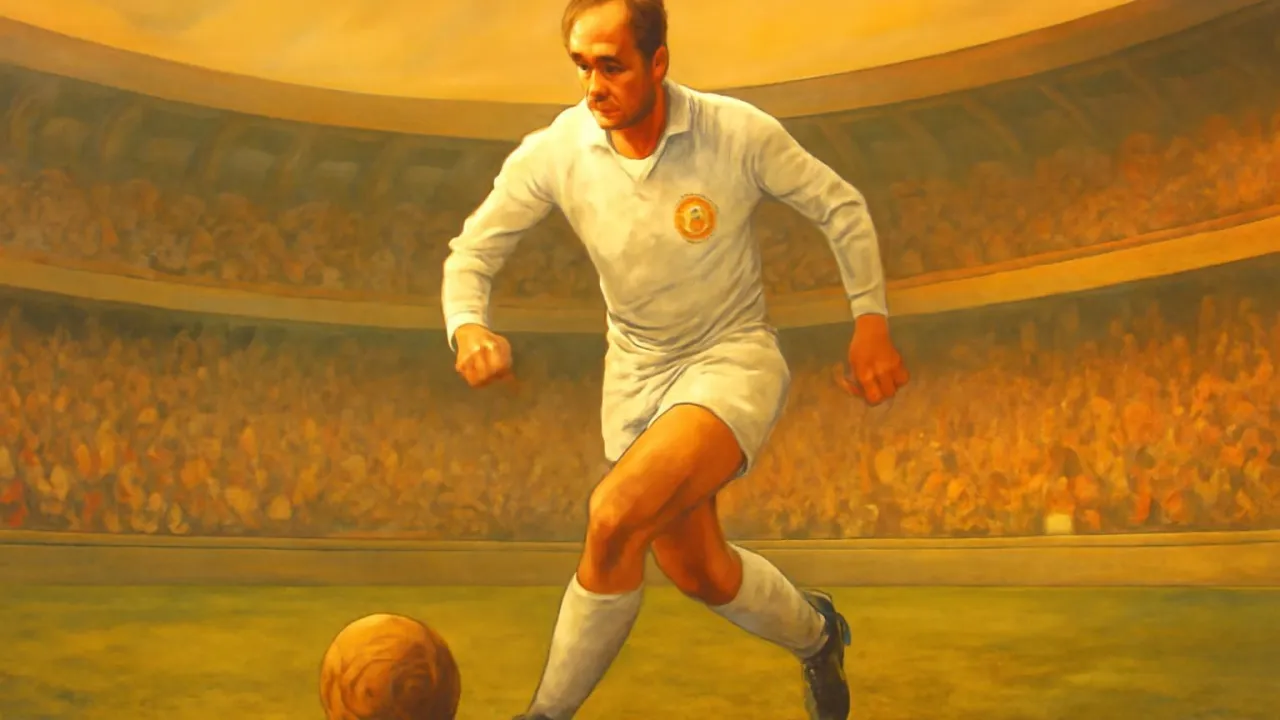
Alfredo played for both Argentina and Spain in his career.
✨ Word Sparks (Grade 2 Glossary)
Tap 🔊 to hear
legend
A person who is very famous
champion
Someone who wins the big games
dribble
Move the ball with your feet
🪝
What makes a soccer player a true legend on the field?
1
Chasing the Ball
As a boy, Alfredo chased his soccer ball through busy streets. He practiced every day with friends, learning new tricks and moves. His family cheered him on from the sidelines.
2
Working Hard and Listening
Alfredo worked hard at practice and listened to his coaches. He learned how to pass, , and score in many ways. His teamwork helped everyone play better together.
3
Becoming a Champion
Alfredo joined a famous team called Real Madrid. He led his team to win many championships and scored in five finals. People everywhere called him a soccer .
1. Which team did Alfredo help win many championships?
2. What did Alfredo do to get better at soccer?
🤯 Mind-Blowing Fact • Grade 3
Alfredo Di Stéfano could play almost every position on the field!
✨ Word Sparks (Grade 3 Glossary)
Tap 🔊 to hear
perseverance
Keep trying, even when it’s hard
strategy
A smart plan to win the game
versatility
Able to do many different things
🪝
How did Alfredo Di Stéfano become one of soccer’s greatest leaders and scorers?
1
A Street Soccer Star
Young Alfredo loved playing soccer in the streets of Buenos Aires. He practiced dribbling, passing, and shooting with his friends every afternoon. His quick feet and clever moves made him stand out. Even as a child, he dreamed of playing for the world’s best teams.
2
Learning from Every Game
Alfredo joined River Plate, a famous team in Argentina, when he was a teenager. He listened closely to his coaches and learned new strategies for every match. His helped him improve his skills and become a strong leader. Soon, he was known for his teamwork and powerful shots.
3
The Real Madrid Revolution
When Alfredo moved to Spain, he joined Real Madrid and changed the club’s history. He played as a forward but also helped defend and organize the team’s attacks. His vision and made him the heart of the team. With Alfredo, Real Madrid won five European Cups in a row.
4
A Lasting Soccer Legacy
Alfredo scored in every European Cup final he played. He won two Ballon d'Or awards as the best player in Europe. Soccer experts say he helped invent 'total football' with his all-around style. Today, fans remember him as one of the greatest soccer legends ever.
Alfredo Di Stéfano played for three national teams: Argentina, Colombia, and Spain!
✨ Word Sparks (Grade 4 Glossary)
Tap 🔊 to hear
tactical
Using smart plans in sports
academy
A special school for training
consecutive
Happening one after another
🪝
What does it take to transform a soccer team—and the entire sport—with your vision and skill?
1
From Buenos Aires Streets to Stardom
As a boy in 1930s Buenos Aires, Alfredo Di Stéfano played barefoot with homemade balls, developing quick reflexes and an instinct for the game. His family, Italian immigrants, supported his love for soccer, and he joined River Plate’s youth as a teenager. The Argentine soccer scene was highly competitive, but Alfredo’s dedication and creativity made him stand out among young players. By his late teens, he was already a rising star in South America.
2
A New Era in Spain
After early success in Argentina and Colombia, Alfredo moved to Spain and joined Real Madrid in 1953, during a time when the club was rebuilding. He quickly became the centerpiece of the team, blending technical skill with intelligence on the field. Di Stéfano’s ability to play both offense and defense transformed how soccer was played in Europe. His leadership inspired Real Madrid to win five European Cups, a record that still amazes fans.
3
Inventing Total Football
Alfredo was known for his versatility, often dropping back to defend before sprinting forward to score. This style, later called 'total football,' encouraged every player to contribute in all areas of the game. He earned two Ballon d'Or awards as Europe’s best player and scored in five straight European Cup finals. His vision changed how coaches and players around the world thought about teamwork and strategy.
4
A Global Soccer Legend
Di Stéfano played for Argentina, Colombia, and Spain, showing his international influence. He retired with over 400 career goals and became a respected coach after his playing days. Historians and fans agree that Alfredo Di Stéfano’s impact on soccer is unmatched, as he inspired generations to play with skill, intelligence, and passion. Today, his name is still celebrated in stadiums across the world.
Di Stéfano scored in every European Cup final he played—five finals in a row, an unmatched record.
✨ Word Sparks (Grade 5 Glossary)
Tap 🔊 to hear
dynasty
A team that wins for many years
versatility
Able to play many positions well
ambassador
A person who represents something important
🪝
Imagine stepping onto a field and redefining not just your team—but the entire future of soccer itself. How did Alfredo Di Stéfano accomplish this remarkable feat?
1
A Childhood of Ingenuity and Grit
In the bustling neighborhoods of Buenos Aires, young Alfredo Di Stéfano crafted soccer balls from rags and string, honing his skills on dusty streets. His early years were shaped by his family’s immigrant roots and the vibrant soccer culture of Argentina in the 1930s. Even as a child, Alfredo demonstrated remarkable determination, practicing daily and watching older players to learn advanced techniques. By age seventeen, he had joined River Plate’s senior team, quickly earning a reputation for his relentless energy and technical brilliance. These formative experiences laid the groundwork for a career that would change the course of soccer history.
2
Rising Through Adversity and Adaptation
Di Stéfano’s career faced early obstacles, including league strikes in Argentina and a competitive move to Colombia’s Millonarios, where he continued to develop his versatile playing style. He adapted to new teammates, tactics, and cultures, showing resilience and an ability to thrive under pressure. His performances in South America caught the attention of European scouts, leading to a dramatic transfer saga between Barcelona and Real Madrid. Ultimately, his arrival at Real Madrid in 1953 marked a turning point for both the club and European soccer as a whole.
3
The Architect of Real Madrid’s Dynasty
At Real Madrid, Di Stéfano became the heartbeat of a team that dominated Europe throughout the 1950s and early 1960s. He played as a forward but was renowned for his total football approach, seamlessly switching between defense, midfield, and attack within a single match. Di Stéfano scored 216 goals in 282 league appearances for Real Madrid and was instrumental in securing five consecutive European Cups from 1956 to 1960. His ability to read the game, orchestrate attacks, and inspire teammates set new standards for leadership and sportsmanship.
4
A Global Icon and Three National Teams
Remarkably, Di Stéfano represented three different national teams—Argentina, Colombia, and Spain—due to shifting eligibility rules and historical circumstances. Although he never played in a FIFA World Cup, his international career showcased his adaptability and influence across continents. He won two Ballon d'Or awards (1957 and 1959) and was named European Footballer of the Year twice, cementing his reputation as one of the sport’s all-time greats. Even after retiring, he continued to shape soccer as a coach and .
5
Legacy: The Maestro Who Changed the Game
Alfredo Di Stéfano’s legacy endures in the modern era, as his vision of total football inspired future generations of players and coaches worldwide. He was inducted into the FIFA Hall of Fame, and his impact is still felt in the tactics and teamwork seen in today’s top clubs. Di Stéfano’s life story is a testament to perseverance, adaptability, and the power of innovative thinking in sports. Young athletes everywhere look up to him as a model of leadership, , and lifelong passion for the beautiful game.