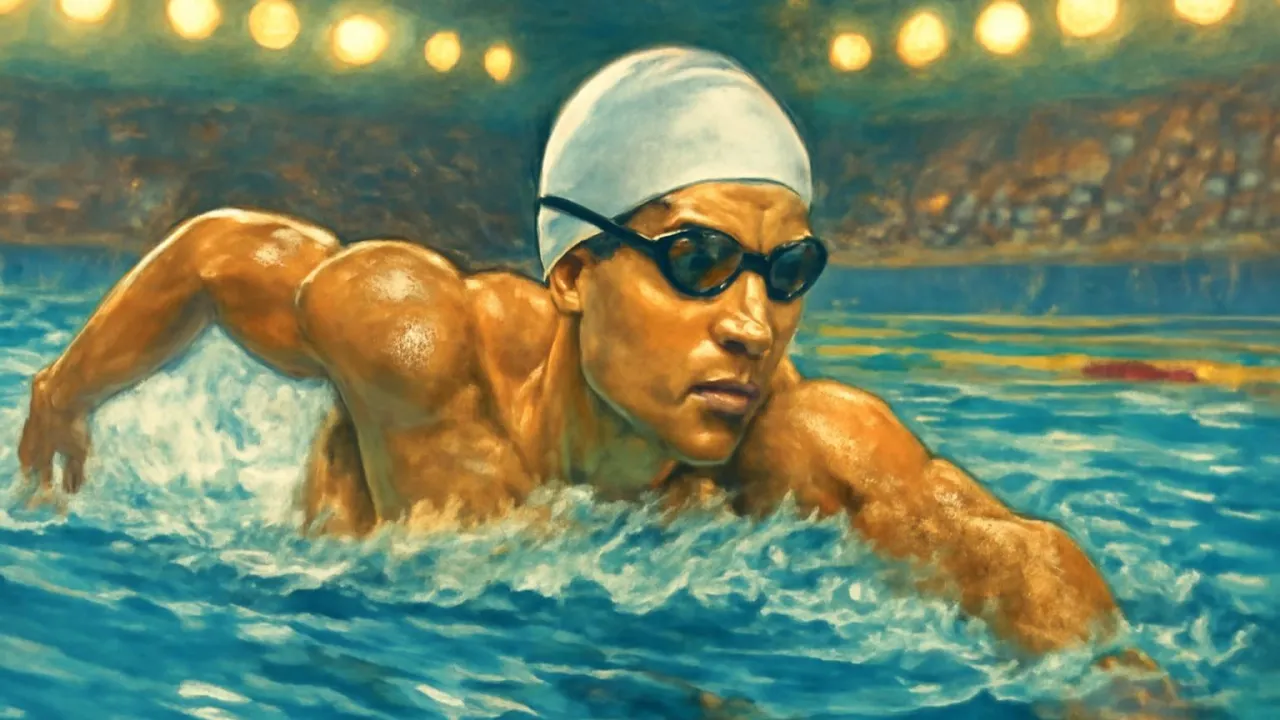
Alexander Popov set world records in the 50-meter and 100-meter freestyle races!
✨ Word Sparks (Grade 2 Glossary)
Tap 🔊 to hear
champion
A person who wins first place
coach
Someone who helps you get better
stroke
A way to move in swimming
🪝
What does it take to be the fastest swimmer in the world?
1
Racing the Waves
Alexander loved splashing in the water as a child. He always tried to swim faster than his friends. His dream was to become a swimmer one day.
2
Training Hard
Alexander practiced swimming every single day, even when tired. He listened to his and worked on his freestyle . He wore goggles and a cap to help him move quickly.
3
Olympic Champion
Alexander swam in the Olympics and won four gold medals. He became famous for his amazing speed in the pool. People called him the 'Russian Rocket' because he was so fast.
Popov is the only male swimmer to win back-to-back Olympic golds in both the 50m and 100m freestyle!
✨ Word Sparks (Grade 3 Glossary)
Tap 🔊 to hear
perseverance
Never giving up, even when it's hard
technique
The special way you do something well
legacy
What people remember you for
🪝
Can you imagine gliding through water so quickly that the world calls you a rocket?
1
Early Love for Water
Alexander Popov first discovered his love for swimming when he was a young boy in Russia. He enjoyed racing his friends and always wanted to be the fastest in the pool. His curiosity about how to move smoothly through water made him practice different strokes. Alexander’s dream was to swim in the Olympics one day.
2
Dedication and Training
To reach his goal, Alexander trained for hours each day with his coach. He focused on perfecting his freestyle and building strong muscles. Wearing his swim cap and goggles, he learned how to dive and turn quickly at each end of the pool. His helped him become faster every year.
3
Olympic Glory
Alexander’s hard work paid off when he competed in the Olympic Games. He won four gold medals in the 50-meter and 100-meter freestyle events. His powerful strokes and smooth style amazed fans and competitors alike. People around the world cheered for the 'Russian Rocket.'
4
Changing the Sport
Alexander Popov inspired swimmers everywhere by showing how discipline and lead to success. He set world records that lasted for years and became a role model for young athletes. Popov also promoted sportsmanship and teamwork in swimming. His continues to make waves in the swimming world today.
1. What helped Alexander become a champion swimmer?
2. Why do people call Popov the 'Russian Rocket'?
🤯 Mind-Blowing Fact • Grade 4
Popov’s world record in the 100m freestyle stood unbroken for nearly eight years!
✨ Word Sparks (Grade 4 Glossary)
Tap 🔊 to hear
efficiency
Doing something with no wasted effort
resilience
Bouncing back after a tough time
icon
A person who is greatly admired
🪝
What does it take to become a swimming legend who inspires athletes across the globe?
1
A Spark in the Water
As a child growing up in Russia, Alexander Popov was fascinated by the feeling of gliding across water. Even in cold weather, he would practice swimming at the local pool, always eager to improve his speed and technique. His early dedication caught the attention of coaches, who saw great potential in his smooth, powerful strokes. By his teenage years, Popov was already training with some of the best swimmers in the country.
2
The Path to Olympic Greatness
Popov’s journey to the top was filled with long hours of disciplined training and countless laps in the pool. He focused on perfecting his freestyle sprint, learning to control every movement for maximum . Under the guidance of his legendary coach Gennadi Touretski, Popov developed a unique style that combined strength, balance, and flawless turns. His commitment to practice and his ability to stay calm under pressure set him apart from other swimmers.
3
Making History in the Pool
At the 1992 and 1996 Olympic Games, Popov stunned the world by winning both the 50-meter and 100-meter freestyle events. He became the only male swimmer to achieve this double victory at back-to-back Olympics, setting new world records along the way. His nickname, the 'Russian Rocket,' reflected both his speed and his smooth, seemingly effortless swimming style. Popov’s achievements made him a national hero and a global in the sport.
4
A Lasting Impact
Beyond his medals, Alexander Popov inspired generations of swimmers with his sportsmanship and dedication to fair play. He later worked to promote swimming and healthy lifestyles for young people around the world. Popov’s legacy lives on in the records he set and the athletes he inspired to chase their own dreams. His story reminds us that true greatness comes from hard work, , and a passion for what you do.
1. Which coach helped shape Popov’s swimming style?
2. What made Popov’s swimming unique?
🤯 Mind-Blowing Fact • Grade 5
Popov is the only man to win both the 50m and 100m freestyle at two consecutive Olympics (1992 and 1996).
✨ Word Sparks (Grade 5 Glossary)
Tap 🔊 to hear
endurance
The ability to keep going for a long time
innovation
A new idea or way of doing things
sportsmanship
Being fair and respectful in sports
🪝
How did a determined young swimmer from Russia become one of history’s greatest freestyle champions?
1
A Childhood Fueled by Curiosity
Picture a young boy in icy Russia, braving chilly waters just to feel the thrill of speed. Alexander Popov’s fascination with swimming began early, as he raced friends and challenged himself to glide faster with every lap. Driven by a natural curiosity about movement and water, he constantly experimented with different strokes, always seeking ways to improve his technique. His early coaches noticed his dedication and encouraged him to pursue competitive swimming. Even as a child, Popov’s relentless determination set him apart from his peers.
2
Relentless Training and Technical Mastery
Popov’s rise to the top of the swimming world was no accident; it was the result of years of disciplined, scientific training. Under the mentorship of Gennadi Touretski, he analyzed every aspect of his freestyle sprint, from the angle of his hand entry to the efficiency of his flip turns. Popov’s workouts often involved thousands of meters each day, focusing on both speed and . His coach emphasized the importance of mental preparation, teaching Popov how to stay calm and focused under the intense pressure of international competition. This combination of physical and mental mastery became his trademark.
3
Olympic Triumphs and World Records
Alexander Popov’s Olympic career is legendary: at the 1992 Barcelona and 1996 Atlanta Games, he won gold medals in both the 50-meter and 100-meter freestyle events—an unprecedented achievement for a male swimmer. He set world records in both distances, with his 100-meter freestyle record remaining unbroken for nearly eight years. Popov’s signature style combined long, smooth strokes with explosive power off the blocks, earning him the nickname 'The Russian Rocket.' His ability to maintain perfect technique even at top speed set a new standard in sprint swimming.
4
Legacy Beyond the Pool
Popov’s influence extends far beyond his medal count. After retiring from competition, he became a leader in international swimming organizations, advocating for athlete rights and the promotion of youth sports. He is celebrated for his , humility, and commitment to clean, fair competition. Popov’s story is often cited by coaches and athletes as a model of resilience, discipline, and the pursuit of excellence. His records and example continue to inspire new generations of swimmers worldwide.
5
Lessons from a Swimming Legend
Alexander Popov’s life demonstrates that greatness is achieved through a blend of talent, hard work, and a willingness to learn from both success and failure. His technical reshaped the way freestyle sprinting is taught and executed, influencing training methods across the globe. Popov’s journey from a curious child in Russia to a world-renowned champion shows the power of perseverance and the importance of setting ambitious goals. Today, his legacy endures not only in the record books but also in the hearts of those he has inspired to chase their dreams, both in and out of the water.