🇺🇸 U.S. HISTORY
🏛️ Founding Father • 1st U.S. Secretary of the Treasury (1789–1795)
VA History & Social Science SOL K.1, 1.2, 2.4, VS.1–VS.10, USI & USII
Alexander Hamilton
Constitution Champion and Architect of U.S. Finance
Grade 5 • Advanced • 439 words
⏳ Era / StatehoodFounding Era: 1757–1804 (Treasury Secretary: 1789–1795)
🗺️ Region / CapitalNevis (Caribbean) & New York City, New York
📜 Key MilestoneCo-Wrote Federalist Papers, Built U.S. Credit, Mint & Coast Guard
⚡ Historical SparkWrote 51 Federalist Papers and designed the financial foundation of the United States
🤯 Mind-Blowing Fact • Grade 1
Alexander Hamilton started a small fleet of ten wooden patrol boats in 1790 that grew into today's heroic United States Coast Guard!
✨ Word Sparks (Grade 1 Glossary)
Tap 🔊 to hear
essay
A short piece of writing sharing clear ideas
Treasury
The department managing our country's money and coins
Mint
The official place that stamps metal coins
🪝
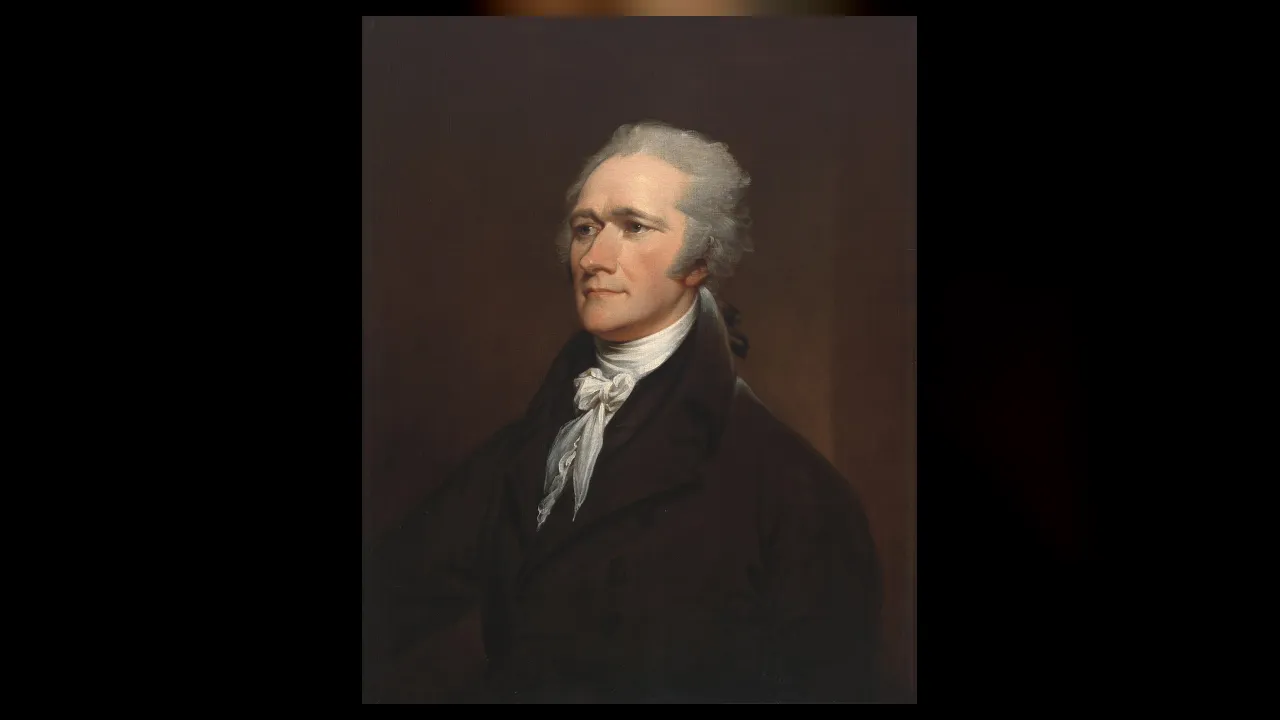
Who is the Founding Father smiling on the ten-dollar bill?
1
Writing His Way Across the Sea
Scratch, scribble! Growing up poor on a warm Caribbean island, young Alexander loved reading and writing. Neighbors admired his smart so much they helped send him to college in New York!
2
George Washington's Right Hand
During the Revolutionary War, General George Washington trusted Alexander to write important letters and lead brave troops at Yorktown in Virginia!
3
America's Money Builder
Never a president, Alexander became our very first Secretary of the ! He started the U.S. to make coins and put his face on the ten-dollar bill.
1. Which piece of U.S. paper money features Alexander Hamilton's portrait?
2. Which military rescue service traces its roots to ten cutter boats started by Hamilton in 1790?
🤯 Mind-Blowing Fact • Grade 2
Writing at top speed in 1787 and 1788, Alexander Hamilton personally penned fifty-one of the eighty-five Federalist Papers—that is an average of nearly two complex constitutional essays every week!
✨ Word Sparks (Grade 2 Glossary)
Tap 🔊 to hear
aide
A trusted assistant helping an important leader
credit
Trust that someone will pay back borrowed money
approve
To agree officially to adopt a plan
🪝
How did an orphaned teenager from a tiny island help build the U.S. Constitution and our money system?
1
From Island Clerk to Yorktown
Howl, whoosh! After a fierce hurricane swept his Caribbean island home, teenage clerk Alexander Hamilton wrote such a vivid letter describing the storm that townspeople raised money to send him to school in New York. Soon he joined the Revolution, serving four years as General George Washington's chief and leading a daring victory charge at Yorktown, Virginia!
2
Explaining the New Constitution
After the war, America's first weak government struggled to pay soldiers or regulate trade. Hamilton signed the new U.S. Constitution in 1787 and teamed up with James Madison and John Jay to write eighty-five newspaper essays—The Federalist Papers—explaining why states should it.
3
First Secretary of the Treasury
Appointed by President Washington in 1789 as America's first Treasury Secretary, Hamilton paid the young nation's debts fairly, created the U.S. Mint, and started the Coast Guard.
1. Which two fellow Founders teamed up with Alexander Hamilton to write The Federalist Papers?
2. At which decisive 1781 Revolutionary War battle in Virginia did Colonel Alexander Hamilton lead a bold nighttime capture of Redoubt No. 10?
🤯 Mind-Blowing Fact • Grade 3
Over dinner in June 1790 with Virginians Thomas Jefferson and James Madison, Alexander Hamilton struck a famous compromise: Congress approved Hamilton's debt plan, and in return the permanent U.S. capital—Washington, D.C.—was placed along the Potomac River!
✨ Word Sparks (Grade 3 Glossary)
Tap 🔊 to hear
confederation
A loose group of states with weak central rules
uniform
Matching and working the exact same way everywhere
compromise
Reaching a fair middle ground where both sides gain
🪝
Why did early America have thirteen different kinds of confusing money until Alexander Hamilton stepped in?
1
Immigrant Student and Patriot Officer
Imagine running an entire international trading store at age fourteen because the owner trusted your math skills! Orphaned young in the West Indies, Alexander Hamilton sailed to New York in 1772 to study at King's College (now Columbia University). When war broke out, General George Washington relied on young Hamilton's sharp mind for four grueling years before Hamilton led troops to victory at Yorktown, Virginia.
2
Champion of a Stronger Union
Under the weak Articles of , each state printed its own money and argued over trade. Representing New York at the 1787 Constitutional Convention in Philadelphia, Hamilton signed the Constitution and organized The Federalist Papers—writing fifty-one of the eighty-five essays himself to persuade voters to ratify it.
3
Rescuing America's Credit
Named first Secretary of the Treasury by President Washington in 1789, Hamilton faced huge war debts. He convinced Congress to pay off state and national debts honestly—trading capital-city location plans with Thomas Jefferson and James Madison so the future national capital would sit along the Potomac River bordering Virginia!
4
Coins, Banks, and Lasting Institutions
Hamilton established the First Bank of the United States, the U.S. Mint for dollars and cents, and the Revenue Cutter Service (today's Coast Guard), plus founded the New York Post newspaper before dying in an 1804 duel.
1. What did Hamilton, Jefferson, and Madison agree to in their famous Compromise of 1790?
2. Why did Hamilton, Madison, and Jay publish all eighty-five Federalist Papers under one shared pen name, 'Publius'?
🤯 Mind-Blowing Fact • Grade 4
After Alexander Hamilton died in 1804, his devoted wife Elizabeth 'Eliza' Schuyler Hamilton lived to age ninety-seven—co-founding New York City's first private orphanage and helping raise funds to build the Washington Monument!
✨ Word Sparks (Grade 4 Glossary)
Tap 🔊 to hear
assumption
Taking over responsibility for paying earlier state debts
implied powers
Constitutional powers reasonably needed to carry out duties
manumission
The legal act of freeing enslaved individuals
🪝
How did Alexander Hamilton turn a bankrupt confederation of thirteen states into a trusted modern economy?
1
Caribbean Beginnings to Yorktown Valor
Growing up without wealth or family connections on the Caribbean islands of Nevis and St. Croix, Alexander Hamilton learned accounting, shipping, and currency exchange firsthand in a merchant countinghouse before sailing to New York in 1772. Commissioning an artillery company in 1776, he served four pivotal years as Lieutenant Colonel and chief staff aide to General George Washington—drafting orders at Valley Forge—before leading a decisive bayonet assault on British Redoubt No. 10 at Yorktown, Virginia, in October 1781.
2
Constitutional Convention and The Federalist
Having witnessed soldiers go unpaid because Congress lacked taxing authority under the Articles of Confederation, Hamilton called early for constitutional reform at the 1786 Annapolis Convention and signed the U.S. Constitution in 1787 as New York's sole remaining delegate. Recruiting Virginia's James Madison and New York's John Jay, Hamilton organized and authored fifty-one of the eighty-five Federalist essays—including Federalist No. 78 explaining an independent Supreme Court with judicial review—still cited by judges today.
3
Treasury Blueprint and the Compromise of 1790
Appointed first Secretary of the Treasury by President Washington in September 1789, thirty-four-year-old Hamilton submitted brilliant economic reports to Congress on Public Credit, a National Bank, a Mint, and Manufactures. Through the Compromise of 1790 brokered with Jefferson and Madison, the federal government assumed state Revolutionary War debts at full value in exchange for locating the permanent national capital along the Potomac River. Overnight, American bonds became trusted across world markets.
4
Constitutional Debates and Enduring Legacy
When Jefferson argued the Constitution did not explicitly mention a bank, Hamilton invoked Article I's 'Necessary and Proper' Clause to charter the First Bank of the United States (1791)—a constitutional debate that birthed America's first political parties (Federalists and Democratic-Republicans) and later inspired Chief Justice John Marshall. An active member of the New-York Society opposing slavery, Hamilton died in July 1804 following a duel with Vice President Aaron Burr, while his widow Eliza Schuyler Hamilton preserved his papers for fifty years.
1. Which part of the U.S. Constitution did Hamilton point to when arguing Congress had authority to charter a National Bank?
2. What crucial topic did Alexander Hamilton explain in Federalist No. 78?
🤯 Mind-Blowing Fact • Grade 5
Twenty-eight years after Alexander Hamilton wrote his 1791 cabinet essay defending implied constitutional powers for a national bank, Chief Justice John Marshall adopted Hamilton's exact constitutional reasoning to write the Supreme Court's landmark unanimous ruling in McCulloch v. Maryland (1819)!
✨ Word Sparks (Grade 5 Glossary)
Tap 🔊 to hear
enumerated
Written down explicitly one by one in a list
agrarian
Centered on farming, soil, and rural country life
depreciated
Fallen sharply in market value over time
🪝
How did Alexander Hamilton envision and build a dynamic commercial, industrial, and constitutional republic out of thirteen debt-ridden states?
1
Mercantile Youth to Revolutionary Strategist
Born out of wedlock on the British West Indian island of Nevis (likely 1757) and orphaned in boyhood on St. Croix, Alexander Hamilton mastered double-entry bookkeeping, maritime trade, and international bills of exchange as a teenage clerk—where witnessing Caribbean plantation brutality also instilled his lifelong opposition to slavery. Sponsored by island benefactors to enter King's College in New York in 1773, he raised a provincial artillery company in 1776, served four indispensable years (1777–1781) as General George Washington's French-speaking aide-de-camp, and commanded a light-infantry battalion seizing Redoubt No. 10 at the Siege of Yorktown, Virginia, in October 1781.
2
Forging and Ratifying the Constitution
Convinced by wartime supply failures that the Articles of Confederation imperiled independence, Hamilton co-drafted the 1786 Annapolis call that produced the 1787 Philadelphia Constitutional Convention. Though many of his centralized proposals went unadopted, he signed the finished Constitution and immediately launched history's preeminent work of American political theory: The Federalist (1787–1788). Collaborating with James Madison and John Jay as 'Publius,' Hamilton wrote fifty-one of the eighty-five essays—articulating energetic executive responsibility (No. 70) and constitutional judicial review (No. 78)—while leading six weeks of floor debate at Poughkeepsie to win New York's ratification 30–27.
3
Four Reports That Built Modern American Finance
Confirmed on September 11, 1789, as first Secretary of the Treasury, thirty-two-year-old Hamilton transformed roughly $77 million in Continental and state IOUs into rock-solid sovereign bonds. Across four landmark state papers—First Report on Public Credit (1790), Report on a National Bank (1790), Report on the Establishment of a Mint (1791), and farsighted Report on Manufactures (1791)—he consolidated national credit via the Potomac-capital Compromise of 1790 with Jefferson and Madison, established bimetallic decimal currency at the U.S. Mint, created the ten-ship Revenue Marine (forerunner of the U.S. Coast Guard), and envisioned a diversified industrial and technological economy.
4
Implied Powers and the First Party System
When Secretary of State Thomas Jefferson and Attorney General Edmund Randolph argued that chartering the First Bank of the United States exceeded Congress's powers, Hamilton penned his celebrated February 1791 Opinion on the Constitutionality of a National Bank. Grounded in Article I, Section 8's 'Necessary and Proper' Clause, Hamilton's doctrine of implied powers persuaded President Washington—and twenty-eight years later supplied virtually word-for-word logic for Chief Justice John Marshall's unanimous opinion in McCulloch v. Maryland (1819). Simultaneously, clashing visions between Hamilton's urban-commercial Federalists and Jefferson's Democratic-Republicans crystallized America's First Party System.
5
Civic Restraint, Abolitionism, and Final Sacrifice
Returning to New York legal practice in 1795—while co-leading the New-York Manumission Society advocating gradual emancipation and free schools for Black children—Hamilton twice placed constitutional stability above partisan rivalry, including backing longstanding opponent Thomas Jefferson over Aaron Burr during the deadlocked House election of 1800. Mortally wounded by Burr in a Weehawken, New Jersey, duel in July 1804 after firing his pistol harmlessly away, Hamilton left institutional pillars that still underpin the American economy.
1. How did Alexander Hamilton's 1791 'Report on Manufactures' differ from Thomas Jefferson's early economic vision for America?
2. Why did Federalist leader Alexander Hamilton urge House Federalists to choose his longtime rival Thomas Jefferson over Aaron Burr in the deadlocked Election of 1800?