⚡ Cosmic SparkGives us a preview of our own Sun's future, swelling 44 times wider while weighing nearly the same
🤯 Mind-Blowing Fact • Grade 1
NASA's famous Pioneer 10 space probe is coasting silently toward Aldebaran right now—and will arrive in about two million years!
✨ Word Sparks (Grade 1 Glossary)
Tap 🔊 to hear
Taurus
Winter star pattern shaped like a bull
tangerine
Warm bright orange color like citrus fruit
space probe
Robotic spacecraft sent out to explore space
🪝
Which glowing tangerine star gleams like the fierce eye of a charging bull?
1
Bull's-Eye in the Winter Sky
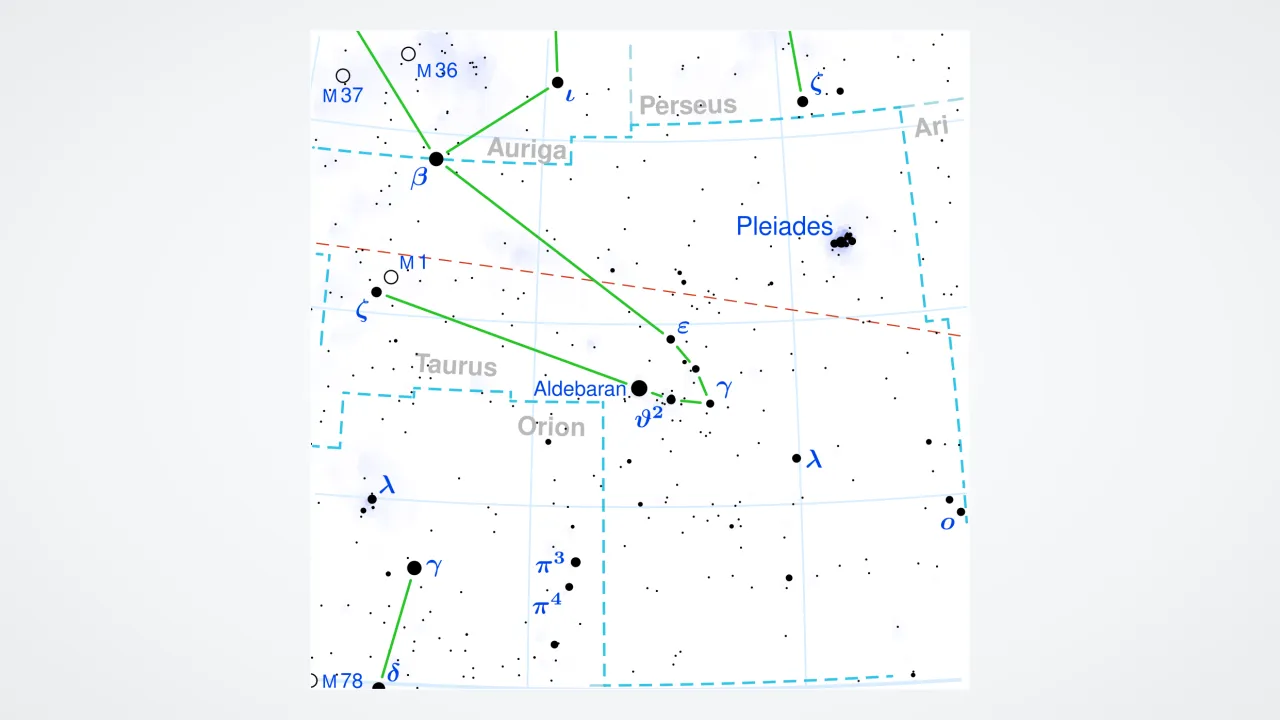
Look up on a frosty winter night for a bright letter 'V' of stars! That V-shape draws the face of the Bull. Shining right at one tip like an angry orange eye glows Aldebaran!
2
Chasing Seven Little Sisters
All night long, this bright orange star marches across the sky right behind a tiny twinkling star cluster called the Seven Sisters.
3
Forty-Four Suns Wide
Even though it weighs about the same as our Sun, it puffed out forty-four times wider!
1. What part of Taurus the Bull does orange Aldebaran represent in the sky?
2. Which historic NASA spacecraft is coasting in the direction of Aldebaran?
🤯 Mind-Blowing Fact • Grade 2
Aldebaran is a cosmic photobomber—it has zero connection to the V-shaped Hyades star cluster behind it and sits more than twice as close to Earth!
✨ Word Sparks (Grade 2 Glossary)
Tap 🔊 to hear
Pleiades
Sparkling Seven Sisters star cluster in Taurus
Hyades
V-shaped star cluster behind orange Aldebaran
red giant
Sun-sized star puffed huge late in life
🪝
How did one star photobomb an entire star cluster from eighty-five light-years in front?
1
'The Follower' Across the Sky
Trace Orion's Belt upward to the right, and you will spot bright orange Aldebaran chasing the misty star cluster across the night! In fact, its name comes from the Arabic word al-Dabaran, meaning 'The Follower,' because it rises right behind those famous Seven Sisters.
2
Cosmic Photobomber!
To our eyes, Aldebaran sits right inside the V-shaped star cluster forming the Bull's face. Yet looks are tricky in space: the Hyades stars sit 153 light-years away, while Aldebaran floats much closer at 65 light-years—photobombing them along the same line of sight!
3
Sneak Peek at Our Sun's Future
Five billion years from now, our own yellow Sun will run low on core fuel and puff into an orange giant very much like Aldebaran!
1. Why does the Arabic name 'al-Dabaran' mean 'The Follower'?
2. Why do astronomers call Aldebaran a 'photobomber' in front of the Hyades cluster?
🤯 Mind-Blowing Fact • Grade 3
Because puffing outward slowed its spin just like an ice skater stretching out both arms, Aldebaran takes nearly a year and a half—520 Earth days—to spin around just once!
✨ Word Sparks (Grade 3 Glossary)
Tap 🔊 to hear
hydrogen shell
Burning layer wrapped around a star's core
helium core
Dense ash center left after core hydrogen burns
conservation
Physics rule slowing spin when objects expand
🪝
Why did a Sun-weight star swell forty-four times wider when its central tank ran out of hydrogen?
1
Fourteenth Brightest Star at Night
Shining 65.3 light-years away in Taurus, Alpha Tauri—Aldebaran—is the fourteenth-brightest star in Earth's sky. Notice the key difference between a giant and a supergiant: while Betelgeuse started life nearly twenty times heavier than our Sun, Aldebaran weighs just 1.16 solar masses—barely heavier than our Sun!
2
How a Sun Grows Into a Red Giant
After roughly six billion years of steady yellow sunshine, Aldebaran used up all the hydrogen fuel in its central core. As its shrank and heated up, hydrogen ignited furiously in a thin shell around that core—pushing the star's outer gas out to 38 million miles wide!
3
Cooler Skin, Brighter Lantern
Expanding cooled Aldebaran's surface to about 6,700°F (3,900 K), turning it tangerine-orange while boosting its total brightness to 440 times our Sun's glow.
4
Slow, Dignified Spin
Just like a figure skater extending their arms spins much slower, puffing out forty-four times wider slowed Aldebaran's spin to over 500 Earth days per turn!
1. How does Aldebaran's mass compare with our own Sun's mass?
2. Why does Aldebaran take roughly 520 Earth days to complete just one rotation?
🤯 Mind-Blowing Fact • Grade 4
In 509 CE, astronomers in Athens watched the Moon cover Aldebaran—a historic observation Edmond Halley used 1,200 years later to prove stars move across the galaxy!
✨ Word Sparks (Grade 4 Glossary)
Tap 🔊 to hear
red-giant branch
Evolutionary climb when aging stars swell huge
helium flash
Sudden runaway ignition of core helium fuel
Doppler wobble
Rhythmic starlight shift from gravity or pulsing
🪝
How did Edmond Halley use Roman star records of Aldebaran to shatter a two-thousand-year-old myth—and does a giant planet orbit it?
1
Halley Breaks the Myth of 'Fixed Stars'
For two millennia after Aristotle, scholars taught that stars were pinned permanently in place on a crystal sphere. Then in 1718, English astronomer Edmond Halley checked ancient Greek and Roman records of lunar occultations—moments when the Moon passed directly across bright stars near the ecliptic. Comparing positions from 509 CE in Athens against 18th-century London skies, Halley realized Aldebaran, Sirius, and Arcturus had drifted several arcminutes across the sky—proving stars zoom through space on their own!
2
Ascending the Red-Giant Branch
Modern Kepler K2 space-telescope asteroseismology—tracking subtle sound waves rippling every few days through Aldebaran's bloated 61-million-kilometer body—pegs its age near 6.4 billion years. Right now it climbs the ',' fusing hydrogen in a thin shell around a crushed, inert helium core before eventually igniting helium in a dramatic core flash!
3
The Riddle of Planet Candidate Aldebaran b
Back in 1993, astronomers noticed a 629-day rhythmic in Aldebaran's light that looked like a six-Jupiter-mass giant planet ('Aldebaran b') orbiting slightly farther out than Mars! Yet recent asteroseismic and magnetic studies warn that giant convective oscillations on bloated red giants can mimic planet wobbles—keeping astronomers eagerly debating whether Aldebaran b is real.
4
Pioneer 10's Gold Plaque Messenger
Carrying a gold-anodized aluminum plaque greeting the cosmos, NASA's silent Pioneer 10 coasts at 27,000 mph toward Taurus, due to pass near Aldebaran two million years from now.
1. How did 6th-century Athens Moon observations of Aldebaran help Edmond Halley in 1718?
2. Why are astronomers extra cautious when confirming giant planet candidate 'Aldebaran b'?
🤯 Mind-Blowing Fact • Grade 5
Before giant laser interferometers existed, astronomers measured Aldebaran's 38-million-mile width by timing millisecond light ripples as the airless edge of our Moon sliced across it!
✨ Word Sparks (Grade 5 Glossary)
Tap 🔊 to hear
diffraction fringe
Tiny light-dark wave ripple past sharp edge
planetary nebula
Glowing gas shell shed by dying Sun-like star
isothermal core
Central star zone holding uniform high temperature
🪝
How do lunar occultation diffraction fringes, K2 asteroseismology, and degenerately supported helium cores reveal our own Sun's destiny in Alpha Tauri?
1
Royal Star Lore, Ecliptic Occultations, and Proper Motion
Celebrated in ancient Persia as Tascheter—one of the four 'Royal Stars' guarding the seasonal sky—and cataloged as Alpha Tauri (visual magnitude +0.86), Aldebaran sits just 5.47 degrees south of the ecliptic at 65.3 light-years (20.0 parsecs), foregrounding the 153-light-year Hyades cluster purely by perspective. Because the Moon's 18.6-year nodal regression periodically sweeps across Aldebaran, high-speed photometers timing millisecond Fresnel at the Moon's airless limb measured Aldebaran's ~20-milliarcsecond angular diameter decades before modern optical interferometers.
2
Degenerate Core Physics on the Red-Giant Branch
As the primary K5+III spectral standard, Aldebaran illustrates the exact interior physics awaiting our Sun in five billion years. Inside its 61-million-kilometer (~44.1 solar radii) convective envelope sits an isothermal helium core crushed to quantum electron degeneracy. As a surrounding hydrogen-burning shell dumps fresh helium ash onto that core, core gravity intensifies and shell fusion accelerates, driving luminosity to ~439 Suns while radiative losses cool the bloated photosphere to ~3,910 kelvins.
3
Kepler K2 Photometry Weighing Alpha Tauri
Although first-magnitude glare normally overwhelms space photometers, clever pixel-halo analysis with NASA's Kepler K2 mission extracted solar-like acoustic oscillations oscillating around a ~5-day timescale. Coupled with interferometric radii, asteroseismology pinned Aldebaran's mass cleanly at 1.16 ± 0.07 solar masses and dated its evolutionary age near 6.4 billion years—resolving earlier spectroscopic uncertainties.
4
629-Day Radial-Velocity Debate and Faint Red Dwarf Companion
Precise radial velocities begun by Artie Hatzes in 1993 revealed a coherent 628.96-day, ~140-m/s oscillation consistent with a ~6.5-Jupiter-mass companion at 1.46 AU, though variable long-period amplitude leaves astronomers testing planet-versus-nonradial-oscillation models. Farther out at ~31 arcseconds (~600 AU), faint 13.6-magnitude M2.5 red dwarf Alpha Tauri B shares common proper motion.
5
Planetary Nebula Horizon
Following an eventual core helium flash and asymptotic-giant-branch thermal pulses, Aldebaran will gently cast off its outer layers as a glowing , leaving behind an Earth-sized carbon-oxygen white dwarf.