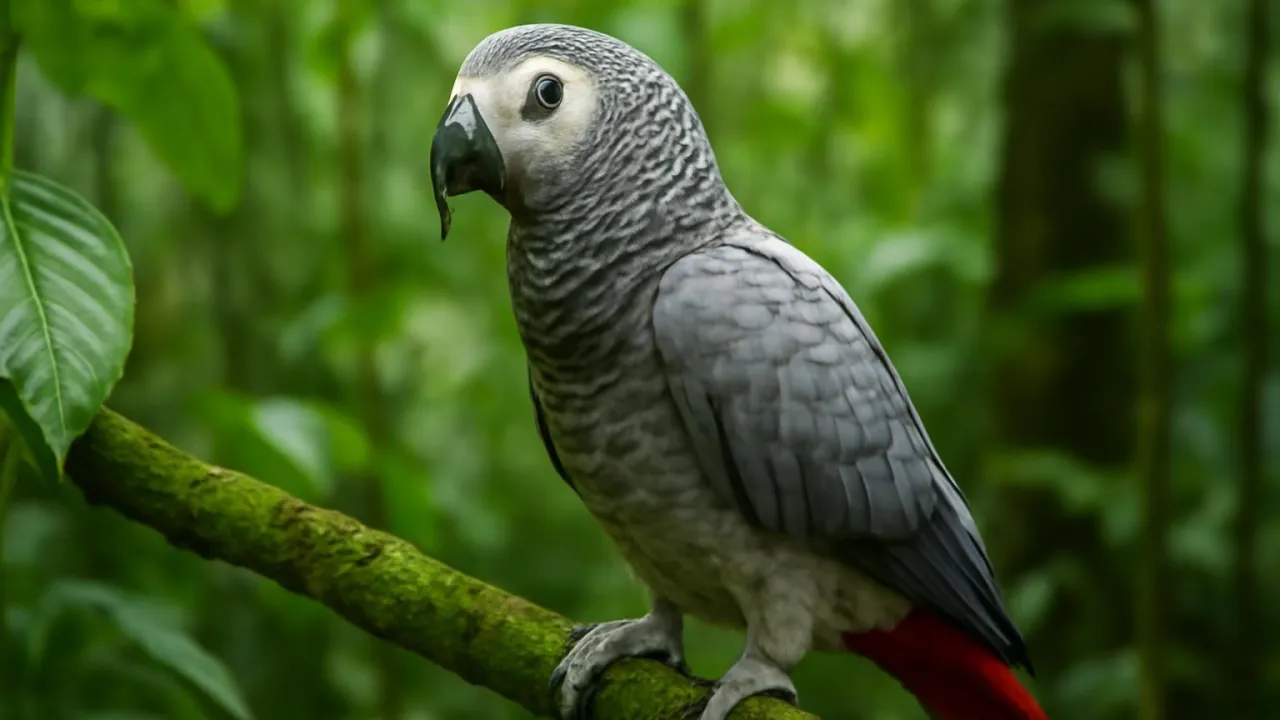
African Grey Parrots can learn hundreds of words and use them in context!
✨ Word Sparks (Grade 2 Glossary)
Tap 🔊 to hear
mimic
To copy sounds or actions exactly.
rainforest
A warm forest with lots of rain and trees.
curious
Wanting to learn or know about things.
🪝
Did you know some birds can talk like humans?
1
Amazing Talking Bird
The African Grey Parrot can human speech very well. It uses its strong beak to eat nuts and seeds. Its feathers are mostly gray with a bright red tail. These birds are very smart and .
2
Home in the Forest
This parrot lives in across West and Central Africa. It likes to stay high in tall trees where it is safe. The forest gives it food like fruits and nuts to eat. It often moves in small groups with other parrots.
3
Special Features
The African Grey has a sharp black beak for cracking hard shells. Its eyes are bright and help it see well in the forest. This bird’s red tail feathers help it stand out. It uses its feet to hold food while it eats.
African Grey Parrots have brain-to-body ratios similar to great apes, showing high intelligence.
✨ Word Sparks (Grade 3 Glossary)
Tap 🔊 to hear
camouflage
Colors that help animals hide in their home.
zygodactyl
Feet with two toes forward and two toes back.
predator
An animal that hunts other animals for food.
🪝
How does the African Grey Parrot use its talking skill to survive?
1
Talking and Mimicry
African Grey Parrots are famous for their ability to mimic human speech and sounds. This mimicry helps them communicate with others in their social groups. Their intelligence is one of their greatest adaptations for survival. They use sounds to warn others about nearby.
2
Habitat and Behavior
These parrots live in the dense rainforests of West and Central Africa. Their gray feathers provide among tree branches and shadows. They live in flocks which helps protect them from . The forest provides them with nutrients from fruits, nuts, and seeds.
3
Physical Adaptations
The African Grey has a strong, curved beak that cracks hard shells easily. Its feet have toes, meaning two toes point forward and two backward, helping it grip branches firmly. Their bright red tail feathers contrast with their gray body for signaling. Their sharp eyes allow them to spot food and danger quickly.
4
Life Cycle and Growth
African Grey Parrots build nests in tree cavities where they lay eggs. The young parrots grow slowly and learn to mimic sounds from their parents. This learning helps them join social groups and find food. Their long lifespan, up to 50 years, allows for many learning experiences.
2. What special feet do African Grey Parrots have?
🤯 Mind-Blowing Fact • Grade 4
African Grey Parrots can understand concepts like shape and color, showing advanced cognition.
✨ Word Sparks (Grade 4 Glossary)
Tap 🔊 to hear
ecosystem
A community of plants and animals living together.
disperse
To spread seeds or animals far and wide.
conservation
Protecting nature and animals from harm.
🪝
How does the African Grey Parrot’s intelligence affect its role in the ecosystem?
1
Communication and Survival
African Grey Parrots use their remarkable ability to mimic sounds to communicate within their flocks, which helps warn others of nearby predators and strengthens social bonds. This advanced communication is a key survival tool in their dense rainforest habitat. Their intelligence also allows them to solve problems, such as opening tough nuts or finding hidden food sources. These skills increase their chances of living longer and reproducing successfully.
2
Ecosystem Role and Food Web
As seed eaters, African Grey Parrots play an important role in dispersing seeds throughout the rainforest, which helps new plants grow and supports the ’s health. They are both prey and predator: hunted by larger birds and mammals while feeding on fruits, nuts, and insects. Their feeding habits help control insect populations and support forest regeneration. Human activities like deforestation threaten their habitats and disrupt these natural processes.
3
Geographic Distribution and Habitat
African Grey Parrots are native to the tropical rainforests of West and Central Africa, including countries like Cameroon, Congo, and Ghana. They prefer dense, humid forests with tall trees that provide shelter and nesting sites. These birds adapt to different forest layers, from the canopy to the understory, to find food and avoid predators. Habitat loss due to logging and agriculture has reduced their natural range significantly.
4
Conservation and Human Impact
Because of their intelligence and popularity as pets, African Grey Parrots face threats from illegal trapping and trade. efforts focus on protecting habitats and regulating trade through laws like CITES. Educating people about their ecological importance helps reduce demand for wild-caught birds. Captive breeding programs also support population recovery. Protecting these parrots helps maintain the balance of their rainforest .
1. How do African Grey Parrots help rainforests grow?
2. What human activity threatens African Grey Parrots?
🤯 Mind-Blowing Fact • Grade 5
African Grey Parrots can learn over 1,000 words and understand concepts like shape and color.
✨ Word Sparks (Grade 5 Glossary)
Tap 🔊 to hear
syrinx
The bird’s voice box that makes sounds.
zygodactyl
Feet with two toes forward and two toes back.
CITES
A law that protects wild animals from trade.
🪝
What makes the African Grey Parrot one of the most intelligent birds on Earth?
1
Taxonomy and Scientific Classification
The African Grey Parrot, scientifically named Psittacus erithacus, belongs to the family Psittacidae, which includes true parrots. It is divided into two subspecies: the Congo African Grey and the smaller Timneh African Grey. This species is native to the tropical rainforests of West and Central Africa, where it plays a vital ecological role. Its classification helps scientists study its behavior and conservation needs.
2
Physiological Adaptations and Mechanics
This parrot’s brain-to-body mass ratio rivals that of great apes, supporting its advanced cognitive abilities. Its vocal organ, the , allows precise control of sound production, enabling complex mimicry of human speech and environmental noises. The feet provide a strong grip for climbing and manipulating objects, while its curved beak efficiently cracks nuts and seeds. These physical traits enable survival in a competitive rainforest environment.
3
Conservation History and Challenges
African Grey Parrots have been heavily impacted by habitat loss due to deforestation and illegal pet trade, causing population declines. They are listed under Appendix II to regulate international trade and protect wild populations. Conservation programs include habitat preservation, captive breeding, and community education to reduce poaching. Understanding their ecological importance motivates global efforts to ensure their survival.
4
Ecological Role and Quantitative Comparisons
These parrots contribute to rainforest health by dispersing seeds from over 30 plant species, aiding forest regeneration. They can live up to 50 years in the wild, with weights ranging from 400 to 600 grams. Their flight speed can reach up to 30 miles per hour, allowing quick escapes from predators. Compared to other parrots, their vocal mimicry is among the most complex, with some individuals learning over 1,000 words.
5
Behavioral Intelligence and Social Learning
African Grey Parrots exhibit problem-solving skills, such as using tools and understanding shapes and colors, demonstrating advanced cognition. They learn vocalizations socially, mimicking sounds from parents and flock members to communicate effectively. Their long lifespan supports cumulative learning and social bonding within flocks. These behaviors highlight their sophisticated intelligence, making them subjects of numerous scientific studies.