🇺🇸 U.S. HISTORY
🏛️ 16th President of the United States (1861–1865)
VA History & Social Science SOL K.1, 1.2, 2.4, VS.1–VS.10, USI & USII
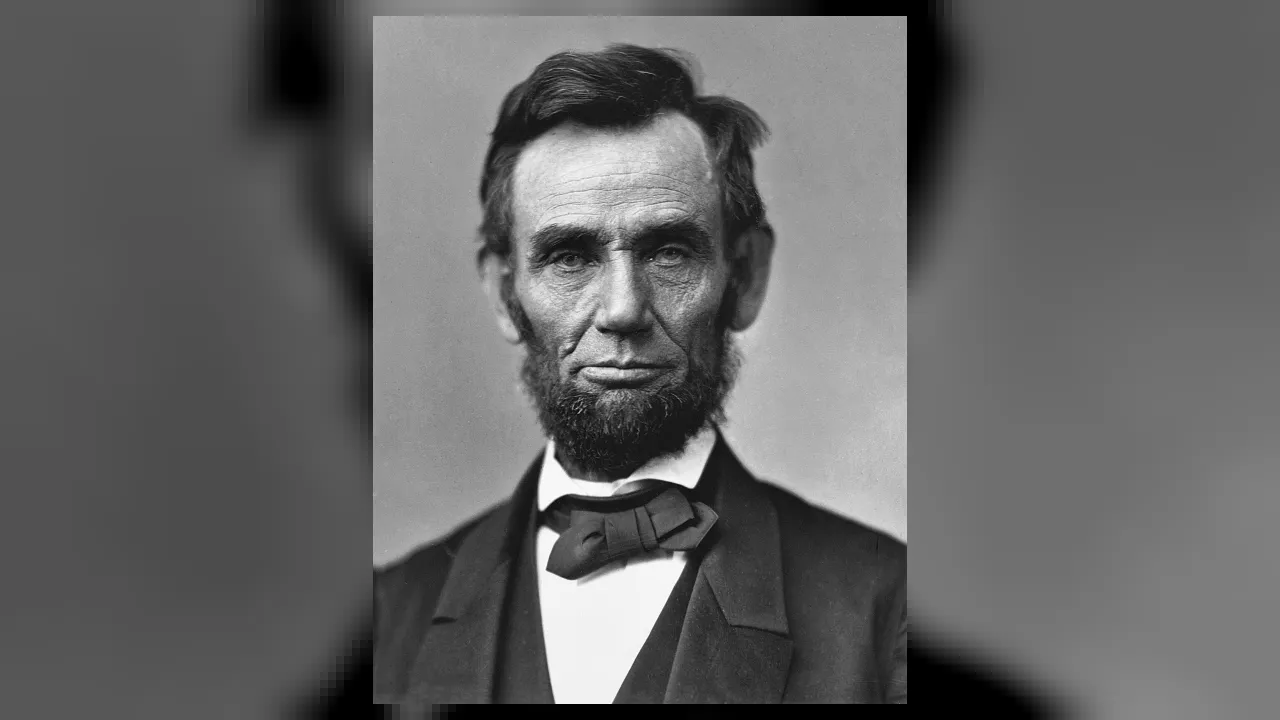
Abraham Lincoln
From Log Cabin Reader to Preserver of the Union
Grade 5 • Advanced • 325 words
⏳ Era / StatehoodPresidential Term: 1861–1865 (Born Feb 12, 1809, Kentucky)
🗺️ Region / CapitalSpringfield, Illinois & Washington, D.C.
📜 Key MilestonePreserved the Union, Emancipation Proclamation & Gettysburg Address
⚡ Historical SparkGuided the United States through the Civil War and championed ending slavery forever
🤯 Mind-Blowing Fact • Grade 1
Abraham Lincoln stood six feet four inches tall—the tallest U.S. president ever—and tucked important letters inside his tall hat!
✨ Word Sparks (Grade 1 Glossary)
Tap 🔊 to hear
cabin
A small simple house built from wooden logs
united
Joined together as one strong whole group
honest
Truthful and fair in words and actions
🪝
How far would you walk just to borrow one good book?
1
Reading by Firelight
Crackle, pop! Warm firelight glowed inside a tiny one-room log . Young Abe lay on the wooden floor reading books late at night. He walked miles to borrow stories!
2
Honest Abe the Leader
Neighbors trusted him because he always told the truth and returned every penny. Wearing a tall black stovepipe hat, he became our sixteenth president during a hard time.
3
Keeping America Together
When states fought in the Civil War, he worked bravely to keep our country . He also helped end slavery so millions of people could live free!
1. Where did Abraham Lincoln often keep important papers and notes?
2. What two big goals did President Lincoln work for during the Civil War?
🤯 Mind-Blowing Fact • Grade 2
Abraham Lincoln is the only U.S. president to hold a formal invention patent—Patent No. 6,469 for a device lifting riverboats over shallow sandbars!
✨ Word Sparks (Grade 2 Glossary)
Tap 🔊 to hear
emancipation
The act of setting enslaved people free
proclamation
An official public announcement by a leader
patent
An official government paper protecting a new invention
🪝
How did a boy with less than one year of formal schooling write some of America's greatest speeches?
1
Self-Taught on the Frontier
Chop, split, thud! Growing up in Kentucky and Indiana, young Abe chopped wood rails by day and read borrowed books by fireplace light at night. Though he attended school for less than a year total, he taught himself math, grammar, and law.
2
Leading Through the Civil War
In Illinois, people called him 'Honest Abe' for his fairness as a store clerk and lawyer. Soon after voters elected him our sixteenth president in 1860, eleven Southern states broke away, starting the American Civil War.
3
Words That Freed Millions
On January 1, 1863, President Lincoln signed the , declaring enslaved people in rebel states free. Later that year, his short Gettysburg Address reminded Americans that government belongs to the people.
1. How did Abraham Lincoln learn to become a lawyer?
2. What did the Emancipation Proclamation announce on January 1, 1863?
🤯 Mind-Blowing Fact • Grade 3
Abraham Lincoln grew his famous beard during the 1860 election after eleven-year-old Grace Bedell of New York wrote him a polite letter suggesting it!
✨ Word Sparks (Grade 3 Glossary)
Tap 🔊 to hear
secede
To formally break away from a country
malice
A wish to hurt or be unkind
transcontinental
Stretching all the way across a continent
🪝
How could a speech just 272 words long—lasting barely two minutes—inspire people around the world for centuries?
1
From Flatboats to Illinois Law
Picture an eleven-year-old girl named Grace Bedell writing a letter suggesting a presidential candidate grow a beard—and he actually listened! Before his famous beard and stovepipe hat, Abraham Lincoln worked on Mississippi River flatboats, ran a post office in New Salem, Illinois, and served in Congress.
2
A Nation Divided in 1861
Lincoln spoke clearly against letting slavery spread into western territories. After he won the 1860 presidential election, Southern states seceded—or broke away—to form the Confederacy. When Confederate cannons fired on Fort Sumter in April 1861, Lincoln vowed to preserve the Union.
3
Emancipation and Gettysburg
In 1863, Lincoln issued the Emancipation Proclamation, opening the Union Army to nearly 200,000 Black soldiers and sailors. That November in Pennsylvania, he delivered the 272-word Gettysburg Address, honoring fallen soldiers and calling for 'a new birth of freedom.'
4
Healing and Lasting Legacy
Lincoln also signed laws building the railroad and making Thanksgiving an annual national holiday. Before his tragic death in April 1865, just days after Union victory at Appomattox in Virginia, he urged Americans to reunite 'with toward none, with charity for all.'
1. About how long did it take President Lincoln to speak the entire Gettysburg Address?
2. Which beloved autumn tradition did Lincoln proclaim as a regular national holiday in 1863?
🤯 Mind-Blowing Fact • Grade 4
Inside the War Department telegraph room, Lincoln sent and read nearly a thousand wartime telegrams, making him the first leader in history to coordinate strategy electronically in real time!
✨ Word Sparks (Grade 4 Glossary)
Tap 🔊 to hear
reconciliation
Restoring friendly peace after a bitter conflict
amendment
An official change or addition to the Constitution
telegraph
An early wire system sending coded electrical messages
🪝
How did Abraham Lincoln hold a fractured republic together while transforming the meaning of American liberty?
1
Frontier Grit and Moral Conviction
Raised on small farms in Kentucky and Indiana before settling in Illinois, Abraham Lincoln knew hard physical labor firsthand. Largely self-educated through the Bible, Aesop's Fables, Shakespeare, and Euclid's geometry, he practiced law across the Illinois Prairie Circuit. In his famous 1858 debates against Senator Stephen A. Douglas, Lincoln warned that 'a house divided against itself cannot stand,' bringing him national attention.
2
Commander in Chief During Crisis
By the time Lincoln took the presidential oath in March 1861, seven Southern states had seceded, soon joined by four more—including Virginia—after the attack on Fort Sumter. Sitting for hours in the War Department office, Lincoln coordinated strategy, patiently searched for capable commanders like General Ulysses S. Grant, and steadfastly refused to accept the permanent breakup of the constitutional Union.
3
The Emancipation Proclamation and Thirteenth Amendment
Using his constitutional authority as Commander in Chief, Lincoln issued the Emancipation Proclamation effective January 1, 1863. Beyond freeing enslaved people in Confederate-held territory, it empowered Black Americans such as Frederick Douglass to recruit Union regiments. Recognizing that a wartime proclamation needed permanent constitutional backing, Lincoln tirelessly worked with Congress to pass the Thirteenth abolishing slavery nationwide.
4
Gettysburg, Appomattox, and Reconciliation
At Gettysburg in November 1863, Lincoln connected the Civil War directly to the Declaration of Independence's promise that 'all men are created equal.' In his March 1865 Second Inaugural Address, he urged healing rather than revenge. Five days after General Robert E. Lee surrendered at Appomattox Court House, Virginia, Lincoln was assassinated on April 14, 1865—leaving a reunited nation forever reshaped.
1. Why did Lincoln push Congress to pass the Thirteenth Amendment even after issuing the Emancipation Proclamation?
2. Which historic founding document did Lincoln point back to at the start of the Gettysburg Address ('Four score and seven years ago')?
🤯 Mind-Blowing Fact • Grade 5
In 1863, Abraham Lincoln signed the charter creating the National Academy of Sciences so independent scientists could advise the U.S. government on engineering, medicine, and discovery!
✨ Word Sparks (Grade 5 Glossary)
Tap 🔊 to hear
existential
Relating to whether something continues to exist
blockade
Sealing off ports with ships to stop trade
perish
To disappear, be destroyed, or come to an end
🪝
How did Abraham Lincoln harmonize the Declaration of Independence and the U.S. Constitution during America's greatest existential test?
1
Self-Education and the Logic of Liberty
Picture a frontier lawyer riding horseback across muddy Illinois prairies with a worn copy of Euclid's Elements in his saddlebag, studying geometric proofs to sharpen his legal logic! Born in Hardin County, Kentucky, in 1809, Abraham Lincoln rose from poverty through disciplined self-study. When the Kansas-Nebraska Act of 1854 reopened western territories to slavery, Lincoln reentered national politics, arguing in his 1858 debates with Stephen A. Douglas that restricting slavery's expansion fulfilled the Founders' vision.
2
Constitutional Crisis and Modern Strategy
Elected in November 1860 as the first Republican president, Lincoln confronted immediate secession. In his First Inaugural Address, he appealed to 'the better angels of our nature' while maintaining that the Union predated the Constitution and was legally unbroken. Once Confederate forces bombarded Fort Sumter in April 1861, Lincoln mobilized Northern industry, ordered a naval , and appointed rivals to a 'team of rivals' cabinet to unite wartime leadership.
3
Transforming the War Into a Crusade for Freedom
Following the Union strategic stand at Antietam in September 1862, Lincoln announced the Preliminary Emancipation Proclamation, signing the final order on January 1, 1863. Grounded in war powers, it declared over three million enslaved people in rebelling areas forever free, deterred European recognition of the Confederacy, and authorized Black enlistment—bringing roughly 180,000 soldiers into the United States Colored Troops and 19,000 sailors into the Union Navy.
4
Building Future Opportunity Amid War
Remarkably, even amid wartime crisis, Lincoln and the 37th Congress enacted transformative domestic legislation in 1862: the Homestead Act opening western acreage to settlers, the Morrill Land-Grant Act founding public agricultural and engineering universities, the Pacific Railway Act launching the transcontinental railroad, and the creation of the Department of Agriculture and National Academy of Sciences.
5
Redefining the Republic and Final Sacrifice
In 272 sculpted words at Gettysburg (November 19, 1863) and 701 reflective words in his Second Inaugural Address (March 4, 1865), Lincoln framed Union survival as testing whether 'government of the people, by the people, for the people, shall not from the earth.' After securing congressional passage of the Thirteenth Amendment in January 1865 and visiting freed Virginians in Richmond that April, Lincoln's assassination at Ford's Theatre sealed his legacy as the Union's great preserver.