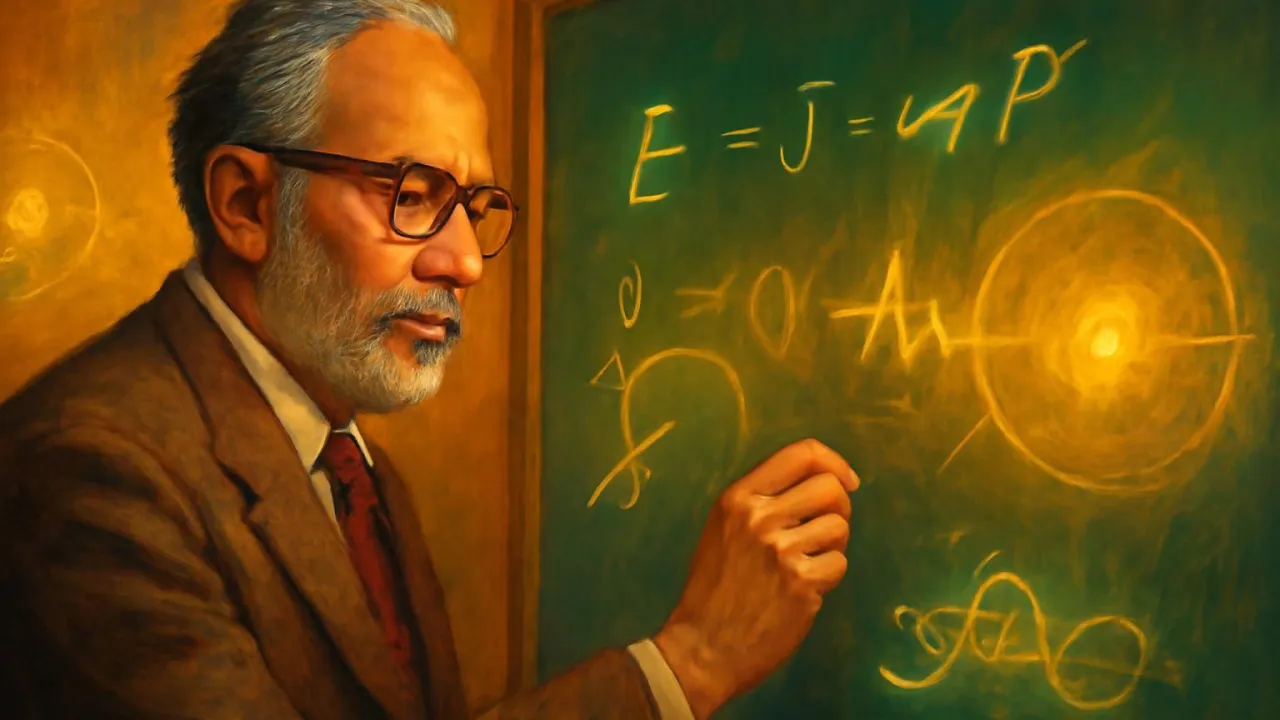
Abdus Salam’s ideas help scientists study stars and electricity today!
✨ Word Sparks (Grade 2 Glossary)
Tap 🔊 to hear
curiosity
Wanting to learn and ask questions
electricity
Power that makes lights and TVs work
universe
All the stars, planets, and space
🪝
What if you could solve the mysteries of light and stars?
1
Wondering About the World
When Abdus was a boy, he gazed at the night sky and asked endless questions. He wanted to know why stars twinkle and how light travels so far. His made him search for answers in every book he could find.
2
Working Toward His Dream
Abdus studied math and science every day, even when it was hard. He practiced solving problems and kept learning new things from his teachers. His family cheered him on as he tried to reach his big dream.
3
A Bright Discovery
Abdus Salam helped scientists understand how light and are connected. This discovery was very important for science, and he won the Nobel Prize. His ideas helped people learn more about the .
Abdus Salam’s electroweak theory helped scientists win more Nobel Prizes after him!
✨ Word Sparks (Grade 3 Glossary)
Tap 🔊 to hear
physics
The science of how things move and work
theory
An idea that explains how something happens
perseverance
Not giving up, even when it’s hard
🪝
Can you imagine solving a mystery about how light and electricity work together?
1
A Boy Full of Questions
Young Abdus Salam always wanted to know how the world worked. He spent hours reading books about math, stars, and science. His teachers saw his curiosity and encouraged him to keep exploring. Even as a boy, Abdus dreamed of making a big discovery.
2
Learning and Working Hard
Abdus studied at the best schools and worked hard every day. He faced many challenges, including moving far from home to study. He never gave up, using to solve difficult problems. His love for science grew stronger with every new lesson.
3
A Groundbreaking Discovery
Abdus Salam helped create the electroweak , which explains how light and electricity are connected. This theory was a huge step forward in and changed how scientists understood the universe. He worked with other scientists to test their ideas and make sure they were right. Their teamwork led to winning the Nobel Prize in Physics.
4
Inspiring Others
Abdus Salam wanted kids everywhere to learn science, no matter where they lived. He started science centers and helped students from many countries. His passion for teaching inspired others to ask questions and explore. Today, his work still helps people understand the secrets of the universe.
Abdus Salam’s Nobel-winning theory is used in particle accelerators like CERN’s Large Hadron Collider today!
✨ Word Sparks (Grade 4 Glossary)
Tap 🔊 to hear
electromagnetism
The force that makes magnets and electricity work
radioactive decay
When tiny particles change and give off energy
particle accelerator
A machine that makes tiny things go very fast
🪝
What would it feel like to discover a hidden rule of the universe?
1
A Childhood Spark
Abdus Salam’s childhood in Punjab was filled with wonder, as he gazed at the night sky and asked questions about how the universe worked. His parents and teachers recognized his talent early on, encouraging his curiosity and love for learning. Salam excelled in mathematics, often solving problems far beyond his grade level. This deep interest in science set him on a path toward groundbreaking discoveries.
2
Journey of Perseverance
Salam’s academic journey took him from his hometown to Cambridge University in England, where he faced cultural and personal challenges. He worked tirelessly, often studying late into the night, determined to master advanced physics. Despite obstacles, Salam’s perseverance and dedication helped him earn top honors. These experiences shaped his belief that science could unite people across borders.
3
Unifying Forces
In the 1960s, Salam made history by helping develop the electroweak theory, which unified two fundamental forces of nature: and the weak nuclear force. This theory explained how particles interact, especially during and in the early universe. Salam collaborated with Sheldon Glashow and Steven Weinberg, and together, their work was recognized with the 1979 Nobel Prize in Physics. Their discovery changed how scientists study the smallest building blocks of matter.
4
A Legacy of Learning
Salam believed science should be accessible to everyone, regardless of background or country. He founded the International Centre for Theoretical Physics in Italy, helping students from developing nations study advanced science. His legacy continues to inspire young scientists to ask big questions, work hard, and share their discoveries with the world. Salam’s life proves that curiosity and perseverance can change history.
1. What did Salam’s electroweak theory help explain?
2. Why did Salam start a science center in Italy?
🤯 Mind-Blowing Fact • Grade 5
Abdus Salam’s work predicted the W and Z bosons—particles discovered at CERN that confirmed his theory and changed physics forever!
✨ Word Sparks (Grade 5 Glossary)
Tap 🔊 to hear
Standard Model
A big idea that explains how tiny particles behave
collaboration
Working together to solve hard problems
boson
A special tiny particle that carries forces
🪝
How do you unite the invisible forces that shape our universe—and inspire a generation to dream bigger?
1
A Childhood of Curiosity and Challenge
Abdus Salam’s journey began in a small town in Punjab, where his fascination with mathematics and the mysteries of the cosmos set him apart from his peers. As a child, he would often cycle miles to the nearest library, devouring every science book he could find and solving complex problems for fun. Encouraged by supportive teachers and his devoted family, Salam’s early achievements in school earned him scholarships and recognition. These formative experiences fueled his determination to explore the deepest questions in physics, despite the limited resources and opportunities available in his community.
2
Academic Excellence and Perseverance Abroad
After excelling at Government College in Lahore, Salam earned a scholarship to the University of Cambridge, where he faced the dual challenges of adapting to a new culture and mastering advanced physics. He worked relentlessly, often studying late into the night, driven by a passion for discovery and a sense of responsibility to represent his homeland. Salam’s perseverance paid off with a double first in mathematics and a PhD in theoretical physics, achievements that opened doors to international research but also highlighted the barriers faced by scientists from developing countries.
3
The Electroweak Revolution
In the 1960s, Salam made his most significant scientific contribution by helping to develop the electroweak theory, which unified the electromagnetic force and the weak nuclear force—two of nature’s four fundamental interactions. Collaborating with American physicists Sheldon Glashow and Steven Weinberg, Salam’s work explained how these forces behave at high energies, such as those present just after the Big Bang. Their theory predicted the existence of new particles, later confirmed by experiments at CERN, and earned the trio the 1979 Nobel Prize in Physics. This breakthrough transformed particle physics and remains a cornerstone of the .
4
Championing Science for All
Salam believed that scientific knowledge should not be limited by geography or wealth, and he dedicated much of his life to supporting scientists from developing nations. He founded the International Centre for Theoretical Physics (ICTP) in Trieste, Italy, which has trained thousands of researchers from around the world. Salam also advocated for science education in Pakistan and across Asia and Africa, emphasizing the importance of curiosity, critical thinking, and international . His efforts helped bridge gaps between countries and inspired countless students to pursue careers in science.
5
A Lasting Legacy of Discovery and Inspiration
Abdus Salam’s legacy extends far beyond his Nobel Prize and scientific theories. He demonstrated that perseverance, intellectual courage, and a commitment to sharing knowledge can overcome even the greatest obstacles. Salam’s electroweak theory continues to guide research at major laboratories like CERN, shaping our understanding of the universe’s most fundamental laws. His life story encourages young people everywhere to ask bold questions, break barriers, and use science to build a better future for all. Salam remains a symbol of hope, unity, and the power of human curiosity.