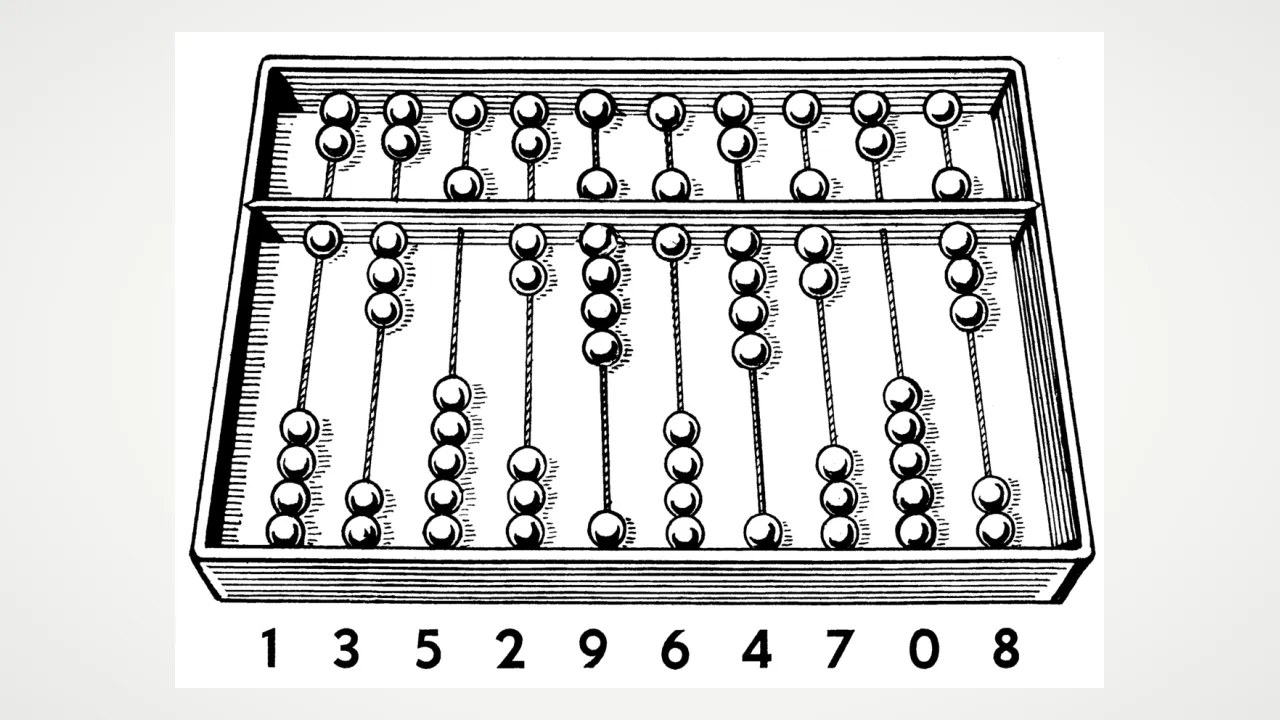
1. If the first rod counts ones, what does the rod right next to it count?
2. How much electricity does an abacus need to work?
🤯 Mind-Blowing Fact • Grade 2
In a famous 1946 math contest in Tokyo, a master using a wooden soroban beat an electric calculating machine in four out of five events!
✨ Word Sparks (Grade 2 Glossary)
Tap 🔊 to hear
merchant
A person who buys and sells goods
groove
A long narrow cut on a surface
soroban
A sleek Japanese style of bead abacus
🪝
How did ancient shopkeepers add up hundreds of sacks of grain before paper and pencils were common?
1
Drawing Lines in the Dust
Long ago in busy markets, traders smoothed flat sand on stone tables and lined up little pebbles in . Even the word abacus comes from an old word for a dusty counting board!
2
Beads Locked Into a Frame
Later, clever makers in China and Rome slid carved beads onto bamboo or metal wires inside a wooden box. Now nobody could lose their pebbles when the wind blew or a cart bumped!
3
Upper Deck and Lower Deck
A horizontal bar splits the frame into two decks. Beads below the bar count one each when pushed to the middle, while each bead above the bar counts for five all at once!
1. How much is one bead on the upper deck worth when pushed toward the middle bar?
2. What did the earliest market traders use before beads were put onto rods?
🤯 Mind-Blowing Fact • Grade 3
Our English word 'calculate' comes from 'calculi'—the Latin word for the tiny limestone pebbles Romans slid along their counting boards!
✨ Word Sparks (Grade 3 Glossary)
Tap 🔊 to hear
suanpan
Traditional Chinese abacus with two top beads
place value
Worth of a digit based on position
calculi
Small Latin pebbles used for ancient counting
🪝
Why did Roman numbers like XXXVIII + XLIX stump writers on parchment—yet take only seconds on a counting frame?
1
Try Adding Roman Numerals!
Imagine running a bustling harbor in ancient Rome and trying to add CCLXIV jars of olive oil to DCCCXCIX jars on wax tablets! Without a symbol for zero, written numerals were clumsy for arithmetic—until fingers flew across a counting board.
2
Across Continents and Centuries
Over four thousand years ago, Mesopotamian scribes slid stones across ruled clay slabs. Greeks and Romans cast bronze pocket tablets with slotted grooves. In China during the Han Dynasty, inventors strung wooden beads onto bamboo rods to create the , which later inspired Japan's streamlined soroban and Russia's curved-wire schoty.
3
Place Value You Can Touch
A reckoning bar divides each vertical rod. Pushing lower earth beads up to the bar adds ones, while pulling an upper heaven bead down adds five. Whenever a column reaches ten, you clear those beads back and flick one bead on the next column left—carrying a ten you can actually feel!
4
Training Young Brains Today
Schools across Asia and around the world still teach bead arithmetic because touching builds rock-solid number sense and lightning mental math.
1. Where does our modern English word 'calculate' come from?
2. What happens on an abacus when a single column reaches ten?
🤯 Mind-Blowing Fact • Grade 4
Brain scans show that expert abacus users solve math in the visual-spatial parts of the brain rather than the language centers most people use!
✨ Word Sparks (Grade 4 Glossary)
Tap 🔊 to hear
bi-quinary
Number system pairing twos and fives together
tactile
Experienced through the physical sense of touch
beam
Divider bar separating upper and lower beads
🪝
How could wooden beads race neck-and-neck with an electric machine—and actually win?
1
Showdown in Tokyo
On November 12, 1946, crowds packed a theater in Tokyo to watch an unforgettable duel: Kiyoshi Matsuzaki, armed with a palm-sized wooden soroban, versus Thomas Wood, operating a gleaming U.S. Army electric calculator. Clicks raced against whirring motors—and Matsuzaki won addition, subtraction, division, and composite problems hands down!
2
Four Millennia of Evolution
Mechanical counting began in Sumer around 2400 BCE, when temple accountants arranged tokens in columns on clay boards. The oldest surviving stone counting tablet, the Salamis Tablet from Greece around 300 BCE, still displays chiseled lines for Greek drachma coins. Chinese craftsmen perfected the framed bead suanpan with two upper fives-beads and five lower ones-beads per rod, allowing both base-10 decimal math and base-16 weight measurements.
3
Bi-Quinary Speed Engineering
Japanese makers later trimmed the soroban down to just one upper five-bead and four lower one-beads per rod, eliminating every extra motion. This '' layout mirrors human hands—two hands of five fingers—and displays zero automatically whenever no beads touch the central reckoning . Masters add, subtract, multiply, divide, and even extract square and cube roots from left to right.
4
Accessible Math for Every Learner
Modified with soft felt backing so beads stay put until moved intentionally, the Cranmer abacus empowers blind and visually impaired students worldwide to solve complex algebra and decimals entirely by touch.
1. Why did traditional Chinese suanpan frames include two upper beads and five lower beads per rod?
2. How does a Cranmer abacus help blind mathematicians work accurately?
🤯 Mind-Blowing Fact • Grade 5
World mental-abacus champions can add fifteen separate three-digit numbers flashed on a screen in less than two seconds—faster than anyone could even type them into a computer!
✨ Word Sparks (Grade 5 Glossary)
Tap 🔊 to hear
positional
System where column placement determines digit value
complementary
Paired numbers that combine to make ten
neuroplasticity
The brain's ability to rewire through practice
🪝
Why does a 4,400-year-old mechanical register operate almost identically to the memory cells inside a modern computer?
1
A Tangible Memory Register
Long before silicon chips stored bits as electrical charges, ancient engineers realized that separating memory from mental effort unlocked extraordinary speed. Watch a soroban champion flick diamond-shaped birch beads with thumb and index finger: unlike a calculator, the abacus never thinks on its own, yet it stores running totals instantaneously as each digit is entered.
2
From Sumerian Tokens to Global Trade
Archaeological evidence traces counting boards back to Sumerian city-states around 2400 BCE, where six-sexagesimal columns tracked grain harvests and silver weights. Across the Mediterranean, the marble Salamis Tablet (c. 300 BCE) and grooved bronze Roman hand-abaci enabled tax collectors and architects to compute large sums despite non-positional Roman numerals. By China's Song and Ming dynasties, the bead-and-rod suanpan powered imperial engineering, astronomical tables, and Silk Road commerce.
3
Positional Notation and Zero Made Physical
Mathematically, a modern 1:4 soroban encodes each decimal column in bi-quinary notation: four lower 'earth' beads valued at 10^n each, separated by a reckoning bar from one upper 'heaven' bead valued at 5 × 10^n. An unactivated rod—earth beads down, heaven bead up—physically represents zero, a breakthrough concept that helped inspire written zero across Eurasia. arithmetic rules, such as adding 7 by flicking +10 on the left rod while clearing 3, replace slow mental carrying with effortless muscle-memory reflexes.
4
Cognitive Neuroscience of Mental Anzan
Functional MRI studies of students trained in 'anzan' (mental abacus) reveal remarkable : instead of relying on left-hemisphere verbal loops, experts project a high-speed visual-motor image in their visuospatial cortex, summing ten-digit numbers flashed for fractions of a second.
5
Enduring Legacy in Computing
From Mesoamerican Nepohualtzintzin maize-counter bracelets using base-20 astronomy to Tim Cranmer's tactile frame for blind scholars, this timeless register laid the conceptual foundation for every mechanical and digital computer that followed.