Introduction
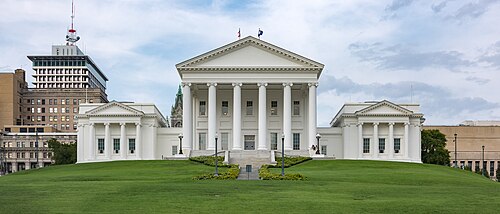
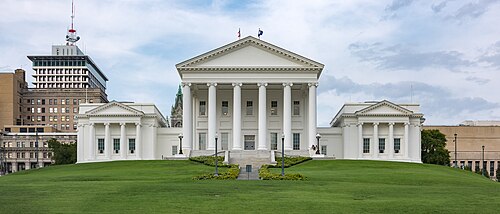
Crowning Shockoe Hill in downtown Richmond stands the gleaming white Virginia State Capitol—the first public building in the Americas modeled after a classical Roman temple, designed by Thomas Jefferson in 1785, and the proud home of the Virginia General Assembly, the oldest continuous lawmaking body in the Western Hemisphere (since 1619)!
An important word to know in this book is (may-ZOHN kah-RAY). Maison Carrée means: The 2,000-year-old ancient Roman temple in Nîmes, France, that Thomas Jefferson used as the direct architectural model for the Virginia State Capitol in 1785. Learning about Maison Carrée helps us understand how The Virginia State Capitol: Jefferson's Classical Temple fits into 🔔 Revolution, Statehood & Civil War Turning Points.
Key Features
When Virginia moved its state capital from Williamsburg to Richmond in 1780 to be safer from British warships and more centrally located for Virginia’s growing population, legislators asked Thomas Jefferson (then serving as U.S. Minister in Paris, France) to design a brand-new Capitol worthy of a free republic! Rejecting ornate British royal palace styles, Jefferson teamed up with French architect Charles-Louis Clérisseau and modeled Virginia’s Capitol after the —a remarkably preserved 2,000-year-old ancient Roman temple in Nîmes, southern France!
Scientists and explorers also look closely at (roh-TUN-duh), which means: A grand circular hall topped by an interior dome at the heart of the Virginia State Capitol, where Houdon’s marble statue of George Washington stands. These special traits make The Virginia State Capitol: Jefferson's Classical Temple easy to spot and study.
How It Works
Before shipping the architectural blueprints across the Atlantic to Virginia, Jefferson had French model-maker Jean-Pierre Fouquet carve a detailed plaster scale model of the Capitol—which still sits on display inside the Virginia State Capitol today! Completed in 1788 (four years before the White House or U.S. Capitol were even started!), Jefferson’s Virginia State Capitol sparked the Classical Revival movement that inspired the columns and domes of Washington, D.C., and state capitols across America! In 1904–1906, two matching wings were added on the west and east sides to house the modern Senate of Virginia and House of Delegates chambers.
Here is another helpful term: (lyfe mask). It means: A plaster mold cast directly on a living person’s face—made on George Washington at Mount Vernon in 1785 by French sculptor Jean-Antoine Houdon. Step by step, and Life Mask work together in nature.
In Our World
In the center of the Capitol’s beneath a hidden interior dome stands one of the most priceless works of art in the United States: the 1796 life-sized Carrara marble statue of George Washington sculpted by French master Jean-Antoine Houdon! Houdon traveled all the way from Paris to Mount Vernon in October 1785 to take a wet plaster directly from George Washington’s face and measure his exact height (6 feet 2 inches)—making it the ONLY life-sized statue of George Washington carved from life! Outside on Capitol Square stand the 1813 Executive Mansion (the oldest continuously occupied governor’s residence in the U.S.), the Virginia Civil Rights Memorial honoring 16-year-old student , and the Virginia Women’s Monument: Voices from the Garden!
Understanding how The Virginia State Capitol: Jefferson's Classical Temple works in our world also involves (roh-TUN-duh): A grand circular hall topped by an interior dome at the heart of the Virginia State Capitol, where Houdon’s marble statue of George Washington stands. Even when surrounding conditions shift across seasons or regions, the interaction between , Rotunda, and helps sustain balance and resilience in the wider environment.
Amazing Facts
Amazing Fact #1: Jean-Antoine Houdon’s marble statue of George Washington inside the Virginia State Capitol is the ONLY life-sized statue of Washington ever created from real-life body measurements and a plaster face mask!
Amazing Fact #2: Look closely at Houdon’s statue of Washington: he wears his Continental Army uniform, but his sword hangs peacefully on the side of a bundle of 13 rods (fasces) representing the 13 states, while his hand rests on a farmer’s plowshare—showing that Washington voluntarily gave up military power to return to farming as a citizen!
Amazing Fact #3: Inside the Capitol’s Old House Chamber in 1807, Chief Justice John Marshall presided over the famous treason trial of former Vice President Aaron Burr!
Read & Review
Let's review what we discovered about The Virginia State Capitol: Jefferson's Classical Temple! In this book, we explored how , , and connect to 🔔 Revolution, Statehood & Civil War Turning Points.
Key Question #1: Who designed the Virginia State Capitol in 1785, and what ancient building inspired its design? Answer: Thomas Jefferson (with French architect Charles-Louis Clérisseau), modeled after the , an ancient Roman temple in Nîmes, France. Jefferson admired the pure Roman republican proportions of the Maison Carrée and introduced Classical Revival architecture to America.
Key Question #2: Why is Jean-Antoine Houdon’s marble statue of George Washington in the Capitol considered the most accurate likeness of Washington in the world? Answer: Houdon traveled to Mount Vernon in 1785 to cast a plaster directly on Washington’s face and measure his exact 6-foot-2-inch frame in person. Houdon’s 1785 life mask and precise anatomical measurements make the Richmond statue the definitive three-dimensional portrait of George Washington.