Introduction
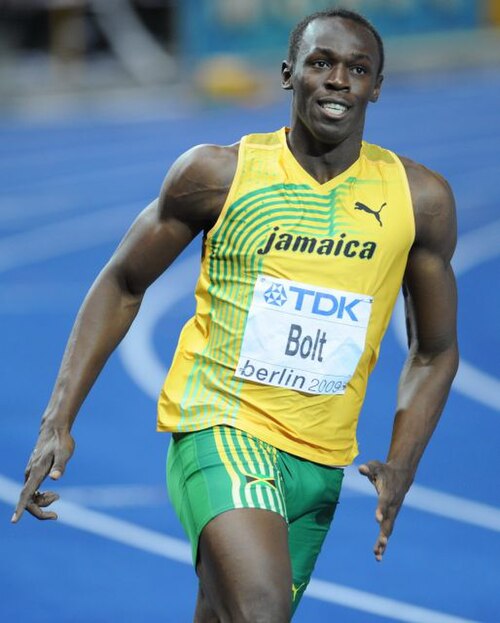
For decades, track-and-field coaches and biomechanics scientists believed that an extra-tall sprinter—someone standing 6 feet 5 inches (1.95 meters) tall—could never dominate the short 100-meter dash because long legs would take too long to unwind out of the starting blocks. Then came "Lightning" Usain Bolt (born 1986) from Sherwood Content, Jamaica! Combining a giant 2.44-meter (8-foot) stride length with the rapid leg turnover of a much shorter runner, Bolt shattered the 100-meter World Record (9.58 seconds) and the 200-meter World Record (19.19 seconds)—becoming the fastest human being ever recorded and the only sprinter in history to win Olympic Gold in both the 100m and 200m at three straight Olympic Games (2008, 2012, and 2016)!
An important word to know in this book is (stryd length / FREE-kwuhn-see). Stride Length vs. Stride Frequency means: In sprinting physics, running speed equals Stride Length (how far you travel with each step, ~2.44 m for Bolt) multiplied by Stride Frequency (how many steps you take per second, ~4.5 steps/sec). Learning about Stride Length vs. Stride Frequency helps us understand how Usain Bolt: Lightning Bolt & the Fastest Human in History fits into ⚽ Global Sports Legends: Soccer, Basketball, Golf, Tennis & Track.
Key Features
Born on August 21, 1986, in the quiet rural town of Sherwood Content in Trelawny Parish, Jamaica, where his parents Wellesley and Jennifer Bolt ran a small village grocery shop, young Usain spent his childhood carrying buckets of water from the community standpipe and playing cricket and soccer in the street using oranges as balls! In fact, Usain originally wanted to be a fast bowler in cricket—until his primary school cricket coach noticed how fast the boy ran up to bowl the ball and told him: "Try out for track and field!" By age 12, Usain was the fastest kid at Waldensia Primary School, and at age 15 at the 2002 World Junior Championships in Kingston, Jamaica, he became the youngest World Junior Gold Medalist in history in the 200 meters!
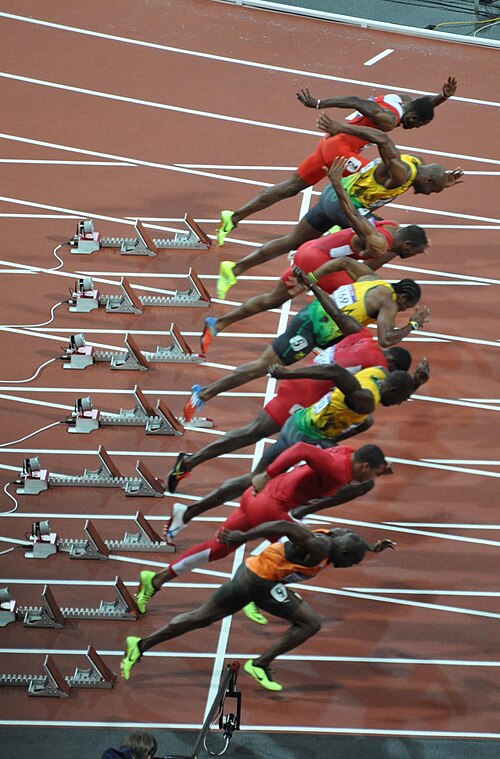
Scientists and explorers also look closely at (STAHR-ting bloks), which means: The angled metal foot pedals runners push off from at the sound of the starter’s gun; in Olympic rules, reacting in less than 0.100 seconds (100 milliseconds) is a false start. These special traits make Usain Bolt: Lightning Bolt & the Fastest Human in History easy to spot and study.

How It Works
What is the physics secret behind 9.58 seconds (set at the 2009 World Championships in Berlin)? In a 100-meter race, most world-class sprinters have to take 44 to 45 full strides to cover 100 meters from the starting line to the finish tape. Because of his 6-foot-5 frame and explosive hip-extension power developed with his legendary Jamaican coach Glen Mills ( after overcoming childhood , a curvature of the spine, by strengthening his core and back muscles!), Usain Bolt covers the entire 100 meters in only 41 strides! Between the 60-meter and 80-meter marks of his 9.58-second World Record sprint, radar lasers clocked Bolt at a top speed of 44.72 km/h (27.78 miles per hour)—covering more than 12.4 meters (40.7 feet) every single second!
Here is another helpful term: (grownd ree-AK-shuhn fors). It means: By Newton’s Third Law of Motion (action and reaction), the downward force a sprinter’s spikes apply to the track (nearly 1,000 pounds of force in 0.08 seconds!) that propels them forward. Step by step, and Ground Reaction Force work together in nature.
In Our World
First bursting onto the global Olympic stage at the 2008 Beijing Olympics (where he broke the 100m World Record in 9.69 seconds even with his golden shoelace untied and celebrating before the finish line!), Bolt repeated his 100m, 200m, and 4×100m relay gold-medal sweeps at the 2012 London Olympics and 2016 Rio de Janeiro Olympics (8 Olympic Gold Medals and 11 World Championship Gold Medals!). Famous for his joyful smile, relaxed confidence under pressure, and signature "To Di World" ("Lightning Bolt") pose pointing to the sky, Bolt showed the world that joy and calm focus can make an athlete even faster than tension!
Understanding how Usain Bolt: Lightning Bolt & the Fastest Human in History works in our world also involves (STAHR-ting bloks): The angled metal foot pedals runners push off from at the sound of the starter’s gun; in Olympic rules, reacting in less than 0.100 seconds (100 milliseconds) is a false start. Even when surrounding conditions shift across seasons or regions, the interaction between , Starting Blocks & Reaction Time, and helps sustain balance and resilience in the wider environment.
Amazing Facts
Amazing Fact #1: During his 9.58-second 100-meter World Record in Berlin on August 16, 2009, Usain Bolt hit a peak speed of 27.78 mph (44.72 km/h)—fast enough to get a speeding ticket in a 25-mph neighborhood school zone on foot!
Amazing Fact #2: While his competitors took 44 to 45 strides to finish a 100-meter race, Usain Bolt’s giant 8-foot (2.44-meter) stride let him cross the entire 100-meter track in just 41 steps!
Amazing Fact #3: When Usain Bolt ran 9.69 seconds to win his first Olympic 100m Gold Medal at the 2008 Beijing Olympics, his left shoelace had come completely untied halfway down the track!
Read & Review
Let's review what we discovered about Usain Bolt: Lightning Bolt & the Fastest Human in History! In this book, we explored how , , and connect to ⚽ Global Sports Legends: Soccer, Basketball, Golf, Tennis & Track.
Key Question #1: What are Usain Bolt’s two official World Records in the 100-meter dash and the 200-meter dash, both set at the 2009 World Championships in Berlin? Answer: 9.58 seconds in the 100 meters and 19.19 seconds in the 200 meters. Bolt ran 9.58 seconds in the 100m on August 16, 2009, and 19.19 seconds in the 200m four days later on August 20, 2009.
Key Question #2: In the biomechanics of sprinting, why was 6-foot-5 Usain Bolt able to run faster than every other sprinter in history once he reached top speed? Answer: His 8-foot (2.44 m) stride length let him cover 100 meters in just 41 steps (instead of 44–45 steps) while maintaining a rapid stride turnover rate. Combining an 8-foot stride length (41 steps per 100m) with elite stride frequency produced his 27.78 mph (44.72 km/h) top speed.