Introduction
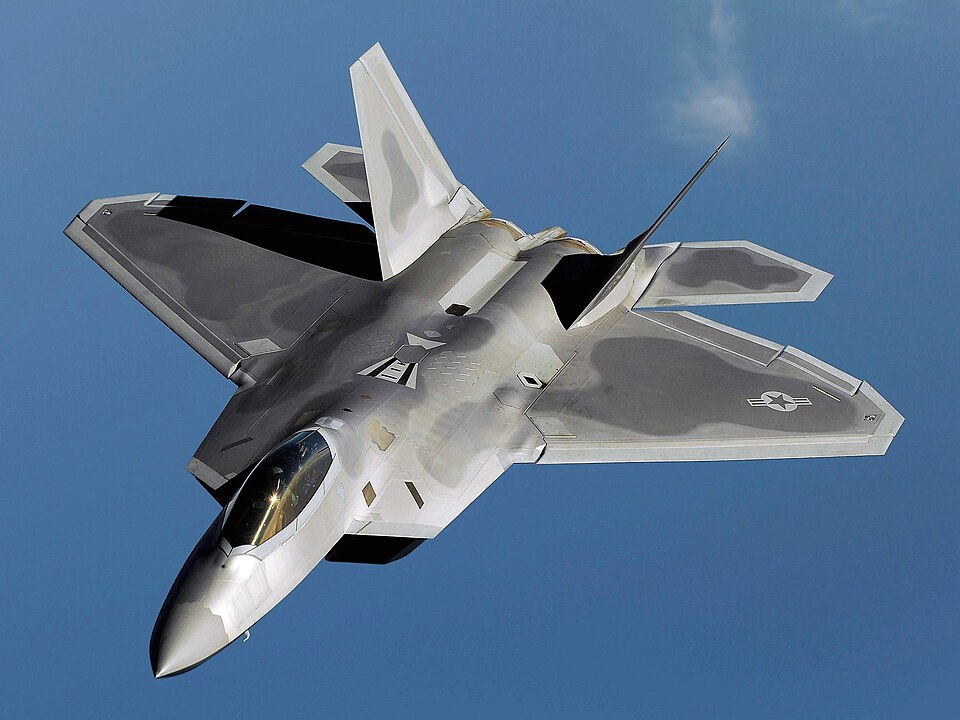
The Lockheed Martin F-22 Raptor is the world's first operational 5th-generation air superiority fighter, combining low-observable radar stealth, supersonic "," integrated sensor fusion, and thrust-vectoring agility.
A foundational concept in this investigation is (pronounced SOO-per-krooz), which refers to: Sustained supersonic flight (faster than Mach 1) without needing to use high-fuel-consumption engine afterburners. Every part of F-22 Raptor: 5th-Gen Stealth Air Superiority Fighter (Langley, VA) within ✈️ U.S. Air Force Fighter Planes & Iconic Aircraft Showcase builds upon this essential concept.
At the Grade 4 level of United States Armed Forces (✈️ U.S. Air Force Fighter Planes & Iconic Aircraft Showcase), researchers compare structure, function, and environmental context to see how , , and shape measurable outcomes.

Key Features
Measuring 62 feet in length with a 44 feet 6 inch (13.56 meter) wingspan and canted vertical stabilizers, the F-22's planform alignment and radar-absorbent material (RAM) coatings reduce its to the size of a steel marble.
To analyze these defining traits accurately, specialists examine (thrust VEK-ter-ing): Jet engine exhaust nozzles that pivot up and down by 20 degrees to steer the aircraft's nose through extreme aerodynamic maneuvers. Alongside (Sustained supersonic flight (faster than Mach 1) without needing to use high-fuel-consumption engine afterburners.), these specialized characteristics set F-22 Raptor: 5th-Gen Stealth Air Superiority Fighter (Langley, VA) apart within ✈️ U.S. Air Force Fighter Planes & Iconic Aircraft Showcase.
Field Observation & Evidence: Researchers studying F-22 Raptor: 5th-Gen Stealth Air Superiority Fighter (Langley, VA) observe how physical form matches function in United States Armed Forces. Each observable feature provides a clear advantage that supports stability, survival, or performance across changing conditions.
How It Works
Powered by twin Pratt & Whitney F119-PW-100 pitch-thrust-vectoring turbofan engines (each delivering 35,000 pounds of thrust), the F-22 achieves a top speed of Mach 2.25 (1,500 mph) at altitude and can sustain Mach 1.5+ "" without lighting fuel-hungry afterburners.
This step-by-step process relies on (pronounced RAY-dar kros SEK-shun), defined as: A measure of how detectable an object is by radar; stealth aircraft use angled surfaces to bounce radar waves away. Each stage of the process prepares the way for the next phase to unfold.
Cause-and-Effect Balance: When conditions remain balanced, and interact inside the to keep the system running smoothly. If any single link in this sequence is disrupted, the entire pace of activity shifts.
In Our World
Joint Base Langley-Eustis in Hampton, Virginia, is the historic home of the F-22 Raptor: the 1st Fighter Wing (America's oldest fighter wing) received the first operational F-22s in 2005 and also trains new Raptor pilots alongside the F-22 Aerial Demonstration Team.
Understanding how F-22 Raptor: 5th-Gen Stealth Air Superiority Fighter (Langley, VA) functions in real environments also involves (thrust VEK-ter-ing): Jet engine exhaust nozzles that pivot up and down by 20 degrees to steer the aircraft's nose through extreme aerodynamic maneuvers. Even when surrounding conditions shift across seasons or regions, the interaction between , Thrust Vectoring, and helps sustain balance and resilience in the wider environment.
Global & Practical Significance: F-22 Raptor (5th-Generation Stealth Air Superiority Fighter) operates as Lockheed Martin / Boeing F-22A Raptor 5th-Generation Stealth Fighter supporting Air Superiority, Supersonic Stealth & Advanced Avionics. Furthermore, Key technical specification: Top Speed: Mach 2.25 (1,500 mph) • Wingspan: 44.5 ft • & .
Amazing Facts
1. Remarkable Scale & Numbers: Even though the F-22 Raptor is 62 feet long, its angled stealth shaping makes it appear no larger than a metal marble or bumblebee on radar screens! This discovery highlights why is central to understanding F-22 Raptor: 5th-Gen Stealth Air Superiority Fighter (Langley, VA).
2. Extraordinary Adaptation & Design: Unlike older jets that must burn extra fuel in "afterburners" to break the sound barrier, the F-22 can "" above Mach 1.5 using normal dry engine power! Specialized conditions involving make these adaptations possible.
3. Surprising Scientific & Historical Record: The U.S. Air Force F-22 Raptor Demonstration Team is headquartered right in Hampton, Virginia, at Joint Base Langley-Eustis! Over time, processes linked to leave a lasting mark across ✈️ U.S. Air Force Fighter Planes & Iconic Aircraft Showcase.
Read & Review
Chapter Synthesis: Throughout this investigation of F-22 Raptor: 5th-Gen Stealth Air Superiority Fighter (Langley, VA) in United States Armed Forces (✈️ U.S. Air Force Fighter Planes & Iconic Aircraft Showcase), we examined its core foundations, defining traits, step-by-step mechanisms, and real-world connections using key terms like , , and .
Academic Vocabulary Review: • (SOO-per-krooz): Sustained supersonic flight (faster than Mach 1) without needing to use high-fuel-consumption engine afterburners. • (thrust VEK-ter-ing): Jet engine exhaust nozzles that pivot up and down by 20 degrees to steer the aircraft's nose through extreme aerodynamic maneuvers. • (RAY-dar kros SEK-shun): A measure of how detectable an object is by radar; stealth aircraft use angled surfaces to bounce radar waves away.
Critical Thinking Check: (1) What is the primary classification and role of F-22 Raptor (5th-Generation Stealth Air Superiority Fighter)? — Lockheed Martin / Boeing F-22A Raptor 5th-Generation Stealth Fighter — Air Superiority, Supersonic Stealth & Advanced Avionics. (2) Which key engineering or performance specification defines F-22 Raptor (5th-Generation Stealth Air Superiority Fighter)? — Top Speed: Mach 2.25 (1,500 mph) • Wingspan: 44.5 ft • & .