Introduction
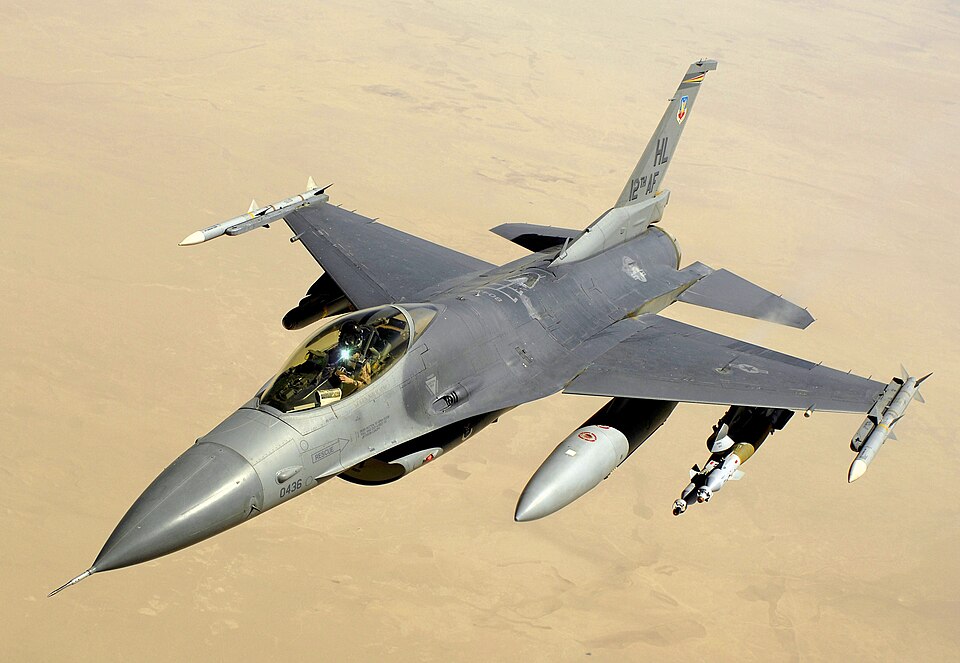
The General Dynamics / Lockheed Martin F-16 Fighting Falcon—universally nicknamed "Viper" by its aircrews—revolutionized aviation as the world's first production fighter designed with relaxed static stability, digital fly-by-wire controls, and a 9-G airframe.
A foundational concept in this investigation is (pronounced JEE-fors), which refers to: The force of gravity felt during rapid acceleration or tight turns; 9 Gs equals nine times normal Earth gravity. Every part of F-16 Fighting Falcon ("Viper") & The USAF Squadron within ✈️ U.S. Air Force Fighter Planes & Iconic Aircraft Showcase builds upon this essential concept.
In Grade 5 advanced nonfiction inquiry across United States Armed Forces (✈️ U.S. Air Force Fighter Planes & Iconic Aircraft Showcase), synthesizing primary evidence around , , and reveals how complex systems operate and adapt over time.

Key Features
Measuring 49.4 feet long with a 32 feet 8 inch (9.96 meter) wingspan, the F-16 features a single seamless polycarbonate for panoramic visibility, a 30-degree reclined ejection seat (which helps pilots withstand nine times the force of gravity, or 9 Gs), and a force-sensing side-stick controller.
To analyze these defining traits accurately, specialists examine (BUB-ul KAN-uh-pee): A single-piece clear cockpit cover with no forward metal frame bow, giving the pilot an unbroken 360-degree view of the sky. Alongside (The force of gravity felt during rapid acceleration or tight turns; 9 Gs equals nine times normal Earth gravity.), these specialized characteristics set F-16 Fighting Falcon ("Viper") & The USAF Squadron apart within ✈️ U.S. Air Force Fighter Planes & Iconic Aircraft Showcase.
Field Observation & Evidence: Researchers studying F-16 Fighting Falcon ("Viper") & The USAF Squadron observe how physical form matches function in United States Armed Forces. Each observable feature provides a clear advantage that supports stability, survival, or performance across changing conditions.
How It Works
Powered by a single F110 or F100 afterburning turbofan delivering up to 29,000 pounds of thrust, the F-16 reaches Mach 2.02 (1,500 mph). Its quad-redundant fly-by-wire computer makes hundreds of micro-adjustments per second to keep the ultra-maneuverable jet stable.
This step-by-step process relies on (pronounced THUN-der-berdz), defined as: The official U.S. Air Force aerial demonstration squadron founded in 1953, flying six red, white, and blue F-16 Fighting Falcons. Each stage of the process prepares the way for the next phase to unfold.
Cause-and-Effect Balance: When conditions remain balanced, and interact inside the to keep the system running smoothly. If any single link in this sequence is disrupted, the entire pace of activity shifts.
In Our World
Since 1983, the F-16 has served as the performative mount of the U.S. Air Force Air Demonstration Squadron—the ""—whose six red, white, and blue jets fly the famous Diamond Formation wingtip-to-canopy at 400+ mph across airshows in Hampton Roads, Virginia, and around the globe.
Understanding how F-16 Fighting Falcon ("Viper") & The USAF Squadron functions in real environments also involves (BUB-ul KAN-uh-pee): A single-piece clear cockpit cover with no forward metal frame bow, giving the pilot an unbroken 360-degree view of the sky. Even when surrounding conditions shift across seasons or regions, the interaction between , Bubble Canopy, and Thunderbirds helps sustain balance and resilience in the wider environment.
Global & Practical Significance: F-16 Fighting Falcon ("Viper") & USAF operates as General Dynamics / Lockheed Martin F-16C/D Fighting Falcon & USAF Thunderbirds supporting Agile Multirole Fighter & USAF Thunderbirds Precision Demonstration Jet. Furthermore, Key technical specification: Top Speed: Mach 2.0 (1,500 mph) • Wingspan: 32.6 ft • 9-G Agility & .
Amazing Facts
1. Remarkable Scale & Numbers: In a 9-G turn inside an F-16, a 180-pound pilot temporarily feels as if they weigh 1,620 pounds—which is why the seat tilts back 30 degrees and the pilot wears an inflating G-suit! This discovery highlights why is central to understanding F-16 Fighting Falcon ("Viper") & The USAF Squadron.
2. Extraordinary Adaptation & Design: When the USAF fly their famous four-jet Diamond Formation, their wingtips are sometimes only 18 inches (1.5 feet) apart at 400 miles per hour! Specialized conditions involving make these adaptations possible.
3. Surprising Scientific & Historical Record: More than 4,600 F-16s have been built since 1976, making it the most widely flown supersonic jet in the modern world. Over time, processes linked to leave a lasting mark across ✈️ U.S. Air Force Fighter Planes & Iconic Aircraft Showcase.
Read & Review
Chapter Synthesis: Throughout this investigation of F-16 Fighting Falcon ("Viper") & The USAF Squadron in United States Armed Forces (✈️ U.S. Air Force Fighter Planes & Iconic Aircraft Showcase), we examined its core foundations, defining traits, step-by-step mechanisms, and real-world connections using key terms like , , and Thunderbirds.
Academic Vocabulary Review: • (JEE-fors): The force of gravity felt during rapid acceleration or tight turns; 9 Gs equals nine times normal Earth gravity. • (BUB-ul KAN-uh-pee): A single-piece clear cockpit cover with no forward metal frame bow, giving the pilot an unbroken 360-degree view of the sky. • (THUN-der-berdz): The official U.S. Air Force aerial demonstration squadron founded in 1953, flying six red, white, and blue F-16 Fighting Falcons.
Critical Thinking Check: (1) What is the primary classification and role of F-16 Fighting Falcon ("Viper") & USAF ? — General Dynamics / Lockheed Martin F-16C/D Fighting Falcon & USAF Thunderbirds — Agile Multirole Fighter & USAF Thunderbirds Precision Demonstration Jet. (2) Which key engineering or performance specification defines F-16 Fighting Falcon ("Viper") & USAF Thunderbirds? — Top Speed: Mach 2.0 (1,500 mph) • Wingspan: 32.6 ft • 9-G Agility & .