Introduction
Picture a hockey rink—now take away the ice, fill the arena with 2 to 3 meters (6.5 to 10 feet) of crystal-clear swimming pool water, and put the goals right on the tiled bottom of the pool! Invented in England in 1954 as "," Underwater Hockey (UWH) is a fast-paced 3D team sport played in over 40 countries while holding your breath!
A foundational concept in this investigation is (pronounced OK-tuh-poosh), which refers to: The original 1954 British name for Underwater Hockey, invented by diver Alan Blake to keep divers fit in winter. Every part of Underwater Hockey within Lesser-Known Sports builds upon this essential concept.
In Grade 5 advanced nonfiction inquiry across Sports & Entertainment (Lesser-Known Sports), synthesizing primary evidence around , Apnea (Breath-Hold), and reveals how complex systems operate and adapt over time.
Key Features
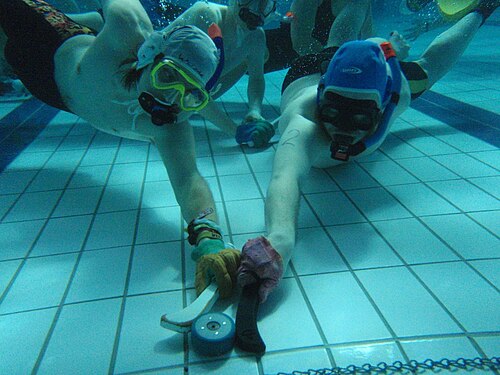
Two teams of 6 active players (with 4 substitutes rotating in) wear diving masks, fins, snorkels, water-polo-style ear-guard caps, and a thick silicone-padded glove on their playing hand (to protect knuckles from scraping the rough pool tiles!). Instead of a long stick, each player holds a short curved wooden or composite mini-stick only 30 centimeters (12 inches) long.
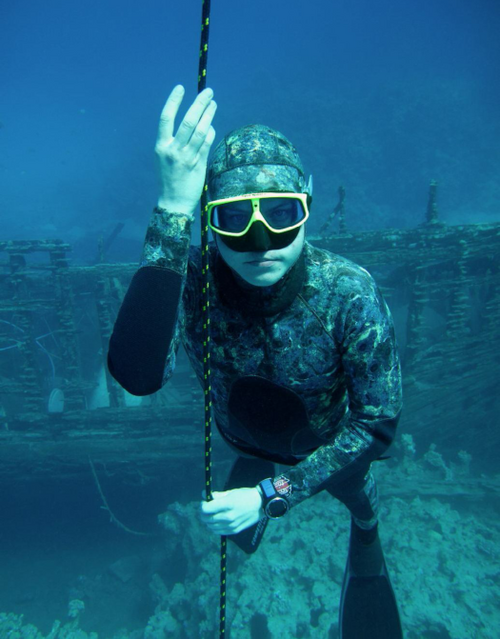
To analyze these defining traits accurately, specialists examine Apnea (Breath-Hold) (AP-nee-uh): Diving underwater on a single held breath without scuba tanks, rotating with teammates at the surface. Alongside (The original 1954 British name for Underwater Hockey, invented by diver Alan Blake to keep divers fit in winter.), these specialized characteristics set Underwater Hockey apart within Lesser-Known Sports.
Field Observation & Evidence: Researchers studying Underwater Hockey observe how physical form matches function in Sports & Entertainment. Each observable feature provides a clear advantage that supports stability, survival, or performance across changing conditions.

How It Works
How does the puck stay on the bottom of the pool instead of floating up? An underwater hockey puck has a solid lead core coated in smooth plastic, weighing 1.3 to 1.5 kilograms (about 3 pounds)—nearly 8 times heavier than an ice hockey puck! Players swim on the surface breathing through their snorkels, then take a deep breath, duck-dive to the pool floor, flick and pass the heavy lead puck up to 3 meters through the water into a 3-meter metal trough goal, and surface for air as a fresh teammate dives down to keep the play moving!
This step-by-step process relies on (pronounced led-kor puk), defined as: A weighted 3-pound puck coated in low-friction plastic that stays on the floor of the swimming pool during play. Each stage of the process prepares the way for the next phase to unfold.
Cause-and-Effect Balance: When conditions remain balanced, and interact inside the Apnea (Breath-Hold) to keep the system running smoothly. If any single link in this sequence is disrupted, the entire pace of activity shifts.
In Our World
Because nobody can shout instructions while holding their breath underwater, Underwater Hockey requires seamless 3D spatial awareness and silent teamwork! British Royal Navy diver Alan Blake originally invented the game in Portsmouth, England, in 1954 to keep scuba diving club members fit and active in indoor heated pools during cold winter months.
Understanding how Underwater Hockey functions in real environments also involves Apnea (Breath-Hold) (AP-nee-uh): Diving underwater on a single held breath without scuba tanks, rotating with teammates at the surface. Even when surrounding conditions shift across seasons or regions, the interaction between , Apnea (Breath-Hold), and helps sustain balance and resilience in the wider environment.
Global & Practical Significance: A weighted lead core overcomes water buoyancy and drag so players can pass and flick the puck along the pool bottom. Furthermore, Continuous breath-hold (apnea) rotation between surface swimmers and diving teammates makes UWH a fast 3D team sport.
Amazing Facts
1. Remarkable Scale & Numbers: An Underwater Hockey puck weighs over 3 pounds (1.3–1.5 kg) because it is filled with dense lead so it sinks and hugs the bottom tiles of the pool! This discovery highlights why is central to understanding Underwater Hockey.
2. Extraordinary Adaptation & Design: When invented in England in 1954, the sport was originally called "" because teams had 8 players ("octo-") pushing a heavy puck with short "pusher" sticks! Specialized conditions involving Apnea (Breath-Hold) make these adaptations possible.
3. Surprising Scientific & Historical Record: Spectators in the stands watch Underwater Hockey matches on giant poolside screens fed by waterproof HD cameras mounted along the bottom of the pool! Over time, processes linked to leave a lasting mark across Lesser-Known Sports.
Read & Review
Chapter Synthesis: Throughout this investigation of Underwater Hockey in Sports & Entertainment (Lesser-Known Sports), we examined its core foundations, defining traits, step-by-step mechanisms, and real-world connections using key terms like , Apnea (Breath-Hold), and .
Academic Vocabulary Review: • (OK-tuh-poosh): The original 1954 British name for Underwater Hockey, invented by diver Alan Blake to keep divers fit in winter. • Apnea (Breath-Hold) (AP-nee-uh): Diving underwater on a single held breath without scuba tanks, rotating with teammates at the surface. • (led-kor puk): A weighted 3-pound puck coated in low-friction plastic that stays on the floor of the swimming pool during play.
Critical Thinking Check: (1) Why does an Underwater Hockey puck weigh 3 pounds (1.3 to 1.5 kg)—almost eight times heavier than an ice hockey puck? — It has a dense lead core so it sinks to the tiled bottom of the pool and slides along the floor instead of floating away. (2) How do Underwater Hockey players breathe during a 30-minute match? — They wear fins, masks, and snorkels at the surface, taking turns duck-diving on a held breath to make passes and shots on the bottom.