Introduction
The glass of water you drink today contains the exact same water molecules that dinosaurs drank 65 million years ago! Earth almost never gains or loses water; instead, the Sun and gravity continuously recycle every drop through the hydrologic cycle (the water cycle).
A foundational concept in this investigation is (pronounced ih-vap-uh-RAY-shuhn), which refers to: The process by which solar heat turns liquid water on Earth’s surface into invisible water vapor gas. Every part of The Water Cycle within Our Changing Planet builds upon this essential concept.
In Grade 5 advanced nonfiction inquiry across Nature & Environment (Our Changing Planet), synthesizing primary evidence around , , and reveals how complex systems operate and adapt over time.
Key Features
The water cycle is driven by four main stages: 1) (and Transpiration from plants), 2) into clouds, 3) as rain, snow, sleet, or hail, and 4) Collection / Runoff back into rivers, groundwater aquifers, and oceans.
To analyze these defining traits accurately, specialists examine (kon-den-SAY-shuhn): The cooling of water vapor gas back into tiny liquid water droplets or ice crystals to form clouds and fog. Alongside (The process by which solar heat turns liquid water on Earth’s surface into invisible water vapor gas.), these specialized characteristics set The Water Cycle apart within Our Changing Planet.
Field Observation & Evidence: Researchers studying The Water Cycle observe how physical form matches function in Nature & Environment. Each observable feature provides a clear advantage that supports stability, survival, or performance across changing conditions.
How It Works
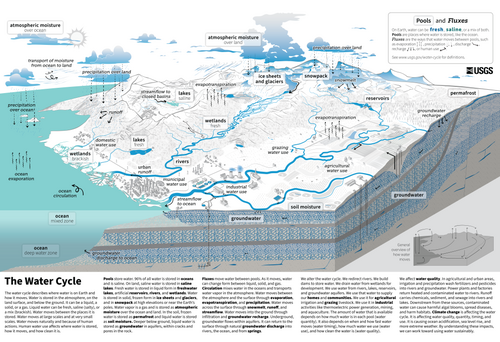
Solar heat warms oceans, lakes, and rivers, turning liquid water into invisible water vapor gas that rises into the sky (). Tree leaves also release water vapor (transpiration). High in the cool atmosphere, water vapor cools and condenses around tiny dust specks into billions of liquid droplets that form clouds. When droplets grow too heavy, gravity pulls them down as !
This step-by-step process relies on (pronounced prih-sip-uh-TAY-shuhn), defined as: Water falling from clouds to Earth’s surface as rain, snow, sleet, or hail. Each stage of the process prepares the way for the next phase to unfold.
Cause-and-Effect Balance: When conditions remain balanced, and interact inside the to keep the system running smoothly. If any single link in this sequence is disrupted, the entire pace of activity shifts.
In Our World
About 97% of Earth’s water is salty ocean water, 2% is frozen in glaciers, and only 1% is liquid fresh water in lakes, rivers, and underground aquifers. When ocean water evaporates, the salt is left behind—so the water cycle naturally desalinates seawater into fresh rain!
Understanding how The Water Cycle functions in real environments also involves (kon-den-SAY-shuhn): The cooling of water vapor gas back into tiny liquid water droplets or ice crystals to form clouds and fog. Even when surrounding conditions shift across seasons or regions, the interaction between , Condensation, and helps sustain balance and resilience in the wider environment.
Global & Practical Significance: separates pure water vapor from dissolved minerals and salt. Furthermore, Rising water vapor cools and condenses onto microscopic particles to form clouds.
Amazing Facts
1. Remarkable Scale & Numbers: When salty ocean water evaporates into the sky, all the salt stays behind in the sea—which is why rainwater is always fresh! This discovery highlights why is central to understanding The Water Cycle.
2. Extraordinary Adaptation & Design: A single large oak tree transpires (releases) up to 150,000 liters (40,000 gallons) of water vapor into the atmosphere every year. Specialized conditions involving make these adaptations possible.
3. Surprising Scientific & Historical Record: A fluffy white cumulus cloud floating overhead can weigh more than 500 metric tons—as much as 100 elephants! Over time, processes linked to leave a lasting mark across Our Changing Planet.
Read & Review
Chapter Synthesis: Throughout this investigation of The Water Cycle in Nature & Environment (Our Changing Planet), we examined its core foundations, defining traits, step-by-step mechanisms, and real-world connections using key terms like , , and .
Academic Vocabulary Review: • (ih-vap-uh-RAY-shuhn): The process by which solar heat turns liquid water on Earth’s surface into invisible water vapor gas. • (kon-den-SAY-shuhn): The cooling of water vapor gas back into tiny liquid water droplets or ice crystals to form clouds and fog. • (prih-sip-uh-TAY-shuhn): Water falling from clouds to Earth’s surface as rain, snow, sleet, or hail.
Critical Thinking Check: (1) Why does rain fall as fresh water even though most water evaporates from salty oceans? — Only pure water molecules evaporate into gas, leaving the heavy salt behind in the ocean. (2) Which stage of the water cycle forms clouds high in the cool atmosphere? — .