Introduction
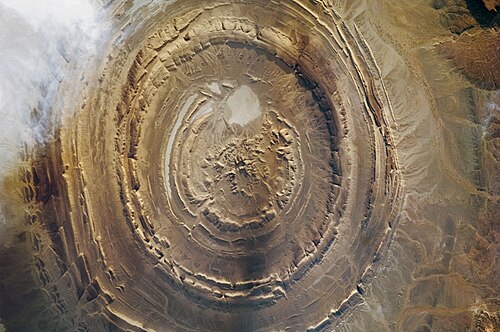
Looking down from the International Space Station onto the vast Sahara Desert of central Mauritania reveals a breathtaking geological bullseye: the Richat Structure, famously nicknamed the "Eye of the Sahara." Stretching 25 miles (40 kilometers) across the Mauritanian Adrar Plateau, its giant rings are so enormous they are easiest to see from orbit!
A foundational concept in this investigation is (pronounced kuhn-SEN-trik), which refers to: Circles or shapes of different sizes that share the exact same center point, like the rings of a bullseye target. Every part of The Richat Structure (Eye of the Sahara), Mauritania within 🧭 Unsolved & Unexplained: 10 Mysterious Places on Earth builds upon this essential concept.
In Grade 5 advanced nonfiction inquiry across Social Sciences & Culture (🧭 Unsolved & Unexplained: 10 Mysterious Places on Earth), synthesizing primary evidence around , , and reveals how complex systems operate and adapt over time.
Key Features
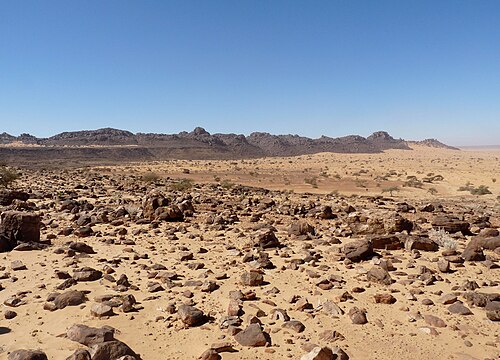
From ground level, a traveler walking across the Richat Structure sees mostly flat desert valleys and low rocky ridges (cuestas). From space, however, those ridges form three main rings of sedimentary quartzite rock surrounding a central limestone-and-breccia core, creating a landmark used by early Gemini and Apollo astronauts as a visual reference point while orbiting Earth.
To analyze these defining traits accurately, specialists examine (jee-uh-LOJ-ih-kuhl dohm): An upward-arched bulge in Earth’s rock layers caused by rising magma or tectonic pressure underneath. Alongside (Circles or shapes of different sizes that share the exact same center point, like the rings of a bullseye target.), these specialized characteristics set The Richat Structure (Eye of the Sahara), Mauritania apart within 🧭 Unsolved & Unexplained: 10 Mysterious Places on Earth.
Field Observation & Evidence: Researchers studying The Richat Structure (Eye of the Sahara), Mauritania observe how physical form matches function in Social Sciences & Culture. Each observable feature provides a clear advantage that supports stability, survival, or performance across changing conditions.
How It Works
The Mystery: For decades after space photographs made it famous, its remarkably round, rings led people to assume it was a colossal meteorite impact crater—or even sparked pop-culture myths claiming it was the legendary lost city of Atlantis. The Science: Field geologists who tested the rocks found zero evidence of extraterrestrial shock metamorphism (impact glass or shocked quartz). Instead, they proved the Richat Structure is a deeply eroded symmetrical (anticline)! Around 100 million years ago, molten magma pushed upward beneath layered desert rock like a giant blister; over millions of years, wind and water eroded the softer shale and limestone layers faster than the harder quartzite layers, carving out flat concentric rings that look like a giant eye from space.
This step-by-step process relies on (pronounced dif-er-EN-shuhl ih-ROH-zhuhn), defined as: When softer rock layers wear away faster than harder rock layers under wind and water, leaving behind raised ridges and valleys. Each stage of the process prepares the way for the next phase to unfold.
Cause-and-Effect Balance: When conditions remain balanced, and interact inside the to keep the system running smoothly. If any single link in this sequence is disrupted, the entire pace of activity shifts.
In Our World
In 2022, the International Union of Geological Sciences (IUGS) named the Richat Structure one of the First 100 Geological Heritage Sites on Earth! Ancient Acheulean stone tools found along its dry riverbeds also show that early human ancestors camped and hunted around its outer rings during wetter Ice Age periods.
Understanding how The Richat Structure (Eye of the Sahara), Mauritania functions in real environments also involves (jee-uh-LOJ-ih-kuhl dohm): An upward-arched bulge in Earth’s rock layers caused by rising magma or tectonic pressure underneath. Because alternating layers of hard quartzite and soft shale wear away at different speeds under desert wind and ancient rain, turned an uplifted rock dome into a 25-mile natural bullseye.
Global & Practical Significance: shapes share a common center, one nested inside another. Furthermore, Magmatic uplift created a dome, and carved its alternating rock strata into concentric rings.
Amazing Facts
1. Remarkable Scale & Numbers: Because the Richat Structure is 25 miles wide, nobody realized it looked like a giant bullseye until astronauts photographed it from space in the 1960s! This discovery highlights why is central to understanding The Richat Structure (Eye of the Sahara), Mauritania.
2. Extraordinary Adaptation & Design: Geologists ruled out a meteorite crater because the rock layers tilt gently outward from the center without any melted impact glass or shocked quartz. Specialized conditions involving make these adaptations possible.
3. Surprising Scientific & Historical Record: During the "Green Sahara" period thousands of years ago, water pooled inside the rings of the Richat Structure, attracting prehistoric wildlife and early Stone Age toolmakers. Over time, processes linked to leave a lasting mark across 🧭 Unsolved & Unexplained: 10 Mysterious Places on Earth.
Read & Review
Chapter Synthesis: Throughout this investigation of The Richat Structure (Eye of the Sahara), Mauritania in Social Sciences & Culture (🧭 Unsolved & Unexplained: 10 Mysterious Places on Earth), we examined its core foundations, defining traits, step-by-step mechanisms, and real-world connections using key terms like , , and .
Academic Vocabulary Review: • (kuhn-SEN-trik): Circles or shapes of different sizes that share the exact same center point, like the rings of a bullseye target. • (jee-uh-LOJ-ih-kuhl dohm): An upward-arched bulge in Earth’s rock layers caused by rising magma or tectonic pressure underneath. • (dif-er-EN-shuhl ih-ROH-zhuhn): When softer rock layers wear away faster than harder rock layers under wind and water, leaving behind raised ridges and valleys.
Critical Thinking Check: (1) In the passage on the Richat Structure, it states that its "perfect rings led people to believe it was a colossal meteorite impact crater." What does the word concentric mean? — Rings or circles of different sizes that share the exact same center point, like a bullseye target. (2) What did geologists discover actually formed the Richat Structure ("Eye of the Sahara") instead of a meteorite impact? — An uplifted symmetrical rock dome whose alternating hard and soft rock layers were eroded by wind and water over 100 million years.