Introduction
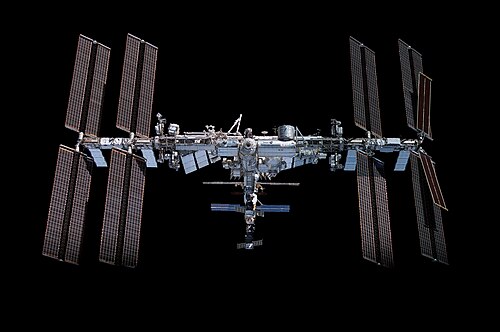
Orbiting 400 kilometers (250 miles) above our heads is the largest spacecraft ever built: the International Space Station (ISS)! As big as an American football field including its solar wings, this orbiting laboratory has been continuously lived in by astronauts since November 2000.
An important word to know in this book is (my-kroh-GRAV-uh-tee). Microgravity means: The condition of apparent weightlessness experienced inside an orbiting spacecraft in continuous free fall around Earth. Learning about Microgravity helps us understand how The International Space Station fits into Space & Astronomy.
Key Features
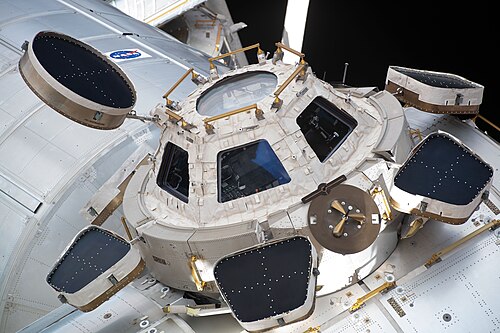
No single rocket could carry the 420-ton ISS into space at once. Instead, 15 nations—led by NASA, Roscosmos, ESA (Europe), JAXA (Japan), and CSA (Canada)—launched 40+ modules and truss pieces over a decade and linked them together in using robotic arms and spacewalks.
Scientists and explorers also look closely at (OR-bit), which means: The curved path of a spacecraft, moon, or planet around a larger body in space. These special traits make The International Space Station easy to spot and study.
How It Works
Why do astronauts float inside the ISS? Not because there is zero gravity in low-Earth (gravity up there is still 90% as strong as on the ground!). Instead, the ISS travels sideways at 28,000 km/h (17,500 mph), falling around the curved Earth at the exact rate Earth’s surface curves away—creating continuous free fall called !
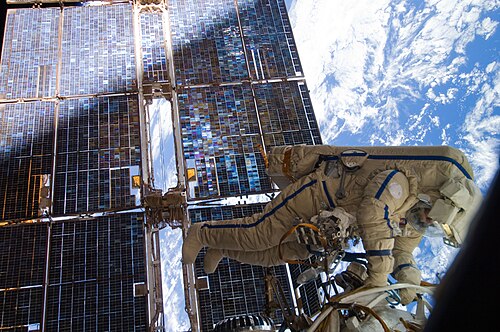
Here is another helpful term: Spacewalk (EVA) (SPAYS-wawk). It means: Extravehicular Activity, when an astronaut wears a pressurized spacesuit to work outside a spacecraft in the vacuum of space. Step by step, and Spacewalk (EVA) work together in nature.
In Our World
Because the ISS circles Earth every 90 minutes, astronauts witness 16 sunrises and 16 sunsets every single day! Inside, crews sleep in zipped wall bags, exercise 2 hours daily so their bones and muscles stay strong, recycle 93% of their water, and grow lettuce and zinnias in space gardens.
Understanding how The International Space Station works in our world also involves (OR-bit): The curved path of a spacecraft, moon, or planet around a larger body in space. Even when surrounding conditions shift across seasons or regions, the interaction between , Orbit, and Spacewalk (EVA) helps sustain balance and resilience in the wider environment.
Amazing Facts
Amazing Fact #1: Traveling at 17,500 mph (28,000 km/h), the International Space Station orbits the entire Earth once every 90 minutes!
Amazing Fact #2: On clear evenings just after sunset, you can spot the ISS with your naked eyes—it looks like a bright, steady white star gliding smoothly across the sky.
Amazing Fact #3: In , astronauts’ spines stretch out without weight pressing down, making them grow up to 5 centimeters (2 inches) taller while in space!
Read & Review
Let's review what we discovered about The International Space Station! In this book, we explored how , , and Spacewalk (EVA) connect to Space & Astronomy.
Key Question #1: How many sunrises and sunsets do astronauts aboard the ISS see every 24 hours? Answer: 16 sunrises and 16 sunsets (one every 90 minutes). Because the ISS completes an orbit every 90 minutes, it circles Earth 16 times a day.
Key Question #2: Why do astronauts and objects float inside the International Space Station? Answer: The station is in continuous free fall () as it orbits Earth at 17,500 mph. Earth’s gravity holds the ISS in ; astronauts float because they and the station are falling around Earth together.