Introduction
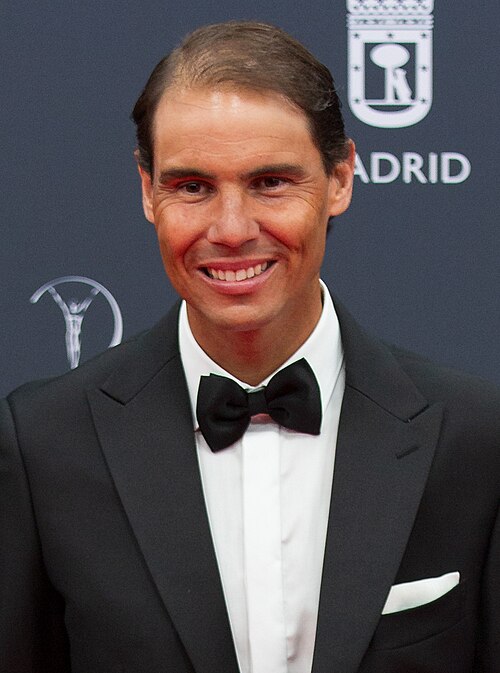
Is it possible for a single athlete to dominate one surface so completely that he wins 14 Grand Slam championships at the exact same tournament, compiling a lifetime record of 112 wins and only 4 losses? Spanish tennis legend Rafael Nadal (born 1986)—known forever as "the King of Clay"—did exactly that at Roland-Garros (the French Open) in Paris, while winning 22 Grand Slam singles titles overall, 2 Olympic Gold Medals, and earning worldwide admiration for his humility and never-give-up fighting spirit on every single point!
An important word to know in this book is Topspin (Magnus Effect) (TOP-spin). Topspin (Magnus Effect) means: Brushing the racket rapidly upward across the back of the tennis ball (over 3,000 RPM) so air pressure pushes the spinning ball downward into the court and makes it kick up high after bouncing. Learning about Topspin (Magnus Effect) helps us understand how Rafael Nadal: The King of Clay & Never-Give-Up Spirit fits into ⚽ Global Sports Legends: Soccer, Basketball, Golf, Tennis & Track.
Key Features
Born on June 3, 1986, in Manacor, on the Spanish Mediterranean island of Mallorca, young "Rafa" was surrounded by sports: one uncle, Miguel Ángel Nadal, played defender for FC Barcelona and the Spanish national soccer team, while another uncle, Toni Nadal, was a local tennis coach! When Rafa was three years old, Uncle Toni noticed the boy hitting two-handed shots on both sides; even though Rafa is naturally right-handed in everyday life (he writes, eats, and plays golf right-handed!), Uncle Toni encouraged him at age 10 to play tennis left-handed—giving his forehand an extraordinary natural advantage!
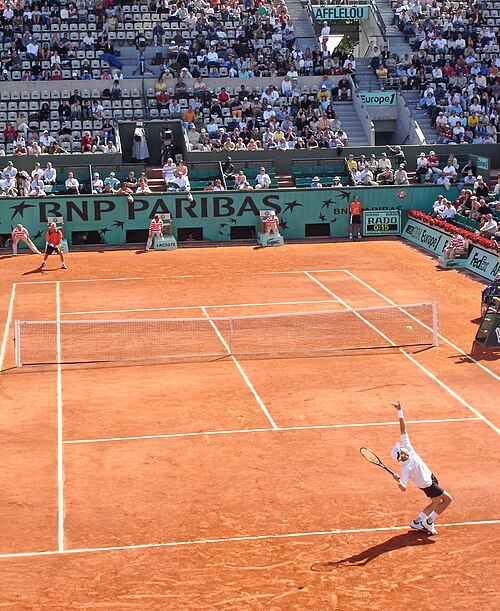
Scientists and explorers also look closely at Roland-Garros (Clay Court) (roh-LAHN gah-ROHS), which means: Home of the French Open in Paris, where courts are surfaced with crushed red brick dust that slows the ball down, rewards high topspin, and requires players to slide into shots. These special traits make Rafael Nadal: The King of Clay & Never-Give-Up Spirit easy to spot and study.
How It Works
Uncle Toni taught young Rafa three unbreakable rules at their small club in Manacor: 1) Never throw or break a racket (Toni told him: "Millions of kids would love to have a racket—losing a point is your fault, not the racket’s fault!", and Rafa never smashed a single racket in his entire life!); 2) Never complain about the sun, the wind, the court, or an injury; and 3) Chase down every single tennis ball as if it were Championship Point! On the crushed red brick dust of clay courts, where the ball bounces slower and higher, Nadal whipped his left-handed racket vertically up the back of the ball to produce an astonishing 3,200 to 5,000 revolutions per minute (RPM) of heavy topspin—making the ball dive down over the net and explode upward above opponents’ shoulders!
Here is another helpful term: (grit). It means: Playing every single point—whether the score is 0–0 in the first game or match point in the fifth hour—with maximum effort and refusal to give up. Step by step, Topspin (Magnus Effect) and Grit & Intensity work together in nature.
In Our World
In 2005, just two days after his 19th birthday, Nadal won the French Open on his very first attempt—and went on to win Roland-Garros 14 times (2005–2008, 2010–2014, 2017–2020, and 2022), along with 2 Wimbledon titles (including the epic 2008 Wimbledon Final against Roger Federer at twilight!), 2 Australian Opens, and 4 US Opens (22 Grand Slams total), plus 2008 Olympic Singles Gold and 2016 Olympic Doubles Gold! Outside Court Philippe-Chatrier in Paris stands a gleaming three-meter-tall steel statue of Rafael Nadal—honoring the greatest single-surface record in the history of all sports!
Understanding how Rafael Nadal: The King of Clay & Never-Give-Up Spirit works in our world also involves Roland-Garros (Clay Court) (roh-LAHN gah-ROHS): Home of the French Open in Paris, where courts are surfaced with crushed red brick dust that slows the ball down, rewards high topspin, and requires players to slide into shots. Even when surrounding conditions shift across seasons or regions, the interaction between Topspin (Magnus Effect), Roland-Garros (Clay Court), and helps sustain balance and resilience in the wider environment.
Amazing Facts
Amazing Fact #1: In his entire life—from age 3 in Mallorca through more than 1,300 professional tour matches and 22 Grand Slam titles—Rafael Nadal NEVER ONCE smashed a tennis racket in anger!
Amazing Fact #2: Even though Rafael Nadal plays tennis with his left hand (hitting the most feared left-handed topspin forehand in history), he is actually right-handed for writing, brushing his teeth, eating, and playing darts!
Amazing Fact #3: At Roland-Garros (the French Open) in Paris, Nadal’s career match record is an almost unbelievable 112 wins and 4 losses (a 96.6% winning percentage) across 19 years, winning 14 French Open championships (4 of them without losing a single set)!
Read & Review
Let's review what we discovered about Rafael Nadal: The King of Clay & Never-Give-Up Spirit! In this book, we explored how Topspin (Magnus Effect), Roland-Garros (Clay Court), and connect to ⚽ Global Sports Legends: Soccer, Basketball, Golf, Tennis & Track.
Key Question #1: Why is Spanish tennis champion Rafael Nadal universally known as "the King of Clay"? Answer: He won an all-time record 14 French Open (Roland-Garros) championships on red clay courts, going 112–4 across his career in Paris. Nadal’s 14 French Open singles titles and 112–4 match record at Roland-Garros are unmatched in tennis history.
Key Question #2: Which rule did Uncle Toni Nadal teach young Rafa in Mallorca that resulted in an incredible lifelong record of self-control? Answer: Never throw or smash a tennis racket in frustration—and Rafa never broke a single racket in over 1,300 pro matches. Uncle Toni taught Rafa respect for his equipment and accountability for his own shots, and Nadal never smashed a racket in his entire career.