Introduction
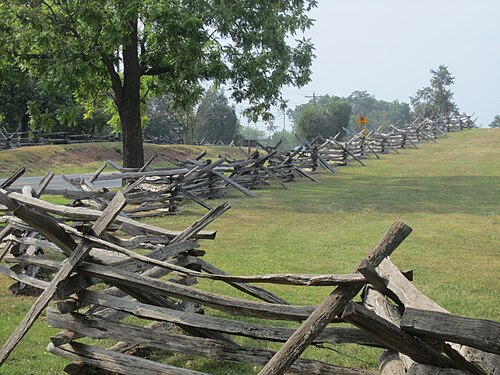
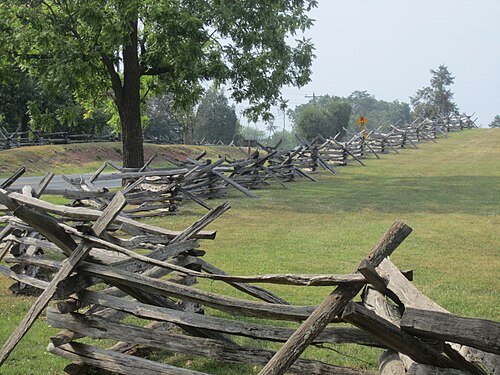
Across 5,000 acres of rolling green hills, split-rail fences, and quiet streams along Bull Run in Prince William County, Virginia—just 30 miles west of Washington, D.C.—lies Manassas National Battlefield Park, the historic site of two pivotal battles of the American Civil War: the First Battle of Bull Run (First Manassas) in July 1861 and the Second Battle of Bull Run (Second Manassas) in August 1862!
An important word to know in this book is (RAYL-rohd JUNGK-shuhn). Railroad Junction means: A strategic meeting point where two or more railroad lines connect—like Manassas Junction, where the Orange & Alexandria and Manassas Gap railroads met. Learning about Railroad Junction helps us understand how Manassas National Battlefield Park (Bull Run) fits into 🔔 Revolution, Statehood & Civil War Turning Points.
Key Features
Why did two huge armies clash in the peaceful Virginia countryside around Manassas? Because of railroads! At Manassas Junction, the Orange & Alexandria Railroad (leading south toward Richmond) met the Manassas Gap Railroad (leading west into the Shenandoah Valley)—making it the most strategic railroad crossroads in Northern Virginia! In July 1861, three months after the Civil War began at Fort Sumter, both the Union (North) and the Confederacy (South) believed the war would be decided in a single quick afternoon battle!
Scientists and explorers also look closely at (HEN-ree hil), which means: The open plateau at Manassas Battlefield where the main fighting of the First Battle of Bull Run took place on July 21, 1861. These special traits make Manassas National Battlefield Park (Bull Run) easy to spot and study.
How It Works
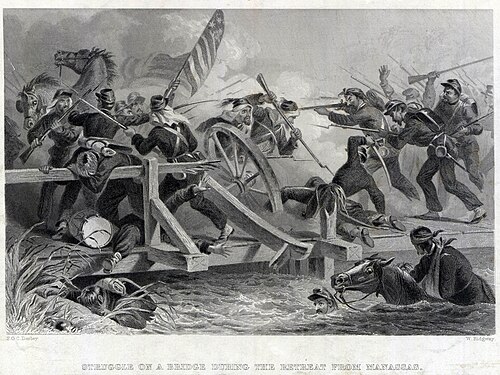
On the blazing hot morning of July 21, 1861, Union General Irvin McDowell marched 35,000 inexperienced soldiers out from Washington, D.C., while hundreds of civilians, congressmen, and reporters rode out in horse carriages with picnic baskets to watch from the hillsides! Union troops crossed Bull Run at Sudley Ford and pushed Confederate forces back onto (around the home of 85-year-old widow Judith Carter Henry). As Confederate lines wavered on the crest of Henry Hill, Brigadier General Thomas J. Jackson formed his brigade of Virginia soldiers in a firm line behind the brow of the hill. Pointing with his sword to rally his retreating men, General Bernard Bee shouted: "There is Jackson standing like a stone wall!"—giving "Stonewall" Jackson his famous nickname! Reinforced by troops arriving by train from the Shenandoah Valley—the first time in military history that railroads rushed directly into a battle—Confederate counterattacks drove the exhausted Union army back toward Washington.
Here is another helpful term: (feeld HOS-pi-tuhl). It means: An emergency medical station set up inside a nearby house, barn, or tent (such as the 1848 Stone House at Manassas) to treat wounded soldiers during battle. Step by step, and Field Hospital work together in nature.
In Our World
The First Battle of Bull Run shocked the entire nation: with nearly 5,000 soldiers killed, wounded, or missing in a single day, Americans realized the Civil War would be long, costly, and hard-fought. Thirteen months later, in August 1862, the Second Battle of Bull Run raged across the exact same fields and along an Unfinished Railroad cut! Today, visitors walking Manassas National Battlefield Park can explore , the historic 1848 Stone House (which served as a in both battles, where two Union soldiers carved their names into the upstairs wooden floorboards!), the reconstructed Stone Bridge over Bull Run, and the site of the Robinson House, the home of free African American farmer James Robinson whose family persevered even as two battles swept across their yard!
Understanding how Manassas National Battlefield Park (Bull Run) works in our world also involves (HEN-ree hil): The open plateau at Manassas Battlefield where the main fighting of the First Battle of Bull Run took place on July 21, 1861. Even when surrounding conditions shift across seasons or regions, the interaction between , Henry Hill, and helps sustain balance and resilience in the wider environment.
Amazing Facts
Amazing Fact #1: Why do Civil War battles often have TWO different names—like First Bull Run vs. First Manassas? Union (Northern) armies usually named battles after the nearest stream or river (Bull Run), while Confederate (Southern) armies named them after the nearest town or (Manassas)!
Amazing Fact #2: The First Battle of Bull Run (July 21, 1861) marked the first time in world history that steam trains were used to transport directly to a battlefield, when General Joseph E. Johnston’s troops rode the Manassas Gap Railroad from the Shenandoah Valley!
Amazing Fact #3: At the start of the First Battle of Bull Run, neither side had standardized uniforms yet—some Union regiments wore gray and some Confederate regiments wore blue, causing massive confusion in the smoke on !
Read & Review
Let's review what we discovered about Manassas National Battlefield Park (Bull Run)! In this book, we explored how , , and connect to 🔔 Revolution, Statehood & Civil War Turning Points.
Key Question #1: Why did the first major land battle of the Civil War in Virginia take place at Manassas (Bull Run) on July 21, 1861? Answer: Manassas Junction was a vital railroad crossroads just 30 miles from Washington, D.C., controlling rail lines toward Richmond and the Shenandoah Valley. Control of the Orange & Alexandria and Manassas Gap railroads made Manassas Junction a crucial strategic target in 1861.
Key Question #2: Why is the July 1861 battle known as BOTH the "First Battle of Bull Run" AND the "Battle of First Manassas"? Answer: The Union named battles after the nearest body of water (Bull Run stream), while the Confederacy named them after the nearest town or rail station (Manassas). This dual naming convention also explains Antietam/Sharpsburg and Shiloh/Pittsburg Landing.