
Introduction
In the summer of 1994, a 30-year-old computer scientist named Jeff Bezos (born 1964) read a startling statistic: the brand-new World Wide Web was growing at 2,300% per year! Determined not to look back at age 80 and regret missing the dawn of the internet, he packed his car, drove across the country to Bellevue, Washington (while his wife drove and he typed a business plan on a laptop!), and built an online bookstore in his rented house’s garage—using a wooden door on four legs as his desk—that grew into Amazon.com and aerospace pioneer Blue Origin!
An important word to know in this book is E-Commerce (Electronic Commerce) (EE-kom-ers). E-Commerce (Electronic Commerce) means: Buying and selling books, goods, and services over the internet, supported by digital catalogs, secure payments, and automated fulfillment centers. Learning about E-Commerce (Electronic Commerce) helps us understand how Jeff Bezos: From a Garage Bookstore to Amazon & Blue Origin fits into 💻 Tech, Business & Innovation Icons.
Key Features
Born on January 12, 1964, in Albuquerque, New Mexico, and raised in Houston and Miami (where his stepfather Miguel "Mike" Bezos, who had arrived in America from Cuba as a 16-year-old refugee speaking no English, worked as an engineer), young Jeff spent his childhood summers on his maternal grandfather Lawrence Preston Gise’s cattle ranch in Cotulla, Texas—repairing windmills, laying pipe, and learning resourceful self-reliance! At Miami Palmetto High School, where he was class valedictorian, he declared in his graduation speech his dream of preserving Earth by moving heavy industry into outer space, then graduated summa cum laude from Princeton University (1986) in electrical engineering and computer science.
Scientists and explorers also look closely at AWS (Amazon Web Services) (ay-dub-uhl-yoo-ES), which means: The cloud-computing platform launched by Amazon in 2006 that rents out on-demand computer servers and storage over the internet to companies, schools, and agencies worldwide. These special traits make Jeff Bezos: From a Garage Bookstore to Amazon & Blue Origin easy to spot and study.

How It Works
Why did Bezos name his garage startup Amazon and start with books? First, he wanted a name starting with "A" (when website directories were listed alphabetically!) named after the Amazon River—the largest river on Earth by water volume! Second, while even the largest physical brick-and-mortar bookstore could hold at most 150,000 book titles on its shelves, an online bookstore could offer a catalog of over 1 million books in print! When Amazon.com opened in July 1995, Bezos wired a little bell in the garage to ring every time someone ordered a book—and within weeks the bell rang so nonstop they had to unplug it!
Here is another helpful term: E-Ink (Electronic Paper) (EE-ink). It means: The glare-free display technology used in the Amazon Kindle e-reader that rearranges microscopic black and white capsules so a digital screen reads just like real ink on paper in bright sunlight. Step by step, E-Commerce (Electronic Commerce) and E-Ink (Electronic Paper) work together in nature.
In Our World
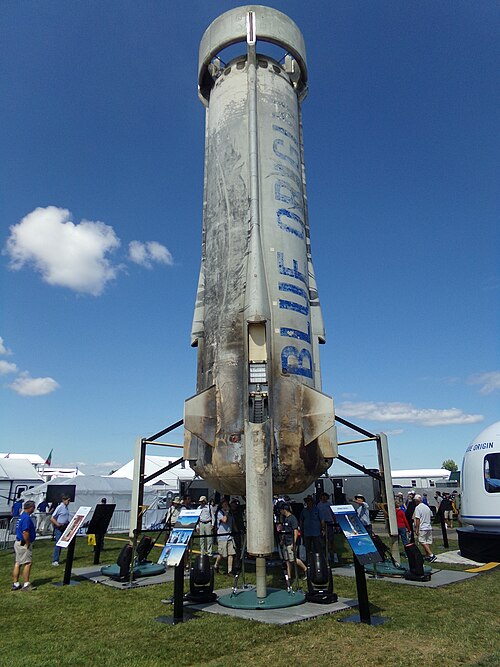
To keep Amazon agile, Bezos introduced the "Two-Pizza Team" rule (no project team should be larger than two pizzas can feed, or ~6 to 8 people!) and a "Day 1" startup mentality. Beyond fast e-commerce delivery and the Amazon Kindle e-reader (2007), Amazon launched Amazon Web Services (AWS) in 2006—pioneering modern cloud computing that today powers Netflix, NASA image archives, and millions of websites! Meanwhile, in 2000, Bezos founded Blue Origin, whose reusable New Shepard rocket (named after astronaut Alan Shepard) and New Glenn orbital rocket (named after John Glenn) are designed to open space travel to future generations!
Understanding how Jeff Bezos: From a Garage Bookstore to Amazon & Blue Origin works in our world also involves AWS (Amazon Web Services) (ay-dub-uhl-yoo-ES): The cloud-computing platform launched by Amazon in 2006 that rents out on-demand computer servers and storage over the internet to companies, schools, and agencies worldwide. Even when surrounding conditions shift across seasons or regions, the interaction between E-Commerce (Electronic Commerce), AWS (Amazon Web Services), and E-Ink (Electronic Paper) helps sustain balance and resilience in the wider environment.
Amazing Facts
Amazing Fact #1: Jeff Bezos built his first desk at Amazon in 1994 by screwing four wooden 2×4 legs onto a $60 wooden Home Depot door—and to this day, Amazon still gives out the "Door Desk Award" to employees who invent clever, frugal ideas that save money for customers!
Amazing Fact #2: When Amazon.com shipped its very first customer book order from the Bellevue garage on April 3, 1995, the book was a science textbook by Douglas Hofstadter titled Fluid Concepts and Creative Analogies!
Amazing Fact #3: Bezos originally considered naming his website "Cadabra" (as in Abracadabra), until his lawyer misheard it over the phone as "Cadaver"—prompting Bezos to look under the letter A in the dictionary and pick Amazon, after Earth’s biggest river!
Read & Review
Let's review what we discovered about Jeff Bezos: From a Garage Bookstore to Amazon & Blue Origin! In this book, we explored how E-Commerce (Electronic Commerce), AWS (Amazon Web Services), and E-Ink (Electronic Paper) connect to 💻 Tech, Business & Innovation Icons.
Key Question #1: Why did Jeff Bezos choose books as the very first product to sell on Amazon.com out of his Bellevue, Washington garage in 1994–1995? Answer: Because there were over 1 million different book titles in print—far more than any physical bookstore could fit on shelves, making an online catalog super valuable. Books offered universal demand and a catalog of millions of titles that only a digital store could index completely.
Key Question #2: Why did Jeff Bezos build his first Amazon desk out of a wooden door on four wooden legs—a tradition still celebrated by Amazon’s "Door Desk Award"? Answer: A wooden door cost far less than a fancy office desk, symbolizing frugality: spending money only on things that help customers. The door desk became Amazon’s enduring symbol of practical frugality and customer focus.