Introduction
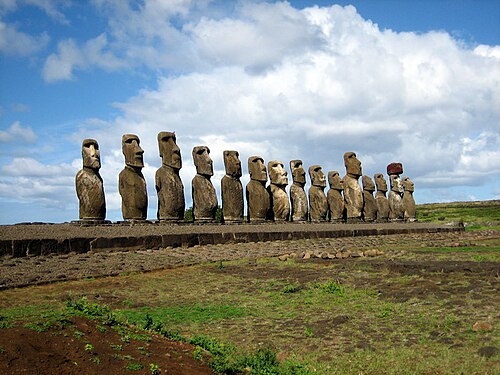
Far out in the southeastern Pacific Ocean—more than 2,000 miles west of mainland Chile—sits Rapa Nui (Easter Island), an isolated volcanic island famous for nearly 900 giant stone statues called Moai. Carved by ancient Polynesian craftspeople between 1250 and 1500 CE, these heavy volcanic rock monoliths average 13 feet tall and weigh around 14 tons.
An important word to know in this book is (MON-uh-lith). Monolith means: A single massive stone or rock carved into a pillar, statue, or monument. Learning about Monolith helps us understand how Easter Island (Rapa Nui), Chile: The Walking Moai Statues fits into 🧭 Unsolved & Unexplained: 10 Mysterious Places on Earth.
Key Features
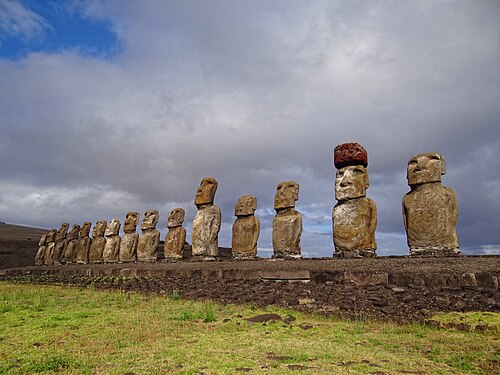
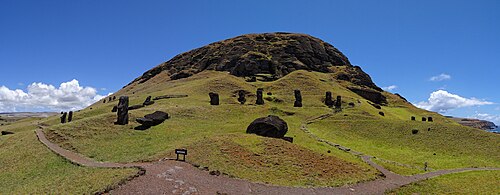
Almost all of the Moai were carved using handheld basalt stone picks (toki) inside the volcanic crater of Rano Raraku out of compressed volcanic ash called tuff. Once carved, the statues were moved miles across the island and raised onto sacred coastal stone platforms called , with their backs to the ocean so their stone eyes could watch protectively over the island villages.
Scientists and explorers also look closely at (KWOR-ee), which means: An open pit or volcanic crater from which building stone or rock is cut and excavated. These special traits make Easter Island (Rapa Nui), Chile: The Walking Moai Statues easy to spot and study.
How It Works
The Mystery: With no wheels, cranes, or large draft animals like horses or oxen, how did the islanders move these multi-ton stone monoliths miles from the Rano Raraku rock to the coast? The Science: Modern archaeologists tested a theory linked to Rapa Nui oral history, which claims the statues "walked" (neke-neke). Using three ropes and small teams of 18 people pulling side-to-side, researchers proved that upright Moai—engineered with a forward-leaning center of gravity and a wide D-shaped base—could be rocked forward down dirt roads like a heavy refrigerator being wiggled across a floor!
Here is another helpful term: (AH-hoo). It means: A sacred ceremonial stone platform built along the coast of Rapa Nui upon which Moai statues were stood upright. Step by step, and Ahu work together in nature.
In Our World
Today, Rapa Nui National Park is a UNESCO World Heritage Site where Polynesian descendants preserve their ancestral language, navigation heritage, and monumental stone carvings. Modern 3D laser scanning and archaeological fieldwork continue to reveal how clever engineering—not mythical forces—built the island’s stone guardians.
Understanding how Easter Island (Rapa Nui), Chile: The Walking Moai Statues works in our world also involves (KWOR-ee): An open pit or volcanic crater from which building stone or rock is cut and excavated. Even on one of the most remote inhabited islands on Earth, ancient Polynesian engineers used physics, center-of-mass balance, and teamwork to move 14-ton volcanic monoliths across miles of rolling terrain.
Amazing Facts
Amazing Fact #1: Although people often call them "Easter Island heads," every Moai actually has a full torso, arms, and hands—many at the were simply buried up to their shoulders by centuries of shifting soil!
Amazing Fact #2: The largest standing Moai ever erected on a platform, called "Paro," stood 33 feet tall and weighed 82 tons, while an unfinished giant still attached to the Rano Raraku bedrock would have weighed over 250 tons!
Amazing Fact #3: Archaeologists discovered carved white coral eye sockets with red volcanic stone pupils that were placed into the Moai once they reached their sacred coastal platforms.
Read & Review
Let's review what we discovered about Easter Island (Rapa Nui), Chile: The Walking Moai Statues! In this book, we explored how , , and connect to 🧭 Unsolved & Unexplained: 10 Mysterious Places on Earth.
Key Question #1: How did modern archaeologists prove that ancient Polynesian islanders could move 14-ton Moai monoliths without wheels, cranes, or draft animals? Answer: By tying ropes to an upright statue and rocking it side-to-side so it "walked" forward using its low center of gravity. Matching Rapa Nui oral tradition that the statues "walked," experiments showed small rope teams could rock upright Moai forward step-by-step like wiggling a heavy refrigerator.
Key Question #2: Which direction did almost all coastal Moai statues face once erected on their stone platforms, and why? Answer: Inland toward the island’s villages, representing protective deified ancestors watching over their people. Moai stood with their backs to the sea to project protective spiritual power (mana) over the clan’s village and farmland.