Introduction
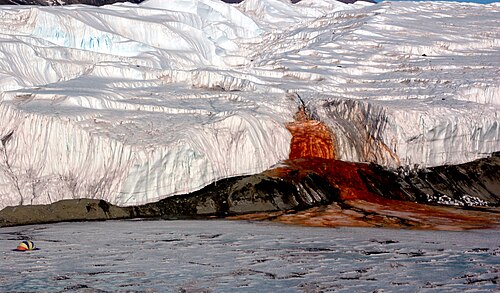
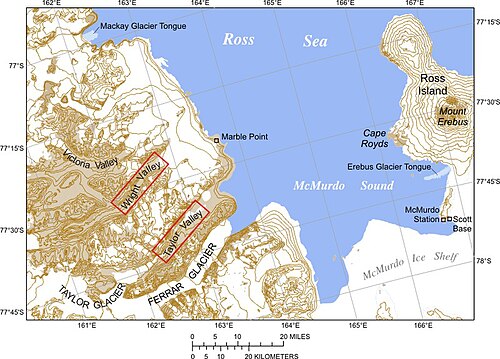
In Antarctica’s freezing McMurdo Dry Valleys, a five-story-tall, bright crimson waterfall pours straight out of the gleaming white ice of the Taylor Glacier onto the frozen surface of Lake Bonney, looking as though the glacier itself is bleeding!
A foundational concept in this investigation is (pronounced hy-per-SAY-leen), which refers to: Water with an extremely high salt concentration—significantly saltier than normal ocean water—which lowers its freezing point. Every part of Blood Falls, Antarctica: The Crimson Glacier Waterfall within 🧭 Unsolved & Unexplained: 10 Mysterious Places on Earth builds upon this essential concept.
At the Grade 4 level of Social Sciences & Culture (🧭 Unsolved & Unexplained: 10 Mysterious Places on Earth), researchers compare structure, function, and environmental context to see how , , and shape measurable outcomes.
Key Features
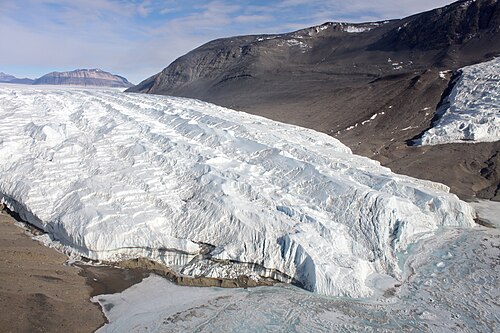
First spotted in 1911 by Australian geologist Griffith Taylor, this striking natural wonder is known as Blood Falls. Despite external air temperatures plunging well below freezing, the water seeping from a narrow fissure in the glacier snout remains liquid even in the polar cold.
To analyze these defining traits accurately, specialists examine (ok-suh-DAY-shuhn): A chemical reaction in which a substance like iron combines with oxygen in the air or water to form rust (iron oxide). Alongside (Water with an extremely high salt concentration—significantly saltier than normal ocean water—which lowers its freezing point.), these specialized characteristics set Blood Falls, Antarctica: The Crimson Glacier Waterfall apart within 🧭 Unsolved & Unexplained: 10 Mysterious Places on Earth.
Field Observation & Evidence: Researchers studying Blood Falls, Antarctica: The Crimson Glacier Waterfall observe how physical form matches function in Social Sciences & Culture. Each observable feature provides a clear advantage that supports stability, survival, or performance across changing conditions.
How It Works
The Mystery: When geologists first saw the vivid red stain in 1911, they hypothesized that red surface algae was coloring the ice—yet the extreme subzero temperatures and lack of nutrients seemed harsh, and the true source remained hidden inside the glacier for nearly a century. The Science: Using ice-penetrating radar and chemical sampling, glaciologists discovered a subterranean lake trapped 1,300 feet beneath the Taylor Glacier for nearly two million years without sunlight or oxygen! The trapped water is (nearly three times saltier than ocean water, which lowers its freezing point so it stays liquid) and packed with dissolved iron scraped from bedrock. The moment this clear, iron-rich brine squeezes through cracks in the ice and touches oxygen in the outside air, the iron instantly oxidizes (rusts), turning the waterfall bright red!
This step-by-step process relies on (pronounced sub-GLAY-shuhl), defined as: Located or occurring underneath the bottom of a glacier or ice sheet. Each stage of the process prepares the way for the next phase to unfold.
Cause-and-Effect Balance: When conditions remain balanced, and interact inside the to keep the system running smoothly. If any single link in this sequence is disrupted, the entire pace of activity shifts.
In Our World
Even more astonishing to astrobiologists at NASA, this pitch-black, oxygen-free brine is home to ancient extremophile microbes that survive by metabolizing iron and sulfates! Studying Blood Falls helps scientists design space probes to search for microscopic life beneath the icy crusts of Jupiter’s moon Europa and Saturn’s moon Enceladus.
Understanding how Blood Falls, Antarctica: The Crimson Glacier Waterfall functions in real environments also involves (ok-suh-DAY-shuhn): A chemical reaction in which a substance like iron combines with oxygen in the air or water to form rust (iron oxide). Because high salt concentration lowers the freezing point of water and dissolved iron reacts immediately with atmospheric oxygen, chemistry explains how clear brine turns crimson on contact with air.
Global & Practical Significance: Clear, iron-rich brine rusts (forms iron oxide) immediately upon exposure to atmospheric oxygen. Furthermore, High salinity depresses the freezing point of water, keeping the subglacial brine liquid in subzero ice.
Amazing Facts
1. Remarkable Scale & Numbers: When the salty water is still trapped inside the dark glacier crack before touching the outside air, it is completely clear—it only turns blood-red when its iron touches oxygen and rusts! This discovery highlights why is central to understanding Blood Falls, Antarctica: The Crimson Glacier Waterfall.
2. Extraordinary Adaptation & Design: Because the brine at Blood Falls is nearly three times saltier than the ocean (), it stays liquid at temperatures well below the normal freezing point of fresh water (0°C / 32°F)! Specialized conditions involving make these adaptations possible.
3. Surprising Scientific & Historical Record: Microorganisms trapped beneath Taylor Glacier have survived in total darkness without photosynthesis or free oxygen for over 1.5 million years! Over time, processes linked to leave a lasting mark across 🧭 Unsolved & Unexplained: 10 Mysterious Places on Earth.
Read & Review
Chapter Synthesis: Throughout this investigation of Blood Falls, Antarctica: The Crimson Glacier Waterfall in Social Sciences & Culture (🧭 Unsolved & Unexplained: 10 Mysterious Places on Earth), we examined its core foundations, defining traits, step-by-step mechanisms, and real-world connections using key terms like , , and .
Academic Vocabulary Review: • (hy-per-SAY-leen): Water with an extremely high salt concentration—significantly saltier than normal ocean water—which lowers its freezing point. • (ok-suh-DAY-shuhn): A chemical reaction in which a substance like iron combines with oxygen in the air or water to form rust (iron oxide). • (sub-GLAY-shuhl): Located or occurring underneath the bottom of a glacier or ice sheet.
Critical Thinking Check: (1) For decades, what did people mistakenly think caused the red color of Antarctica’s Blood Falls, and what did scientists discover is the actual chemical process behind it? — People originally thought red algae colored the ice; scientists discovered it is actually ancient water rich in iron that instantly oxidizes (rusts) when it touches oxygen in the air. (2) Why doesn’t the underground water feeding Blood Falls freeze solid beneath the icy Taylor Glacier? — Because the water is hypersaline (nearly three times saltier than seawater), which dramatically lowers its freezing point.