Introduction
Every two years—alternating between Summer and Winter Games—thousands of athletes from more than 200 nations parade behind the five interlocking Olympic Rings! This global festival of sport began nearly 2,800 years ago in 776 BCE in the sacred valley of Olympia, Greece.
An important word to know in this book is (oh-LIM-pee-ad). Olympiad means: A period of four years measured from one Summer Olympic Games to the next, a tradition begun in 776 BCE. Learning about Olympiad helps us understand how Ancient vs. Modern Olympics fits into The Olympic Games.
Key Features
The Ancient Olympic Games were held every four years (an ) in Olympia to honor Zeus. For the first 13 Olympic Games, there was only ONE event: a 192-meter footrace called the stadion (where our word "stadium" comes from!), won in 776 BCE by a baker named Coroebus of Elis! Later, Ancient Greece added wrestling, boxing, the long-distance race, four-horse chariot racing, and the (discus, javelin, long jump, sprint, and wrestling).
Scientists and explorers also look closely at (oh-LIM-pik troos), which means: The ancient Greek agreement (Ekecheiria) requiring warring city-states to stop fighting so athletes and fans could travel safely to Olympia. These special traits make Ancient vs. Modern Olympics easy to spot and study.
How It Works
During the Ancient Games, messengers proclaimed a sacred (Ekecheiria) across all Greek city-states so athletes and spectators could travel safely through warring territories without being attacked! Ancient winners did not receive gold, silver, or bronze medals—instead, only first place was crowned with a wreath of wild olive leaves (kotinos) cut from Olympia’s sacred grove!
Here is another helpful term: (pen-TATH-lon). It means: An ancient five-event athletic contest testing all-around skill in running, jumping, throwing the discus and javelin, and wrestling. Step by step, and Pentathlon work together in nature.
In Our World
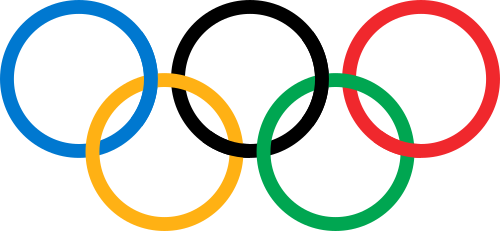
After the Roman Emperor Theodosius I ended the ancient festival in 393 CE, the Olympics slept for 1,500 years—until French educator Baron Pierre de Coubertin revived the Modern Olympic Games in Athens, Greece, in 1896 with 14 nations! Today’s Games feature male and female athletes from over 200 countries, the Winter Olympics (begun in 1924), a torch relay lit by the Sun’s rays in Olympia, and the five Olympic Rings representing the union of the five inhabited continents!
Understanding how Ancient vs. Modern Olympics works in our world also involves (oh-LIM-pik troos): The ancient Greek agreement (Ekecheiria) requiring warring city-states to stop fighting so athletes and fans could travel safely to Olympia. Even when surrounding conditions shift across seasons or regions, the interaction between , Olympic Truce, and helps sustain balance and resilience in the wider environment.
Amazing Facts
Amazing Fact #1: The very first recorded Olympic champion in history—Coroebus of Elis, who won the 776 BCE sprint in Olympia—was a village cook and baker!
Amazing Fact #2: Our word "stadium" comes directly from the Greek stadion—the 192-meter length of the original footrace track at ancient Olympia!
Amazing Fact #3: The five interlocking Olympic Rings (blue, yellow, black, green, and red on a white background) were designed in 1913 because at least one of those six colors appears on the national flag of every country on Earth!
Read & Review
Let's review what we discovered about Ancient vs. Modern Olympics! In this book, we explored how , , and connect to The Olympic Games.
Key Question #1: What prize did victorious athletes receive at the Ancient Olympic Games in Olympia, Greece? Answer: A crown wreath woven from wild olive leaves (kotinos). Ancient Olympic champions were crowned with a sacred olive wreath and honored with statues and poems in their hometowns.
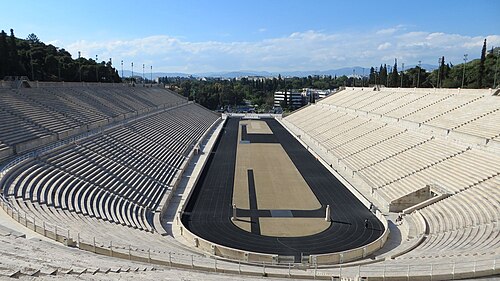
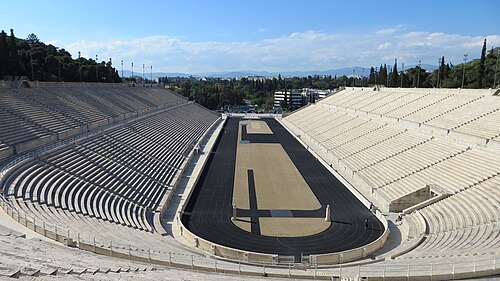
Key Question #2: When and where were the first Modern Olympic Games held after Baron Pierre de Coubertin revived the tradition? Answer: In 1896 in Athens, Greece. Athens hosted the inaugural Modern Olympic Games in April 1896 inside the marble Panathenaic Stadium.